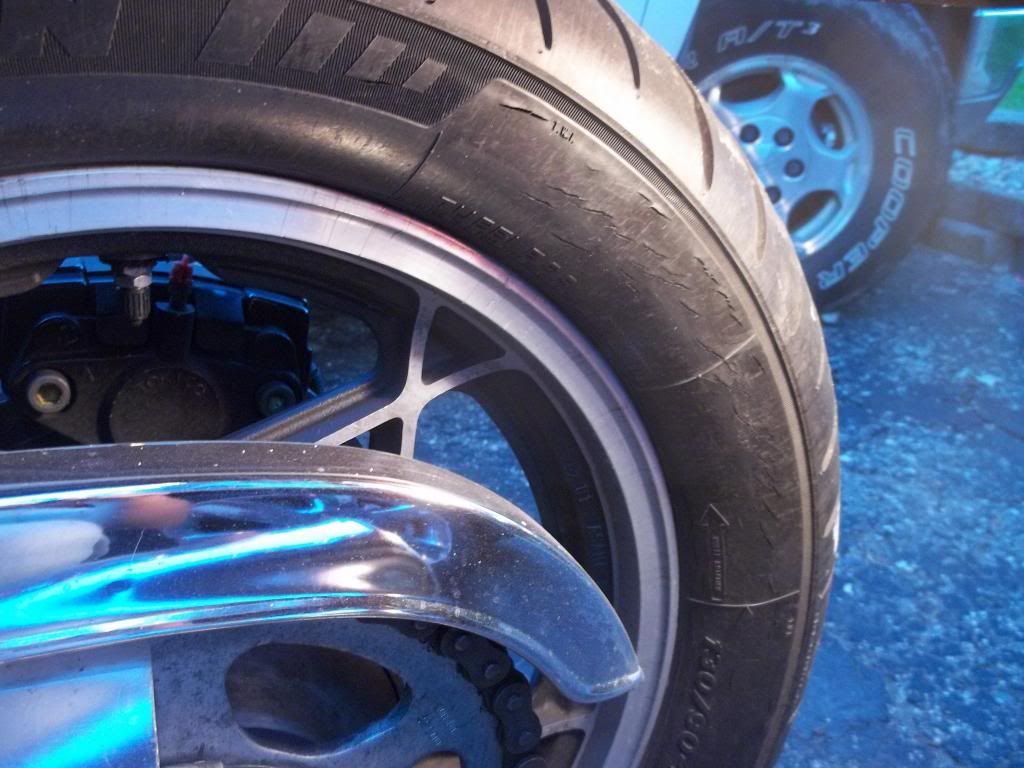
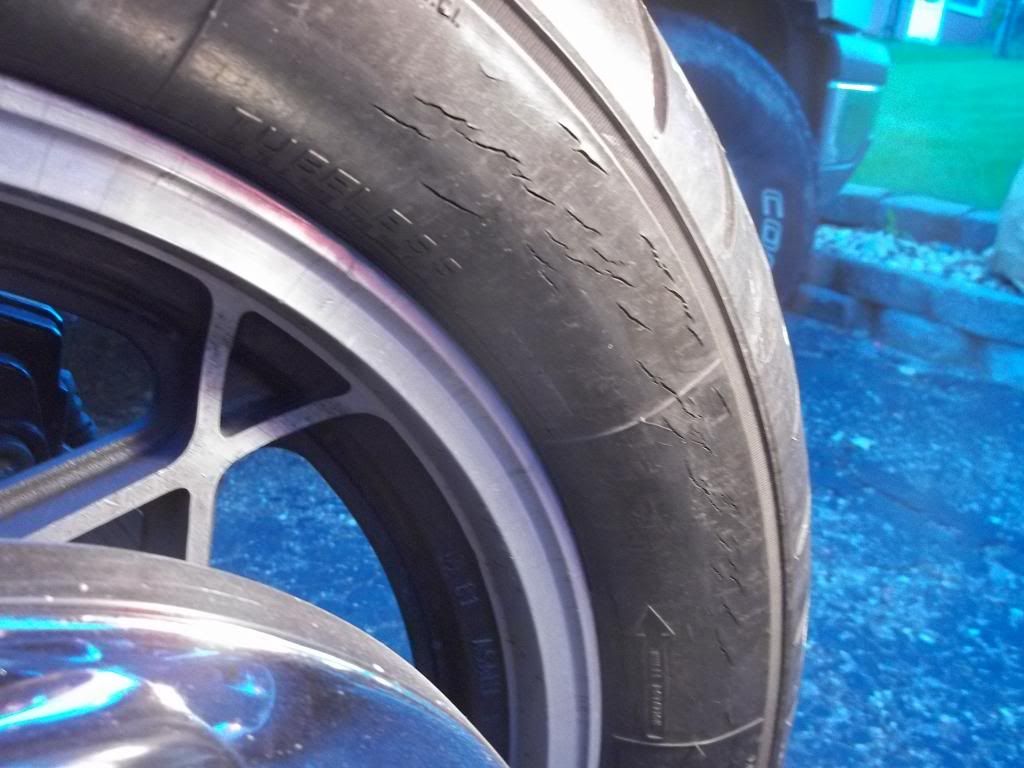
I'm emailing these pictures to him so he can ask a few of his friends to see what their take on it is.
Avon AM26's. Is the cracking issue over
Collapse
X
-
I talked to an ex Michelin engineer this morning on this issue. His belief is that this issue is the result of under inflation, putting the sidewall under stress (bulging), and being subjected to ozone gas. He called it polymeric structure cracking.
I'm emailing these pictures to him so he can ask a few of his friends to see what their take on it is. -
I rode on this tire for 5 months (summer 2012) and checked the pressure religiously. 36psi cold and about 38psi hot (+ or - 2 psi). It showed no signs of cracking when I "put her to bed" in Nov. Side stand. Wood floor shed. Not heated. Outside temp ranged between 40f to -15f. Not really a bad winter for MN.
When I looked at the tire in April it was cracked primarily on the bottom and pressure was still at 32psi.
The 3 year old FRONT road rider shows no signs of cracking.82 1100 EZ (red)
"You co-opting words of KV only thickens the scent of your BS. A thief and a putter-on of airs most foul. " JEEPRUSTYComment
-
Dave, I showed him the picture, don't shoot the messenger. I'll update him with the information you just provided.
Also, for your information, tires contain ozone stabilizers that are supposed to leach out of the tire over it's life. Maybe Avon got the mixture wrong?Comment
-
A tires pressure will rise and fall with temperature. When the bike was put away, the air temp was 'X1'. When it was rechecked in the spring the temp was 'X2'. What did the outside temp do between X1 and X2? On average tires loose 1 lb air pressure for every 10 degree change.
Was the bike stored near a source of ozone? If so which end was closest to that source?
What I'm getting at is, there are a lots of factors to consider other than just the tires composition and construction.Comment
-
Guest
Antiozonants and antioxidants are both mixed into sidwall rubber compounds. They are dissolved in oil first, because the oil can slowly migrate through the rubber. Surface oil gradually gets wiped away, and is replenished by migration from the interior. The compounds mostly retain their protective power until exposed to ozone or oxygen.
Ozone and oxygen almost certainly have nothing to do with it. Few cars or bikes are stored in areas with high concentrations of either gas. If they did, lots of other tires would be having sidewall cracks. Heck, I've had a temporary spare in my shed for the better part of 30 years. It still has air in it, and no sidewall cracks.
Effect of cold storage on tire aire pressure should be small. The ideal gas law is pretty accurate for the pressure-temperature realtionship. Nerdly calculations are inset.Pressue x Volume = (number of gas molecules) x Temperature x (R, the ideal gas constant)So the lowest pressure in the tire would be about 28 psi if the tire were cooled to about -40F.
or PV = nRT
Volume, number of molecultes and R are essentially constant, so the equation reduces to
P = kT
so, P goes up and down with temperature. Absolute temperature.
Absolute zero is -273C. 30C is a good summer temperature. The coldest winters rarely drop below -40F which is very close to -40C. So the absolute temperatures are 0K, about 233K for very cold winter, and 303K for normal summer.
Pressure drops in proportion to temperature, so the pressure in the tire will drop by a factor of (303C-233C)/303C. = 23%.
23% x 36 psi = 8 psi
That isn't the reason that the tires are cracking.
Something in the design or manufacture of the tires is bad. I would put my money on design. If I were assigned the job of figuring it out for Avon, I would start by looking at the "glass transition temperatures" of the various compounds. The basic course on rubber chemistry doesn't cover it.Comment
-
Guest
This issue has been discussed on this & other boards for a couple years now. AFAIK, Avon still refuses to acknowledge the problem, let alone take action to address it. My rear RR (yes, also cracked) is due for replacement....I'll probably be shopping elsewhere.
Comment
-
It is all the way around. Both sides. Yes, primarily on the left (chain) side on the bottom. The front is crack free.
Ozone is produced:
- chemically: by white blood cells, by roots of marigolds, and by reactions involving phosphorous (among others).
- by UV light: light with wavelength shorter than 215 nm can break apart an oxygen molecule. Some of this singlet oxygen can join with O2 to form (eventually) ozone (O3).
- by electrical discharge (corona): electrons lauched across a gas (and sometimes water) that contains oxygen will do much the same thing as the UV light.
In industry, it is most common for ozone to be intentionally produced by the corona method in gas that may or may not be pressurized to 1 atmosphere.
Im gonna go with No on that one....
Last edited by bonanzadave; 06-01-2013, 05:47 PM.82 1100 EZ (red)
"You co-opting words of KV only thickens the scent of your BS. A thief and a putter-on of airs most foul. " JEEPRUSTYComment
-
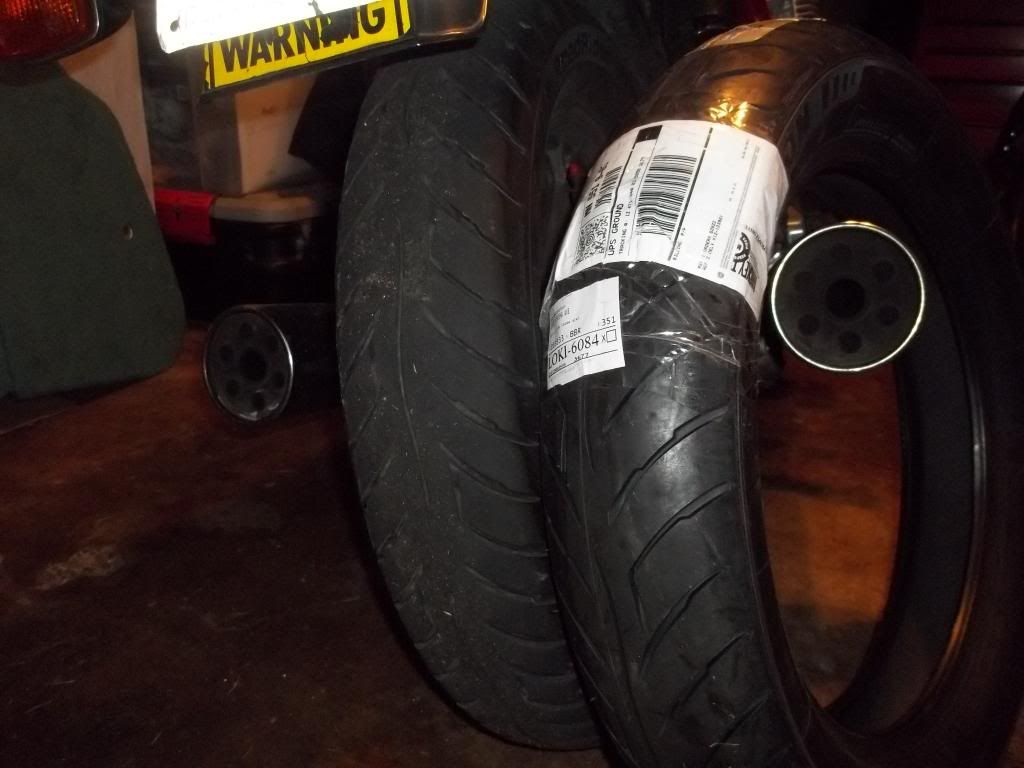
Got the new (from the factory) Road Rider today. It came from Micky Thompson Tires in Stow, OH. Date code 2011 so its a couple years old.
I was surprised by how flat the old one was with just a season and a half of riding. Measured about 1/8" less tread depth than the new one. probably less than 2k miles.
82 1100 EZ (red)
"You co-opting words of KV only thickens the scent of your BS. A thief and a putter-on of airs most foul. " JEEPRUSTYComment


Comment