Redman
I am very familiar with the bigger brother of your Walbro carb, the WB-3A, used on our 100cc 2-stroke racing go-kart. The motor revs to 16,000 rpm and so correct fuel supply is critical to reduce few tenths of a second on lap times. The rubber diaphragm in your bottom photo is all "crinkled" up. The little flap near the top right in your photo is important in the fuel sucking/pumping process. It must be completely flat (as must the rest of the rubber diaphragm) to yield best results. Just to give you an idea, we replace that diaphragm after every race in our search for speed! I am sure your fuel problem will be sorted out by replacing that diaphragm. I am sending you a service manual by e-mail for the Walbro WA series carbs - it shows exploded parts views and has info on setting up the tuning (maybe not specifically for the 19A however, but will give good starting point). The tuning is done on the two mixture screws (with blue and silver spring in your photo) which should be marked H and L. The L screw is for low speed running and H for full throttle. On our WB-3A carb those mixture screws are very sensitive, and even 1/16 of a turn away from "ideal" setting results in a big difference in performance.
Regards, 2BRacing
-
SST,
Yep, Okay, I see that now. And the hole there in the base does is located where the reed valve does not effect it, goes right to the crankcase. And does line up with a hole on the fuel pump side of carb. And when pull cord can feel air pulsing out of that hole (and not the bigger hole with the reed valve). And when pull the cord can see the reed valve chattering-vibrating like it is opening and closing, but cant really feel any air being sucked in. Hum.
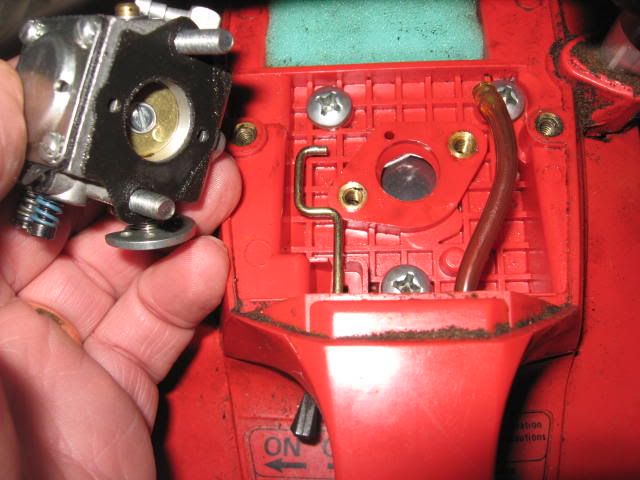
And here is the "fuel pump" side of the carb.
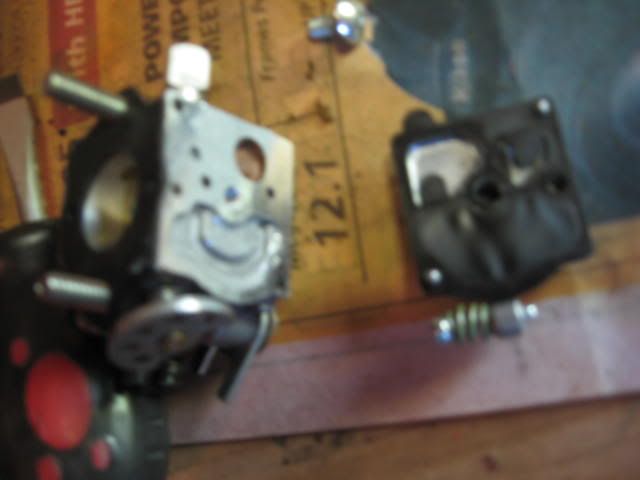
I noticed the "score" in the cyclinder. Looks more like a mark. Cant even feel it with finger or with a pointy pencil.
Did compression test. Was up to 80-90 in about 4 pulls and up to 110 in about 6 pulls. That seems good enough to me (unless 2 cycle needs lot more).
So I supect the story they gave me at the shop was just an excuse.
I am listening more to you guys.
I have now noticed something that is probably a better description of the situation:
I can choke it and pull 6 or 8 times. Then unchoke it and will start and run for about 2 seconds. Will not start again till I choke and pull again 6 or so times, then unchoke, and will start and run for 2 seconds. I suppose when I choke it like that I am sucking in fuel (sucking not really pumping) and precharging the crankcase with fuel mixture, then it only runs till that is gone.
And I noticed that when I do choke it and pull 6 or 8 times that can see the edge of the gaskets on the fuel pump side and on the meter side both get wet with gas, and then when unckoke and pull cord can see the gas get sucked back inside so the edge of the gasket not so wet. Hum... I took apart and coated the edge of gasket surface with a little bit of grease (as a test, not a fix) and reassembled. Runs a little stronger and a little bit longer, but not much longer. So that tells me I am on the right track. Have ordered a carb "repair kit". SHould have it Monday.
And I include this picture for your amsument (or horror). Ran a seperate gas line from carb to a little can of gas. Everything operated pretty much just the same. So that told me no problem with gas line and fuel filter.
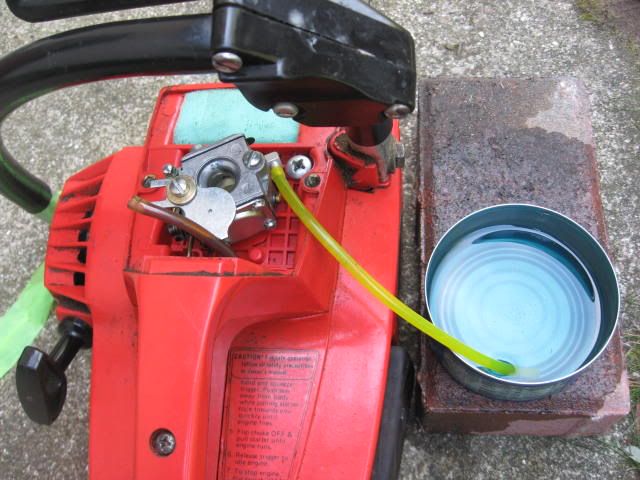
.
.
Dave "Redman"Leave a comment:
-
Thanks Guys.
Have done some reading last night. And studying you guys postings.
Thanks.
Yah, that is what I didnt understand about 2 stroke cycle engines. Have to think about what is happening on bothe sides of the piston at the same time.
Mr. SuperSonic,
I will look for that port. Dont recall there being such. I recall the main carb bore opening that has the flat reed flapper valve in crankcase. Will look to see if there is a small port next to that. IF that small port is not effected by that flapper reed valve, then I can see how it would then see the pressure and vacuum cycle and how that could opperate the gas pump/diaphram thingy.
Tom tkent,
No isnt any springs in there (at least not on the fuel pump side. There is on the "metering" side). Was not any either when it did work. I see in some manauls/books that others do have springs on the fuel pump portion.
This is a dinky little thing, carb is about 3/4 inch by 1 inch. Engine is just 2 cubic inches displacment.
You also said something about if cyclinder scored it may have enough compression to run at high speed but not idle. Hum, maybe that is at low speed doesnt have enough vacuum to to do the intake thru carb. Hum, that sounds kinda like what guy at shop says. .....
BrainWringer & dave388,
About the fuel line. Actaully is one length in tank to a connector in handle, and another one from that connector and thru the handle to the carb. Had the saw running for a while after replacing the fuel filter in tank. Then gas started running all over the place and could not start it. The fuel line broke where it goes thru the tank side (no connectors, just the fuel line sticking thru a hole in tank, tight fit). Apparently me messing with it to replace the filter previously damaged the line enought that it broke later. Yep, that is how hard and brittle the line in the tank was. So I replaced that line and it ran for just a little bit more (I didnt tell this part of the story before), and then had the problem I described where will not start but will start if but not run if drip some gas in carb.
The one line in handle to the carb seemed okay. BUt that is also something I am going to look into today. Maybe just run another temperary line from carb into a little can of fuel as a test.
And to all,
Yah, there are some more things I need to learn about. Such as crankcase seals.
Yah, I now somewhat (not entirely) understand how the crankcase is pressureized and then under vacuum. That is the part of what I did not realize before. The piston while compressing is also pulling a vaccum on crankcase and pulling air thru carb, and then while piston going down/out on power is also pressurizing the crankcase which pushes new mixture in and exhaust out. And apparently this pressure then vaccuum is suppose to operate a fuel pump diaphram.
Carb is a Walbro WA-19ALeave a comment:
-
 Guest repliedhere is a good explanation of how a 2 stroke does its thing
Leave a comment:
-
Guest repliedI think if you look closely at the mounting surface on the block where the carb bolts on you will find a tiny hole that lines up with a hole on the body of the carb and supplies vacuum to the fuel pump diaphragm in the carb. I have done small engine repair for a number of years and find that even though the diaphragms "look good" they tend to stiffen up when stored and dont operate as they should. would be willing to bet that if you buy a diaphragm kit for that carb and install it, it will fire right up. 2 strokes are neat in the way they operate and what most people dont realize is that the piston is always doing 2 things at once. while the piston is traveling up on the compression stroke fuel/air mixture is being pulled in under the piston. when the piston is on its way down on the power stroke its compressing the fuel under the piston getting it ready to flow through the transfer ports to the combustion chamber.Leave a comment:
-
-
I didn't see a mention of replacing the fuel line(s)... these seem to go bad and split every couple of years on more modern stuff, so I can't imagine they're any good on an older machine.Leave a comment:
-
Guest repliedI thought gas was 'pulled' into the carb via a vacuum diaphragm operated on engine vacuum from the crankcase.Leave a comment:
-
This is how air is drawn through a two stroke, the fuel is added by a venturi in the carburetor, also basically the same as any carb. What we are missing here is the method of moving fuel from the tank into the carb so it can be sucked into the engine. Gravity won't cut it, saws need to run at all kinds of odd angles, they have clunks on the fuel pickup in the tank.Leave a comment:
-
Though the mixture is stated at 16:1 by any and all current standards...that is too rich. I run all my 2-cycles on 32:1 no matter how old they are and have done so for up to 10hrs at a time, without ANY problems. Actually the older 2-cycles were over oiled even by standards back then. Additionally...spark is VERY important on a two stroke. I would start by pulling the carb again (complete tear down) and there is usually a screen (very fine) in there some where. Often times IT gets coated in sludge from old pre-mix and is the main culprit.
On the saws, Lawn Boys, wet saws, ect...the exhaust stroke pulls vacuum from below the piston to draw fuel, via the "fuel pump" to the carb(s).
The reeds are just another way to close the holes in a cumbustion chamber. Same job as the valves in a four stroke engine.Leave a comment:
-
Did you dip the carbs?
Have you synched them?
Did you use all new o-rings from chainsaworings.com?
Have you checked the stator output?
Are all your electrical connections clean?
How is the battery?
Oh, sorry, wrong topic. We just get used to tossing out all these questions.
.Leave a comment:
-
Guest repliedI believe the fuel is drawn into the lower crankcase as the piston moves upwards then is forced through transfer ports up into the combustion chamber as the piston moves downwards. When the piston again moves upward it again draws fuel into the crankcase as it's compressing and igniting the fuel in the combustion chamber. Rinse and repeat.
Any leakage (like crank seals for instance) would result in the crankcase sucking in air instead of fuel. So when you dribble gas into the carb throat you're manually loading the crankcase. This assumes that the carb is actually capable of feeding fuel.
If the score is deep enough in the cylinder wall (and what caused that anyway?) it is possible that the negative pressure needed in the lower end no longer exists so it won't pull fuel.Leave a comment:
-
There must be air passages to one side and fuel passages to the other?
Are they all clear? Is the little flap in good shape? Does it seal? Is the diaphragm installed correctly?
Is there perhaps a spring missing there?
There is that.
This is in the intake port, just like on a dirt bike? Just increases engine torque, nothing to do with fuel...
I also have a garage sale leaf blower, two stroke, won't start, fuel issue.
I might get inspired now and dig into it today.
Off to do some chain sawing first, if my saw starts... Good luck.Leave a comment:
-
Like tkent says, check that there is petrol in the carb and not just oil - a common problem on 2 strokes that stand a while. Plus if your plug is getting wet it's an ignition problem, if it stays dry it's either a carb or induction fault (could be crank seals which go hard on 2 stroke left standing).
Ditto what he says on the petroil mix as well. Don't waste money on synthetic oil but at that ratio it'll pay to get low ash oil if you use it a lot as otherwise you'll be decoking the thing all the time.Leave a comment:
-
Gas line goes from tank to side of carb, and that part of the carb has some dipahram and the diaphram has a little flap that seems to cover an oriffice. I would think that diaphram is operated by some pressure during part of the cycle and some suction somehow at an other part of the cycle.
Seems like niether of us really knows. But then again, I think we are friends enough that I can say that I often cant tell if you are joking or serious.
And this is all in addition to the bigger reed valve under the carb between the carb and the crankcase
..Leave a comment:


Leave a comment: