• Required reading for all forum users!!!

    Welcome!
    Register to access the full functionality of the GSResources forum. Until you register and activate your account you will not have full forum access, nor will you be able to post or reply to messages.

    A note to new registrants...
    All new forum registrations must be activated via email before you have full access to the forum.

    A Special Note about Email accounts!
    DO NOT SIGN UP USING hotmail, outlook, gmx, sbcglobal, att, bellsouth or email.com. They delete our forum signup emails.

    A note to old forum members...
    I receive numerous requests from people who can no longer log in because their accounts were deleted. As mentioned in the forum FAQ, user accounts are deleted if you haven't logged in for the past 6 months. If you can't log in, then create a new forum account. If you don't get an error message, then check your email account for an activation message. If you get a message stating that the email address is already in use, then your account still exists so follow the instructions in the forum FAQ for resetting your password.

    Have you forgotten your password or have a new email address? Then read the forum FAQ for details on how to reset it.

    Any email requests for "can't log in anymore" problems or "lost my password" problems will be deleted. Read the forum FAQ and follow the instructions there - that's what we have one for...

  • Returning Visitors

    If you are a returning visitor who never received your confirmation email, then odds are your email provider is blockinig emails from our server. The only thing that can be done to get around this is you will have to try creating another forum account using an email address from another domain.

    If you are a returning visitor to the forum and can't log in using your old forum name and password but used to be able to then chances are your account is deleted. Purges of the databases are done regularly. You will have to create a new forum account and you should be all set.

Intake Ports On 16V 1100?

  • Thread starter Thread starter mark m
  • Start date Start date
M

mark m

Guest
Hi All,

Does someone out there happen to have a 16V 1100 head with carbs off? I would like to know what the ID of the intake ports are where the head meets the intake manifolds (basically the ID of the hole in the aluminum). I would do it myself, but my bike is together and under a pile of junk after a house move, which is a bit inconvenient... :?

I'm just doing a bit of tinkering and need this for some flow area calcs.


Thanks,
Mark
 
I just check my 82 1100 16V head and at Horizontal I get 1.285 but at Vertical I was getting 1.300. :-k Must be alittle egg shaped

This was right at the tip of the intake if I went in farther the hole is getting smaller.
 
RacingJake said:
I just check my 82 1100 16V head and at Horizontal I get 1.285 but at Vertical I was getting 1.300. :-k Must be alittle egg shaped

This was right at the tip of the intake if I went in farther the hole is getting smaller.

Thanks for the info, Jake. 1.300" = 33mm, so that is pretty small by today's standards. Even for high velocity/impulse tuning uses. I have been doing some reading on current MotoGP engine design and simulation and they use pretty small ports given their output. By the parameters given in some tech papers, the intake area at the manifold should be 0.95 x valve area. For 27.5mm valves, this gives me a inlet diameter of 38mm, so the GS is quite a lot smaller than that. There isn't any room to change that, either, is there? Not 5mm worth of diameter anyways...


Mark
 
RacingJake said:
I just check my 82 1100 16V head and at Horizontal I get 1.285 but at Vertical I was getting 1.300. :-k Must be alittle egg shaped

This was right at the tip of the intake if I went in farther the hole is getting smaller.

Thanks for the info, Jake. 1.300" = 33mm, so that is pretty small by today's standards. Even for high velocity/impulse tuning uses. I have been doing some reading on current MotoGP engine design and simulation and they use pretty small ports given their output. By the parameters given in some tech papers, the intake area at the manifold should be 0.95 x valve area. For 27.5mm valves, this gives me an inlet diameter of 38mm, so the GS is quite a lot smaller than that. There isn't any room to change that, either, is there? Not 5mm worth of diameter anyways...


Mark
 
how do you do this math?

27.5mm diameter X 3.14 (PI) = 86.35sqmm
86.35sqmm x 2 (2 IN valves) = 172.7sqmm
172.7sqmm x .95 (motoGP ratio) = 164.07
164.07 / 3.14 = 52.25mm inlet diameter.

what? why am i so bad at this?
 
27.5mm valve dia = 13.75 valve rad
valve area = r^2(pi) = 593.957
Then 2 valves = 1187.9
95% of the area is .95 (1187.9) = 1128.5

1128.5/pi = r^2 = 359.2
sq rt of 359.2 = 18.95 = r
dia = 2r = 38mm
 
I've seen some intake runners that were hogged out and looked to be paper thin too. I guess it all depends on what your trying to do and at what rpm too.

But if I owned a flow bench I'd be given it a good workout.
 
Oh yea.
2r(pi) = circumference
r^2(pi) = area

Thanks Pano, I needed a little geometry review.

Don't those MotoGP motors spend all their time between 11-17k RPM?
Does that translate to a 30yr old hunk of iron with a 9k redline?
I'd love to know more about MotoGP bikes!

-Kevin
 
Here's a really good idea if you're interested, markm. Check out http://www.bertaut.com/gsengine.html

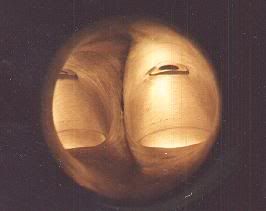
1150port.jpg


Here's his explaination:

Pro Race Only Epoxy Filled Intake Port. Port retains the Pro "D" shape and is made smaller, flow remains near the same (over 130CFM at 10 inches of water) but the velocity goes to the moon! You then adjust camshaft timing to take advantage of this ram tuning by spreading the lobe centers apart more. 113-116 degrees! These engines get over 100% volumetric efficiency. The flat port floor gives the port short side radius more area and it thinks it is as long as the long side. Flow and velocity go straight up.
 
Here's a really good idea if you're interested, markm. Check out http://www.bertaut.com/gsengine.html

Thanks, I've seen his site and his work is art. I do understand the principles behind the high velocity idea. That was why I commented on the MotoGP ports, because they are quite small compared to current sportbike ports. An 05 GSXR1000 has 29mm intake valves, which corresponds to a 40mm inlet diameter, but they are using 44mm throttle bodies (I think it was) and a similar sized inlet port. This means that the inlet has about 20% too much area according to the MotoGP numbers. This for a 12,000rpm streetbike versus a 17,000rpm racebike, both 1000cc displacements. Makes you wonder why the OEM's don't use the MotoGP ports on their top end sportbikes... It's not like it costs any more to cast a good port shape than a bad one, either way there has to be a hole there.

My numbers come from two tech papers by Prof. Gordon Blair, who is a top level engine design consultant. He writes a lot about engine simulation software and race engine design (search on Blair on the SAE website and you will find a ton of stuff). The one paper details simulation work done on big-bang firing orders and their effect on output. That engine is an in-line 4 cylinder and uses 33.5mm intake valves and has an inlet port diameter of 43.5mm (note the GSXR1000 has 29mm valves and the same size inlet). If you work it out, that is an area ratio of only 0.84 for the inlet area to valve area. All for an engine that made 230+hp. This also correlates to Bob Bertaut's work (and others, especially in dragracing) and the Motoman site and his "revolutionary" high-velocity porting methods. But it does make the sportbikes look like they have went down the wrong path or at least a very inefficient one. Imagine a GSXR1000 or ZX-10 with GOOD porting! :)

Mark
 
An 05 GSXR1000 has 29mm intake valves, which corresponds to a 40mm inlet diameter, but they are using 44mm throttle bodies (I think it was) and a similar sized inlet port.

My mistake, the 05 1000 uses 30mm intake valves (the 03-04 1000 had 29's), which correspond to a 41.4mm inlet diameter and the throttle bodies are 52mm 8O , not the 44mm I thought. So they are grossly over the MotoGP design specs, with likely 40%+ more inlet area than recommended by a race engine design authority. That REALLY makes me wonder what a new liter bike would do with GP spec porting... And makes Motoman's ideas seem a lot less radical.

Now I feel like going out and modifying one just to see how it all works. :D


Mark
 
Good to see you still have the GS, Mark. Thought I saw it up for sale, not too long ago.... :)


Tony.
 
mark m said:
An 05 GSXR1000 has 29mm intake valves, which corresponds to a 40mm inlet diameter, but they are using 44mm throttle bodies (I think it was) and a similar sized inlet port.

My mistake, the 05 1000 uses 30mm intake valves (the 03-04 1000 had 29's), which correspond to a 41.4mm inlet diameter and the throttle bodies are 52mm 8O , not the 44mm I thought. So they are grossly over the MotoGP design specs, with likely 40%+ more inlet area than recommended by a race engine design authority. That REALLY makes me wonder what a new liter bike would do with GP spec porting... And makes Motoman's ideas seem a lot less radical.

Now I feel like going out and modifying one just to see how it all works. :D


Mark

Mark please note you said throttle bodies!! NOT the port size, MotoGP bikes are running 65mm and larger throttle bodies.
Dink
 
Mark please note you said throttle bodies!! NOT the port size, MotoGP bikes are running 65mm and larger throttle bodies.

That is correct, Dink. The GSXR throttle bodies are indeed 44mm at the butterfly as I stated in the first post. There was some confusion in specs for that info. The 44mm is still 15% bigger than the MotoGP guideline, regardless. Don't forget that the areas are really what should match and the valve seat ID will actually be about 2mm less than the valve OD. Using a 28mm ID gives us a 39mm port diameter...

Good to see you still have the GS, Mark. Thought I saw it up for sale, not too long ago....

It is still for sale, but I have been through a house move, Christmas and a ton of consulting work in the mean time, so I haven't been working too hard at it. If anybody is interested, PM me for details. It is also listed in the For Sale forum, if you search on "Calgary" it should come up.


Mark
 
RacingJake said:
I've seen some intake runners that were hogged out and looked to be paper thin too. I guess it all depends on what your trying to do and at what rpm too.

But if I owned a flow bench I'd be given it a good workout.

Hey Jake,

I've been crunching some more numbers and it looks like 35-36mm would be more appropriate to the GS valves. Does it look like there is room for that on your 1100 Head?

Second, can you measure your 1150 head (or anyone else) and let me know what size the inlet is?


Don't those MotoGP motors spend all their time between 11-17k RPM?
Does that translate to a 30yr old hunk of iron with a 9k redline?
I'd love to know more about MotoGP bikes!

Yup, they run high rpm. But the inlet area is based on the valve area, not the rpm range. If you start looking at 4 valve engines, they almost all have the same size valves compared to their bore (around 40% of the bore diameter) because you can only physically fit so much in and all the designers (our GS's included) made the valves as big as possible in the first place. The rpm range is more based on the inlet and exhaust lengths and cam details (specifically, time-area of the valves) than port size. The inlet is sized to provide a smooth, mostly constant area duct to allow for the optimal pulse tuning effects. Flow is a detail issue that is achieved with careful design of the correct size duct.

I think it translates to all high performance 4 valve engines myself.

To know more, start reading. If anybody wants a copy of the article I mentioned, PM me and I will mail it to you.


Mark
 
mark m said:
RacingJake said:
I just check my 82 1100 16V head and at Horizontal I get 1.285 but at Vertical I was getting 1.300. :-k Must be alittle egg shaped

This was right at the tip of the intake if I went in farther the hole is getting smaller.

For 27.5mm valves, this gives me a inlet diameter of 38mm, so the GS is quite a lot smaller than that. There isn't any room to change that, either, is there? Not 5mm worth of diameter anyways...


Mark

It is being done, but it is very expensive. The intake ports are machined off and new large billet ones are installed.

Jay
 
The 1150 head is still at the machine shop, but when it gets back I'll measure the intake's. I do know that they are bigger than the 1100 head.

There's alot of material you can still remove from the 1100 intake's, I'd say between 1/16 to 1/8 all the way around.

Here's a pic of both heads, can you tell which one is which :D

1100head.jpg
 
The 1150 head is still at the machine shop, but when it gets back I'll measure the intake's. I do know that they are bigger than the 1100 head.

There's alot of material you can still remove from the 1100 intake's, I'd say between 1/16 to 1/8 all the way around.

Here's a pic of both heads, can you tell which one is which

Thanks for the help, Jake. There does appear to be enough material on the 1100 to get near where Blair says it should be. I re-did my calculations using the ID of the seats instead of the valve head OD and that gives me about a 35.5mm port inlet diameter, which looks to be easy to get to in your pics.

The second part of the job is sticking the head on a flow bench and playing with modelling clay to see where the dead flow areas are and how to increase flow without hogging things out to a ridiculous size. I have been talking to a very knowledgable tuner who uses filled ports extensively and he has mentioned that he generally sees more flow increases (yes, he INCREASES flow by making the ports smaller) from filling the exhaust port than the intake port, but that both produce significant power gains.

Related question - is it cheaper to take an 1100 head and install 1150 size valves and seats or just find an 1150 head and run that? Given that it looks like I can get the "correct" inlet port area from either one, that is.


Mark
 
I'd go with the 1150 head if you had a choice and just run it stock.

By the time you buy new valve's around $300 and pay for the work $300 plus you might be able to find(may take alittle time) a good 1150 head for around $400.

Or maybe just go for a good port job on the 1100 head $300-$400.

Or even go for carbs and cams and a good exhaust. Don't you just hate the power drug. I know I do.
 
Back
Top