-
-
..I dislike the Bolt-on seat of the GSX400 T X. Honda did it better with the seat hinges but not so well as
the GSX400 E X seat catch that unlocks and reveals the toolbox in the tailpiece
but the EX sadly has that UGLY plastic handlebar clamp cover and the heavy- looking speedo/tach box ...Comment
-
Yeah, it helped, but not enough.
Haha there's an idea.
Looks like I'll add that to the list of things to do when it gets above freezing...
The bars are off of Ebay and are the "superbike" bars. I like them a lot, with the caveat that I'm really tall and I need to make myself some rearsets to get the other half of my body in the right place. Again, when it gets warmer...
'77 750s had the choke on the carbs, so my guess is your carbs got swapped or converted at some point. Pretty common from what I've seen. My bike actually came with a set of early carbs.
Gauges are TrailTech Vapor. Awesome unit; I highly recommend it. Brakes are the SaltyMonk conversion and forks are from a GS1100ET. Its a work in progress.
/OTComment
-
I'm all about the 750...and this one is sweet! (Right Tank! I know you like em' clean)
It's enough power for me...and that's what matters. Good to know an 1100 engine can be put in there...but I think I'll keep her pure for now.
Ed
NOTE: I have the side covers for the above bike.Last edited by GSXR7ED; 01-18-2013, 12:51 AM.GS750TZ V&H/4-1, Progressive Shocks, Rebuilt MC/braided line, Tarozzi Stabilizer[Seq#2312]
GS750TZ Parts Bike [Seq#6036]
GSX-R750Y (Sold)
my opinion shouldn't be taken as gospel or in any way that would lead you to believe otherwise (30Sep2021)
Comment
-
Alot of people like the lines of the '82, '83 GS1100E. It's a fairly good looking bike as far as looks go.
Things I don't like about it, haven't been able to get used to, the petcock position, I ususally have to look down to find it when riding if I need to switch the setting, or fiddle around feeling for it. The way the seat comes up on the front where it mates to the tank, always thought that was odd. Don't like the way the seat comes off and goes back on, trial and error getting it to mate properly, and when on it can move around a bit side to side. The train light, well does it really need to be that big? It sits fairly high, there's a long stretch over the tank to the bars, I thought they could've done a better job making a better looking tailpiece like on the earlier 1100, but the luggage rack helps hide it. I like the screw on emblems on my 1000 over the decals on the 1100. You have to remove the part that the tank bolts to to get the air cleaner box out. Plastic trim tabs that break easily on the frame covers and tailpiece. Plastic front fender, and the paint has a tendancy to chip off. That multi piece shift linkage develops slop over time but it hasn't been a problem. How about the anti-dive system, does it really work at all, or does it just add more unsprung weight to the front?
I do like the equalizing feature to adjust the air evenly in the front forks my 1000 doesn't have. I do like the recessed levers. I don't like the mounting screw positions for the muffler heat shields, you have to remove or drop the mufflers to get to one of the four. The chain guard is weak and has a tendancy to crack. I do like how easily I can get it on the centerstand. I don't like the front master cylinder sight glass that's frosted up, the two phillips screws that have a tendancy to get the center reamed out, and it's more prone to leakage, prefer the plastic reservior on the 1000 and the screw on cap. I do like the slotted disks and I do like the electronic ignition over the points in my 1000. It does have more than enough power, at least for me!
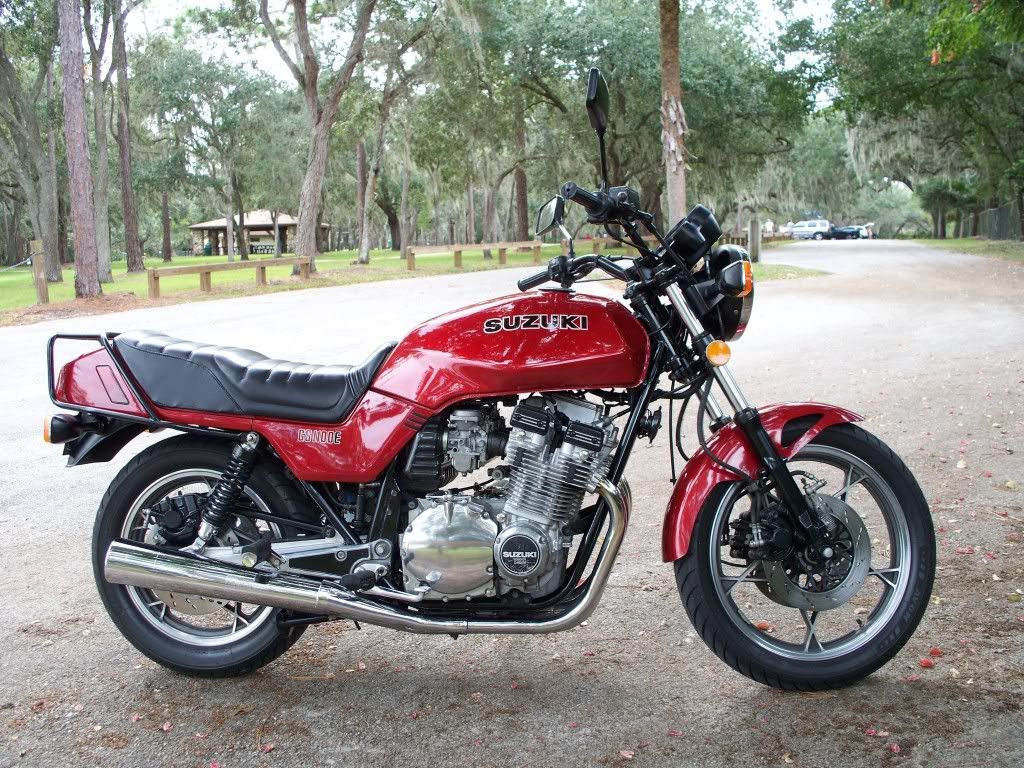
Now lets go with the GS1000, lets see, I'm thinking hard about what I don't like about it......................................
That 1st generation Turn Signal Control unit is a sore spot. The tach cable chaffes the front fender when the front brake is applied.
Most of what I don't like is trying to find certain parts for it, like airbox boots, tail piece chrome trim, front chrome fender, choke carb parts for the VM carbs, expensive petcocks, a tank or stock mufflers should you need them. But this is a bike that is fairly simple, I like the way the frame covers mount, no tabs to break, the seat flips up allowing access to the air cleaner box and you don't have to remove any other parts to pull the air cleaner box out. I like the chrome bars over black. It sits lower than my 1100 and it's not as far a stretch over the tank, the seat is more comfortable. The shift linkage is a simple bolt on. The muffler heat shields have two easily accessed screws. I do wish it came with the recessed levers, which I added, and I wished it had some of the features the later model had like slotted disks, a non-stepped seat, a 2nd generation turn signal control unit, and a single throttle cable, but I'll keep the VM carbs. I don't like how it takes everything I got to get it on the centerstand. I think I'd rather deal with the tappets my 1100 has than the shims this one has. The handling and balance is great. Although not as quick as my 1100, it's still plenty quick for me.
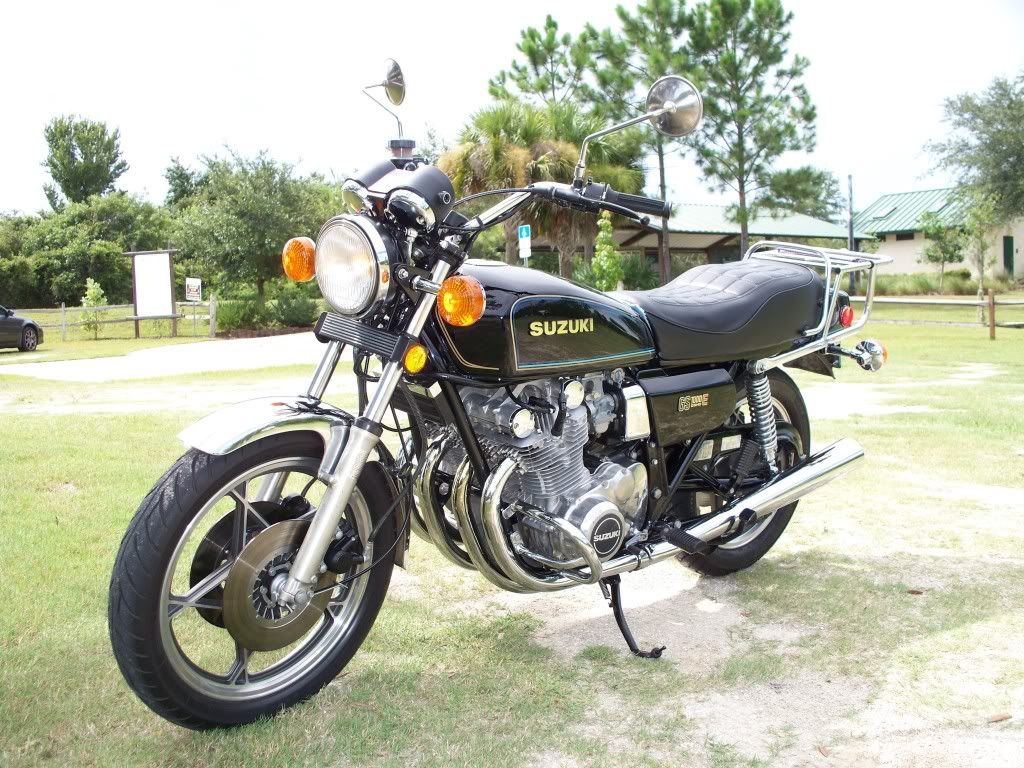
Comment
-
This is how Cycle Guide described the anti-dive in 1982.
"The purpose of the anti-dive is to keep the front suspension from compressing so dramatically during hard braking, a trick it attempts to do by virtually closing off the flow of damping oil whenever the front brake lever is squeezed. The idea, of course, is to prevent the steering geometry from being quickened due to front-end dive, thus allowing the bike to remain much more stable during hard stopping - a time in which it needs all the stability it can get.
While the anti-dive might not weigh a lot, it doesn't really do a lot, either. The truth is that it doesn't prevent front-end dive as much as it merely slows it somewhat. The fork will still compress just about as far during most braking situations as it would have without the anti-dive, but it just takes a little bit longer to do it. So even though you end up with practically the same quickened geometry you would have without the anti-dive, that slower transition gives the rider a little more time - even if it's only a fraction of a second - to adjust to that change."Comment


Comment