-
sigpic
mine: 2000 Honda GoldWing GL1500SE and 1980 GS850G'K' "Junior"
hers: 1982 GS850GL - "Angel" and 1969 Suzuki T250 Scrambler
#1 son: 1986 Yamaha Venture Royale 1300 and 1982 GS650GL "Rat Bagger"
#2 son: 1980 GS1000G
Family Portrait
Siblings and Spouses
Mom's first ride
Want a copy of my valve adjust spreadsheet for your 2-valve per cylinder engine? Send me an e-mail request (not a PM)
(Click on my username in the upper-left corner for e-mail info.) -
I just have a single bulb in the dash. Someone said diodes. Never installed one before.Comment
-
Your single bulb is a standard bulb, not a diode.
The problem with that bulb is that in normal operation (with your original turn signals), it is wired with one lead going to each side's signals, not to a "ground" point. When the left signals operate, current gets to the lead on the indicator bulb and looks for a 'ground' to turn on the light. The other lead is connected to the filaments in the right turn signals, the other sides of which are connected to 'ground'. The indicator bulb can not pass enough current to turn on the right side signals, so the filaments in the right side signals are simply wires to connect the indicator bulb to 'ground'. Same thing happens when you use the right signals, the left signal filaments are used as wires to connect the indicator bulb to 'ground'. This works because an incandescent bulb does not care which direction current goes through it.
With your LED signals, you don't need nearly as much current to activate them. The indicator bulb needs more current than the LED signals. When current hits one side of the indicator bulb, it goes through the filament, as before, looking for 'ground', but sees more LEDs. Since the LEDs don't take much current, they will light up, too. Yep, when you turn on the signals on one side, the other side will light up, too.
What is needed is an electrical check-valve, a diode. Using two of these facing opposite directions, with your indicator in the middle (and re-wired to connect the other lead to 'ground'), you will have no problems.
.Yeah, LED signals are a GREAT idea, aren't they?
Actually they are a great idea, just need a few more things to go along with them to make them work properly.
I have diagrams that might help you with this, but can not access Photobucket (and many other "important" sites) while at work.
.sigpic
mine: 2000 Honda GoldWing GL1500SE and 1980 GS850G'K' "Junior"
hers: 1982 GS850GL - "Angel" and 1969 Suzuki T250 Scrambler
#1 son: 1986 Yamaha Venture Royale 1300 and 1982 GS650GL "Rat Bagger"
#2 son: 1980 GS1000G
Family Portrait
Siblings and Spouses
Mom's first ride
Want a copy of my valve adjust spreadsheet for your 2-valve per cylinder engine? Send me an e-mail request (not a PM)
(Click on my username in the upper-left corner for e-mail info.)Comment
-
Ok I've seen the wiring on basscliff s website. Gonna have to get into the cluster up front and see. Are the diodes all the same or do I need a specific set? I've seen so many articles about this online just no pictures. I'm a very visual personComment
-
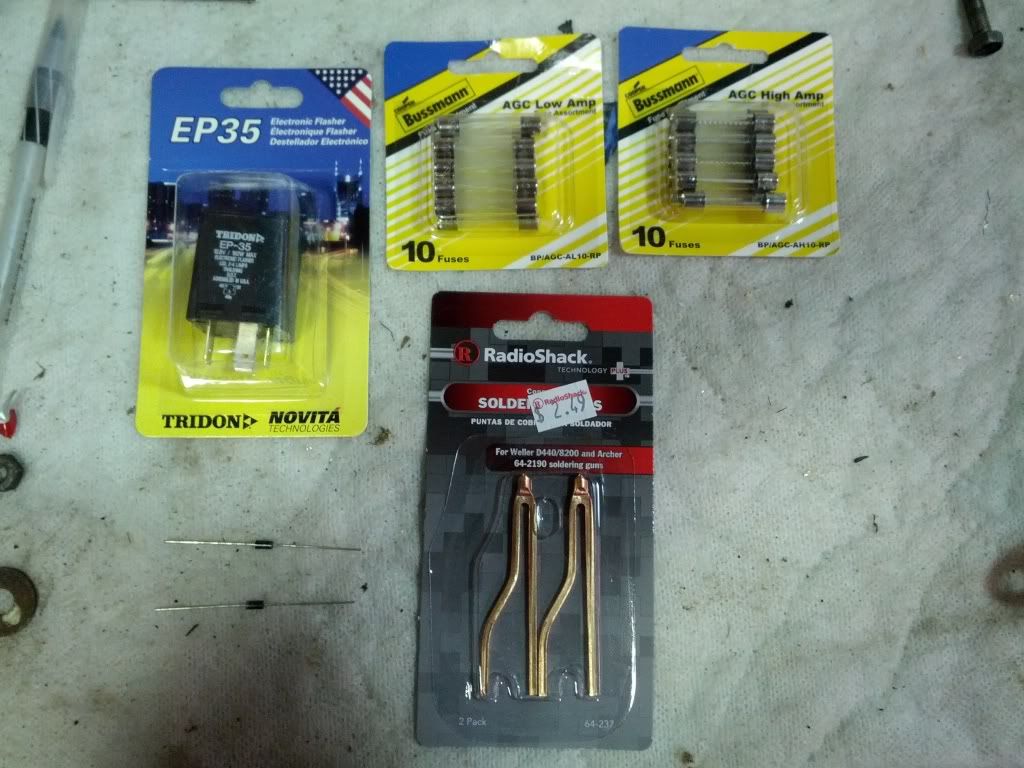
Generic diodes at Radio Snack will work just fine. I think they are 1N4001.
.sigpic
mine: 2000 Honda GoldWing GL1500SE and 1980 GS850G'K' "Junior"
hers: 1982 GS850GL - "Angel" and 1969 Suzuki T250 Scrambler
#1 son: 1986 Yamaha Venture Royale 1300 and 1982 GS650GL "Rat Bagger"
#2 son: 1980 GS1000G
Family Portrait
Siblings and Spouses
Mom's first ride
Want a copy of my valve adjust spreadsheet for your 2-valve per cylinder engine? Send me an e-mail request (not a PM)
(Click on my username in the upper-left corner for e-mail info.)Comment
-
If you were looking at the Converting your gauge lights to LED page, yeah, that's my diagram. Should give you the basics of what you need.
.sigpic
mine: 2000 Honda GoldWing GL1500SE and 1980 GS850G'K' "Junior"
hers: 1982 GS850GL - "Angel" and 1969 Suzuki T250 Scrambler
#1 son: 1986 Yamaha Venture Royale 1300 and 1982 GS650GL "Rat Bagger"
#2 son: 1980 GS1000G
Family Portrait
Siblings and Spouses
Mom's first ride
Want a copy of my valve adjust spreadsheet for your 2-valve per cylinder engine? Send me an e-mail request (not a PM)
(Click on my username in the upper-left corner for e-mail info.)Comment
-
In you version of the diagram I see two diodes on each side and a connection in the middle the dot I assume is the light, but what is the two arrows pointing off into space? Am I going to need to wire a third leg ground?Comment
-
Alright. I will tinker with this tonight. I can simply use my stock bulb in place of the led bulb.Comment
-
You will still need the two diodes facing each other, but yeah, you can use your stock light in place of the LED.
Just be sure to locate both leads for the indicator light. One of them will go to the junction between the two diodes, the other will go to 'ground'.
That is not how it is wired when 'stock', so be aware that you need to re-terminate BOTH leads of that bulb.
.sigpic
mine: 2000 Honda GoldWing GL1500SE and 1980 GS850G'K' "Junior"
hers: 1982 GS850GL - "Angel" and 1969 Suzuki T250 Scrambler
#1 son: 1986 Yamaha Venture Royale 1300 and 1982 GS650GL "Rat Bagger"
#2 son: 1980 GS1000G
Family Portrait
Siblings and Spouses
Mom's first ride
Want a copy of my valve adjust spreadsheet for your 2-valve per cylinder engine? Send me an e-mail request (not a PM)
(Click on my username in the upper-left corner for e-mail info.)Comment
-
Nice this is making more sense now. Does it matter what lead I take for the ground?
I will take pictures when I get it all done.Last edited by Guest; 04-23-2012, 07:01 PM.Comment
-
Too tired tonight but will try to get back to do a proper job of reply.
My intent was not to indicate that amber/yellow turn signal lights are not allowed. Yellow/amber turn signals are allowed on both front & rear in Canada and US.
Yellow/amber and white lights may not show as tail lights (continuous burn as someone more clearly stated), or brake lights. No amber/yellow/white lights to the rear excepting for turn signals.
One may run white, amber/yellow lights to the front as continuous burn as running lights or parking lights.
All the above require approved lenses, reflectors and bulb intensities.
I agree with the point regarding the ideal being the use of the same color LED as that of the lens if one cannot tolerate loss of intensity but the small panels referenced provide very adequate lighting through the original Suzuki turn signal lenses on the front. The loss is not significant in this case.
Thanks for the offer of the bulb adapter sockets but I have a free supply of bulbs, some old, some new and only takes a minute to solder & dab in some RTV silicone.
'Night all!Comment
-
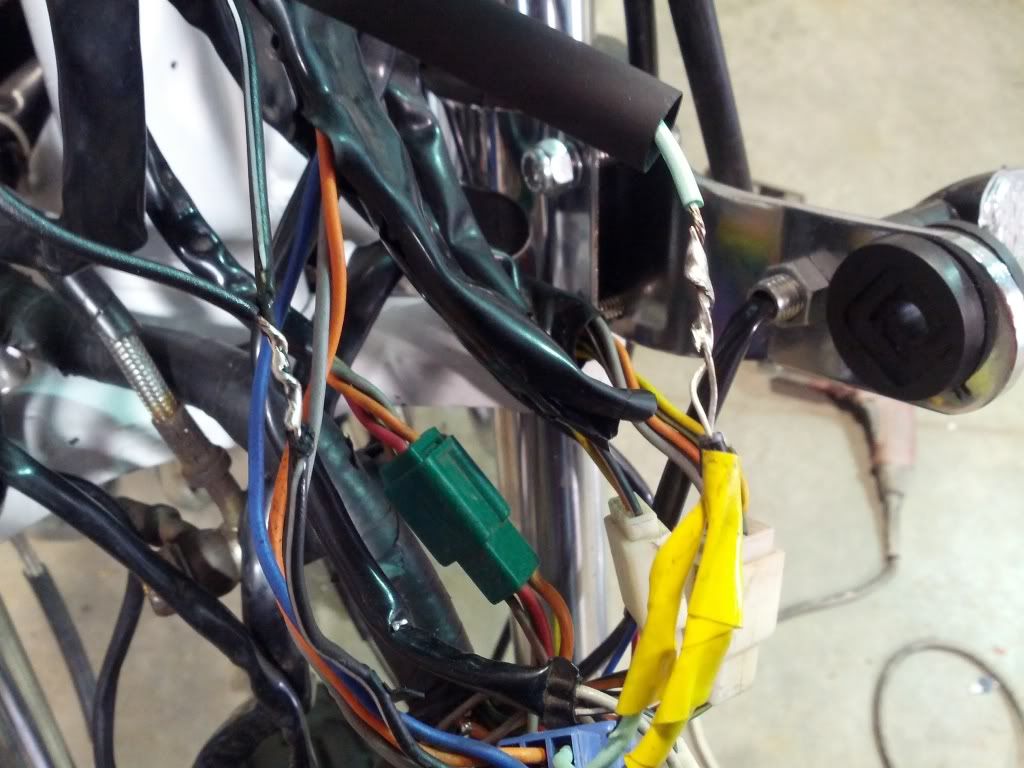
Great success! Wired the diodes together and spliced the black into the ground wire
You can see the diodes under the yellow electrical tape and the black write tapped into the ground.
Comment

Comment