-
sigpic
mine: 2000 Honda GoldWing GL1500SE and 1980 GS850G'K' "Junior"
hers: 1982 GS850GL - "Angel" and 1969 Suzuki T250 Scrambler
#1 son: 1986 Yamaha Venture Royale 1300 and 1982 GS650GL "Rat Bagger"
#2 son: 1980 GS1000G
Family Portrait
Siblings and Spouses
Mom's first ride
Want a copy of my valve adjust spreadsheet for your 2-valve per cylinder engine? Send me an e-mail request (not a PM)
(Click on my username in the upper-left corner for e-mail info.) -
That side looks good (neat and tight), but Roostabunny needs to see other side ! Thanks1981 gs650L
"We are all born ignorant, but you have to work hard to stay stupid" Ben FranklinComment
-
I'll flip it over and shoot it when I get home this evening.
.sigpic
mine: 2000 Honda GoldWing GL1500SE and 1980 GS850G'K' "Junior"
hers: 1982 GS850GL - "Angel" and 1969 Suzuki T250 Scrambler
#1 son: 1986 Yamaha Venture Royale 1300 and 1982 GS650GL "Rat Bagger"
#2 son: 1980 GS1000G
Family Portrait
Siblings and Spouses
Mom's first ride
Want a copy of my valve adjust spreadsheet for your 2-valve per cylinder engine? Send me an e-mail request (not a PM)
(Click on my username in the upper-left corner for e-mail info.)Comment
-
I am jumping into this late, with a question:
That last set of numbers, are those volts? Are you trying to measure voltage between the stator legs and ground? The three stator windings have absolutely no relation to chassis/engine ground and any voltage readings taken like this are nonsense. You want to instead measure resistance. With the engine off and the stator disconnected from the R/R. You should get an open circuit (infinite resistance) between any of the three stator legs and ground. Anything else means there's a path for current to flow from the stator to ground which implies a damaged stator or wire.Leg-->Leg PASS
80
80
80
Leg-->ground What the?
40
40
40
But even if there's no short to ground, it's possible you could still have a bad stator. I just don't know how you can be getting 80v across all legs and not be charging the battery unless the R/R or some wiring somewhere is bad. I agree with posplayr that it would be a good idea to verify the accuracy of your multimeter.Comment
-
Thanks, Steve, for the shot and the future other shot.
As a general update, two things...
1.) I ordered the Polaris 4012941 R/R and will install when it arrives. Since I'll end up with a super-deluxe charging system at the end of this oddyssey (and I've got a stylin' new crimper), I'll be sure to replace the rest of those heated connectors while I'm at it.
2.) Got confirmation that the Rick's folks got my email and that techs were looking at the info I sent. Waiting to hear back.Comment
-
1981 gs650L
"We are all born ignorant, but you have to work hard to stay stupid" Ben FranklinComment
-
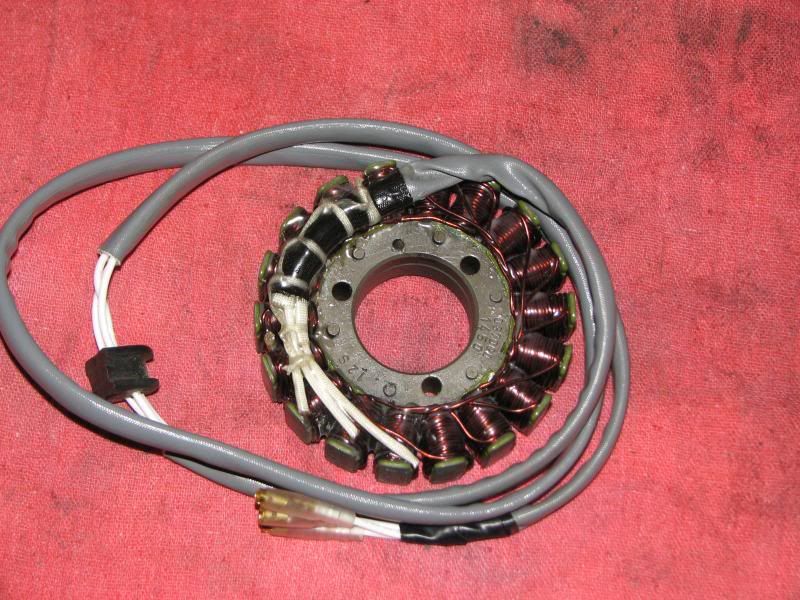
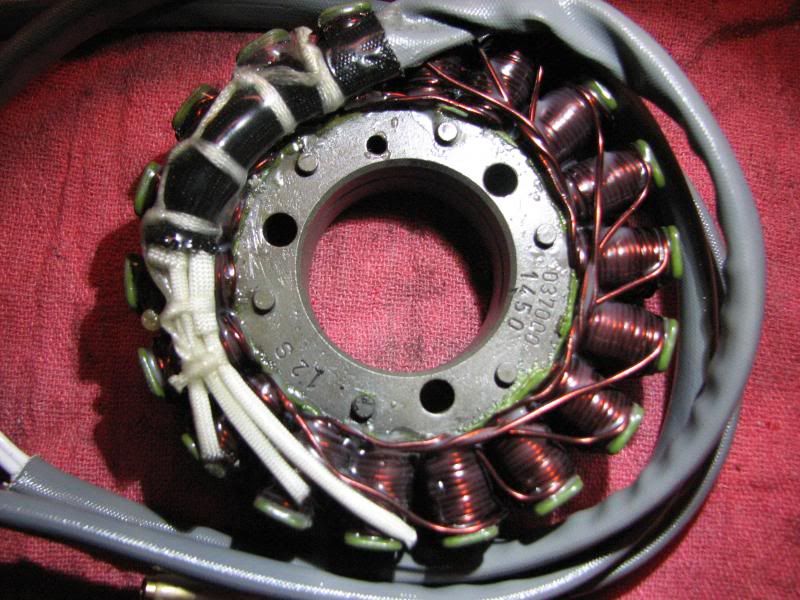
OK, I am home, pictures are shot.
.sigpic
mine: 2000 Honda GoldWing GL1500SE and 1980 GS850G'K' "Junior"
hers: 1982 GS850GL - "Angel" and 1969 Suzuki T250 Scrambler
#1 son: 1986 Yamaha Venture Royale 1300 and 1982 GS650GL "Rat Bagger"
#2 son: 1980 GS1000G
Family Portrait
Siblings and Spouses
Mom's first ride
Want a copy of my valve adjust spreadsheet for your 2-valve per cylinder engine? Send me an e-mail request (not a PM)
(Click on my username in the upper-left corner for e-mail info.)Comment
-
In the case of a perfectly healthy system, any voltage readings between a leg on the stator and ground are nonsense because the stator is electrically isolated from every single other part of the bike, including ground, except for the three wires going into the R/R and the circuit inside the R/R itself. A much more scientific and fool-proof test is to check for continuity between the stator and engine. (Bearing in mind of course, that a faulty stator may only "short" to ground when warm or at higher RPMs.)
If the stator is connected to the R/R while testing, then what you're really seeing is part of the R/R circuitry, which isn't helpful unless you understand how the R/R circuits work and given that the input and outputs are so easy to test on their own.
Now if the stator is disconnected... and a leg on the stator has continuity to ground, you would see 0V on one leg (or close to it), and the other two would read 80V. The only way I can see getting a reading of 40V across all three is if the center tap of the stator (which is not connected to the R/R) is connected to ground. And I've never seen a charging system schematic that showed the center tap connected to anything. If this happened, would it interfere with the workings of the R/R? I honestly don't know.Last edited by eil; 07-02-2013, 05:10 PM.Comment
-
You failed to read my post, which means you failed to grasp the diagnostic capability of the test method. The leg to ground tests at 5K RPM has been established as probably one of the best diagnostic measurement for determining failed stators.
Your statement above is also incorrect and can be confirmed with a simple circuit analysis. You can put one short any where an any of the three legs and it will not have any bearing on the VAC outputs. Again draw yourself a circuit.
By the way, I have never seen a voltmeter register "Nonsense", is that a special kind of meter? Could you elaborate on what that means?Last edited by posplayr; 07-02-2013, 05:42 PM.Comment
-
and God said, "Let there be air compressors!"
__________________________________________________ ______________________
2009 Suzuki DL650 V-Strom, 2004 HondaPotamus sigpic Git'cha O-ring Kits Here!Comment
-
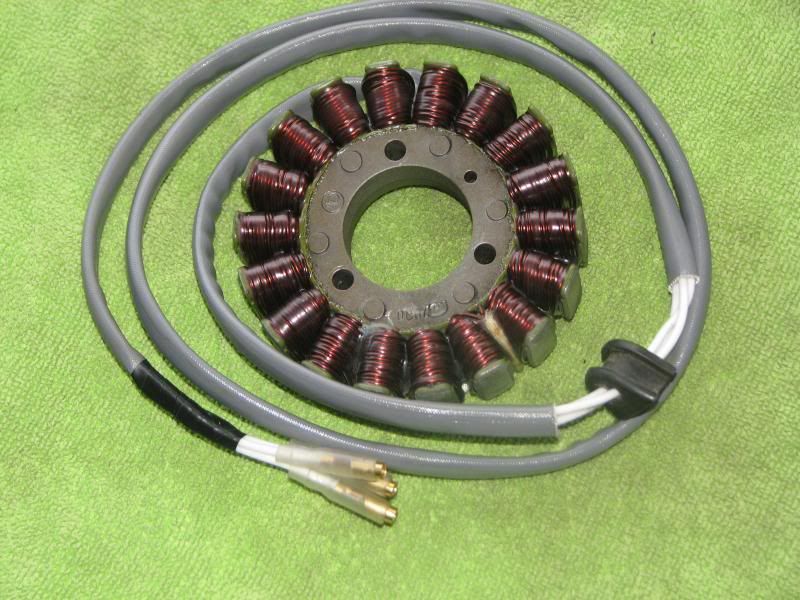
Wish I could take credit for the work, but I send them out to a guy who does this for a living.
Price? See below.
I have the second batch out for rewinding right now. Once they get back, I will be "hanging my shingle" for rewound stators.
For now, I am thinking that the price will be $85, shipped to your door.
If that's not quite enough, I will be happy to "adjust".
Of course, this will be on an "exchange" basis, but I hope to have a few stators on-hand to minimize turn-around time.
Exchanges will be tracked, but I hope to keep them on an honor system, so I don't have to go through the hassle of a core charge.
If you would like to send a stator to be rewound, send me a PM or an e-mail for arrangements.
I would also like to ask if anyone else has any dead stators they would like to donate to the project.
I would be happy to pay shipping costs for items donated to the project, but exchange units are on your "dime".
.sigpic
mine: 2000 Honda GoldWing GL1500SE and 1980 GS850G'K' "Junior"
hers: 1982 GS850GL - "Angel" and 1969 Suzuki T250 Scrambler
#1 son: 1986 Yamaha Venture Royale 1300 and 1982 GS650GL "Rat Bagger"
#2 son: 1980 GS1000G
Family Portrait
Siblings and Spouses
Mom's first ride
Want a copy of my valve adjust spreadsheet for your 2-valve per cylinder engine? Send me an e-mail request (not a PM)
(Click on my username in the upper-left corner for e-mail info.)Comment
-
That's a nice looking rewind job! I'll donate some BBQ ones , I'm a good recycler and need to clean out my stash.1981 gs650L
"We are all born ignorant, but you have to work hard to stay stupid" Ben FranklinComment


Comment