Honda Regulator/Rectifier Issue and Fix

Collapse
X
 
  • Time
  • Show
Clear All
new posts

  • Steve
    replied
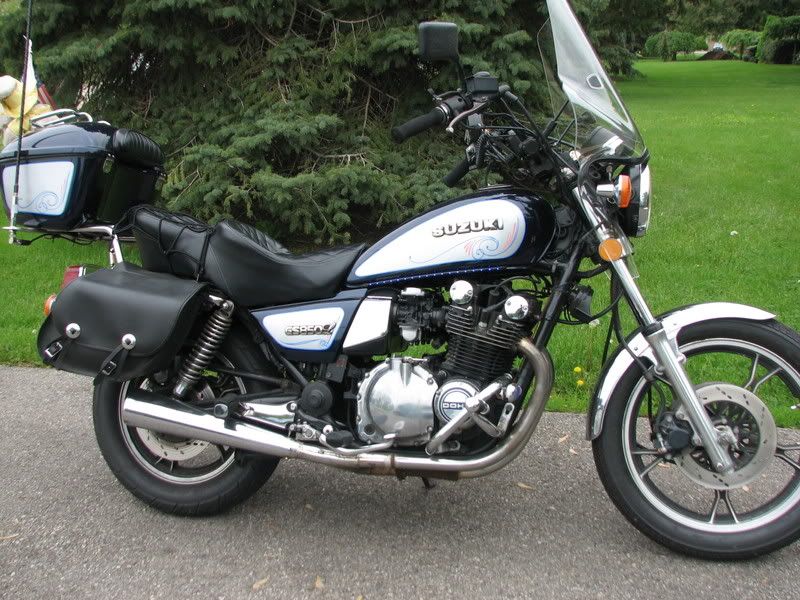
    Here are a couple more shots. The first one shows how invisible they are when they are turned off, the second one shows them on.


    .

    Leave a comment:


  • Steve
    replied
    Originally posted by Suzuki_Don
    Steve what are the LEDs on the tank that you refer to. Thanks
    These.


    It is a string of 18 LEDs that is 16 inches long and just exactly the width of the lip on the bottom of the tank.

    I got them at Auto Zone, and have seen them at Pep Boys, but they are not to be found on either of their web sites. The manufacturer is Pilot, and they are not found on the Pilot web site, either.

    You probably don't have either of those stores down there, but you'd think you could find them on this Inter-Web thingy.

    .

    Leave a comment:


  • Suzuki_Don
    Guest replied
    Originally posted by Steve
    The third row is constant power, which can be used to power the LEDs on the dedge of the tank. The fourth row comes from the switches in the lower right corner of the picture (they are for the tank LEDs). The bottom two rows are grounds from all the accessories.
    .
    Steve what are the LEDs on the tank that you refer to. Thanks

    Leave a comment:


  • knotzilla
    Guest replied
    Great idea. When I hooked up my Honda senser wire to the tailight circuit I'm getting about 15-15.5 volts charging. I just came back from the electronics store and for $10 Can. I got an automotive relay and matching wiring harness, Thanks Ted

    Leave a comment:


  • bonanzadave
    replied
    Originally posted by bwringer
    So I ended up wiring in a high-quality relay
    BTDT. I went from 15.9 down to 14.6. I always monitor the charge with my onboard voltmeter.

    Leave a comment:


  • Steve
    replied
    Originally posted by ryonker
    Pictures to come Mr. Bwinger?
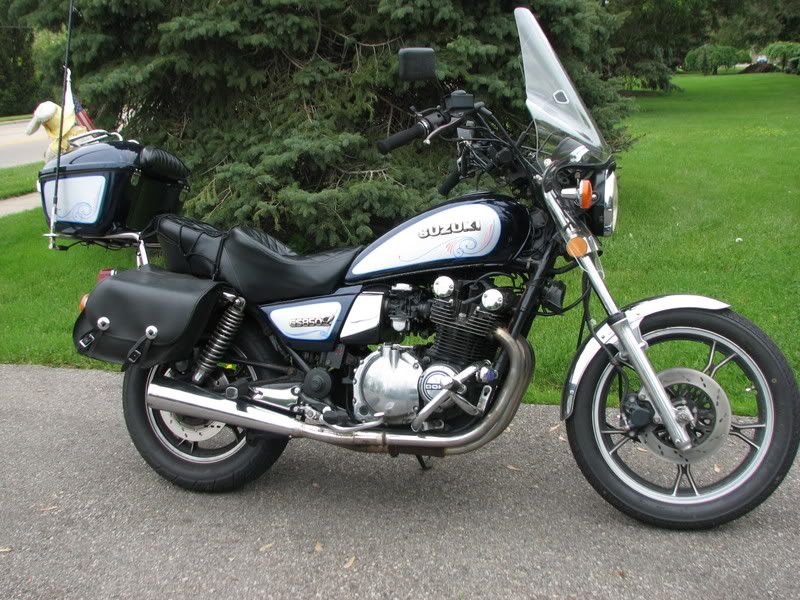
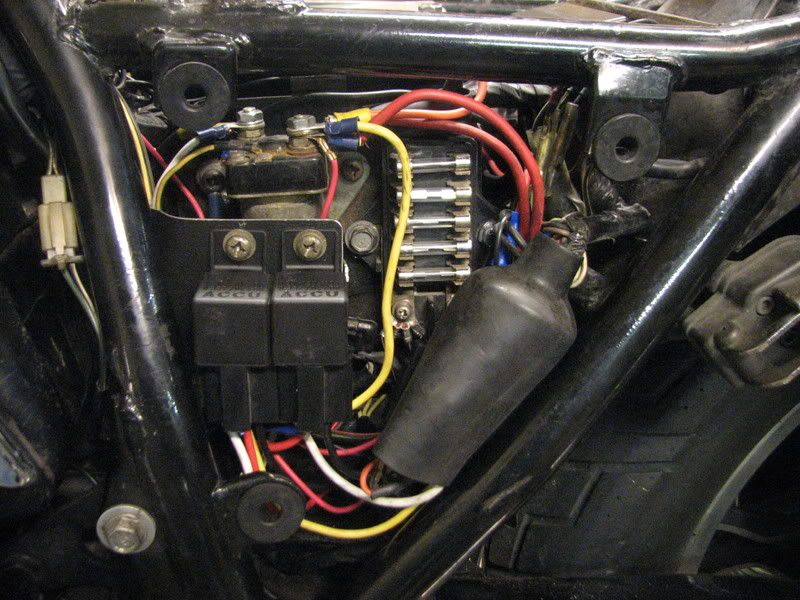
    OK, so I'm not Mr. Bwringer, nor did I stay in a Holiday Inn Express last night, but here are pictures of my wife's bike,
    to which I did the very same thing, for the very same reason.
    However, I did not use the sealed relays he spoke of, these are the cheap ones from Parts Express.


    The relay on the left (toward the front of the bike) cuts off the headlight when the starter button is pushed.
    I feel that is another good mod. The right relay powers the strip in the next photo.


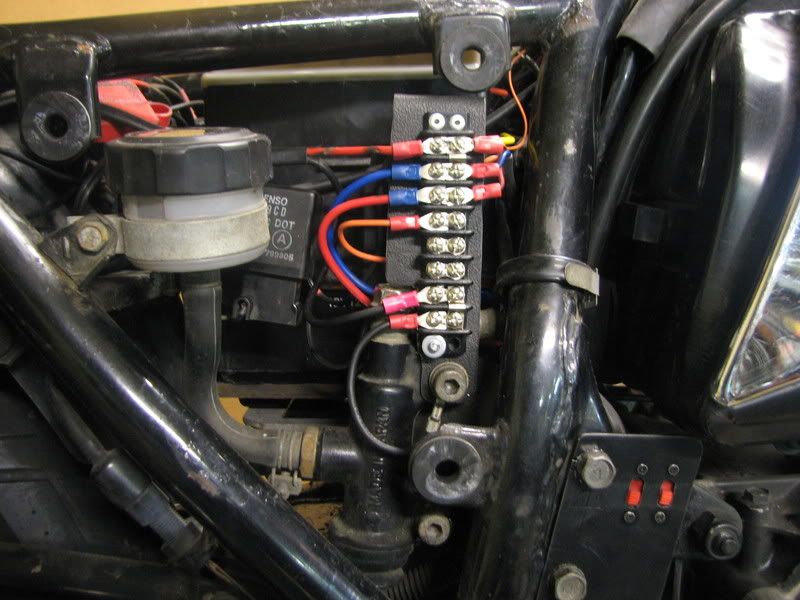
    This picture was taken before the project was complete. In this picture, the top two rows are switched power from the relay on the other side of the bike. This is what poweres the CB radio, the XM radio and the GPS. The third row is constant power, which can be used to power the LEDs on the edge of the tank. The fourth row comes from the switches in the lower right corner of the picture (they are for the tank LEDs). The bottom two rows are grounds from all the accessories.


    .
    Last edited by Steve; 09-08-2008, 06:09 PM.

    Leave a comment:


  • Clone
    Guest replied
    If you don't hook up the sense wire it detects 0Volts and tries to compensate by dumping more power into the electrical system, Usually this is in the range of 18-19V. You need to hook up the sense wire. I did a relay from the battery that is engergized by the fuse block. I am getting a steady 14.5V at the battery

    Leave a comment:


  • Suzuki_Don
    Guest replied
    If you have a sense wire you must hook it up. The only problem as I see it with the sense wire is that if it is hooked up to the brake light switch then it only has juice to it when the ign sw is turned on. But with it hooked up to the battery it has juice going to it all the time. There is a possibility that it could drain the battery over time, particularly if the bike is not used regularly. With my installation I used a relay between the sense wire and the battery to prevent voltage drain from the battery.
    Hope this helps.
    Just my thoughts,

    Leave a comment:


  • flyingace
    Guest replied
    What happens if you don't hook up the sense wire - no output from the R/R?

    Leave a comment:


  • rkubik
    Guest replied
    So, following this logic, when the battery charge is a low, the R/R boosts output, then levels off once it's reached 12V? Seems like a good way to have it.

    Leave a comment:


  • bwringer
    replied
    Originally posted by ryonker
    Pictures to come Mr. Bwinger?

    Your help is always awesome!!!!!!!!!!!!

    Thanks!

    Rick
    Thanks for the kudos!

    Picture a little black plastic cube with four wires coming out of it, and you're there. In other words, there ain't really much to see, so I didn't take photos.

    The details of mounting the relay and running the wiring were different on both bikes. You sort of have to make it up as you go. The relay comes with a wiring diagram.

    All the connectors were soldered and everything was fully protected with adhesive lined heat shrink, connector grease, and a few eldritch spells of binding. I don't really like wiring, so I usually make sure it's sufficient for underwater battle conditions so I never have to touch it again.

    I will say that there's a lot more spare room to work on the electrics on an 850 shaftie than an 1100E with the stock airbox. Crikey, that thing was cramped. I can see why so many E pilots go to pod filters.

    Leave a comment:


  • Nessism
    replied
    Interesting complication. Sounds like you found a reasonable solution.

    Interesting that some Honda R/R's have the "sense wire" circuirty and others don't. I picked up a late model CBR R/R and it doesn't have a sense wire. Not sure it matters or not but happy that my bike charges at 14.6 volts almost all the time.

    Leave a comment:


  • GQROD
    Guest replied
    Originally posted by bwringer
    I've installed Honda regulator/rectifiers on both my bikes and on several other bikes as well. They're a fantastic upgrade to the cruddy Suzuki bits. (Contact Duanage to get yours, or haunt eBay for early '80s Honda R/Rs made by Shindengen.)

    Anyway, I noticed that the output voltage was a little high following the upgrade on two different bikes owned by friends (Al's '82 GS850GL, and Bob's '83 GS1100E). Not totally out of control, but in the high 15s and low 16s. Hmmm.

    After investigation, it turned out there was a 1.3 to 1.5V voltage drop on the switched wire feeding the R/R's sense wire (the wire to the rear brake switch, in both cases). This was causing the R/R to crank up output to the battery too much. With the bike running, simply switching the sense wire to the battery dropped output to a lovely and rock-steady 14.4 volts.

    All the connectors have been cleaned on both bikes, yet the voltage drop remained. I also didn't really feel like disassembling and cleaning the ignition switches (the likely cause for much of the remaining V drop) on a sunny Saturday morning.

    So I ended up wiring in a high-quality relay on both bikes to ensure that full battery voltage is fed to the sense wire when the ignition is on. The brake switch wire simply activates the relay now.

    Works like a charm! Output is also much steadier now -- the R/R isn't straining to crank out too much voltage, and the more direct connection allows the R/R to react to loads much more easily.

    Now that you have a source of switched battery voltage, you could also use the same relay to power heated grips and/or the coils. The sense wire doesn't really draw any current to speak of, so the full capacity of the relay is available.

    One last hint -- I got the relays at Advance Auto. They sell a crappy 30A unsealed relay for $6 over in the electrical parts section, but they sell a very nice 40A sealed relay for $4 over by the fog lights.
    Excellent tip!

    Leave a comment:


  • ryonker
    Guest replied
    Pictures to come Mr. Bwinger?

    Your help is always awesome!!!!!!!!!!!!

    Thanks!

    Rick

    Leave a comment:


  • Jaguarjoe
    Guest replied
    This issue was discussed here about 9 months ago or so. I installed a relay to control the orange "switched" ignition feed to eliminate the high currents and associated voltage drop across the ignition switch. This also brought the sense voltage up to the battery's real voltage. I charge at 14.2 volts but for some unknown reason the battery is consuming 6 amps.

    Leave a comment:

Working...