Is that why it is so slow, it is 30 years old?
This was an article published in Cycle World.
That is everyone's justification for staying stock; the data from an independent source, Cycle World, supports it.
-
 Guest repliedGood, you can see the article. If you read through it, they do establish that the stock setup approaches the performance of the modified unit, not only on the dyno but also at the strip.
Leave a comment:
-
I know I read that article before but there are many new things that I picked up on this time or just forgot about reading.Leave a comment:
-
-
Guest repliedThis is the link to the actual document I have referenced. If you cannot open it, please send me a PM rather than putting the information in this thread.
I can see it, but I belong to the forum.
I have it saved as a jpg, but at 317k it far exceeds our limitation of 97.7k.
Leave a comment:
-
Hey Koolaid, I found the tread that I posted my results...
.png)
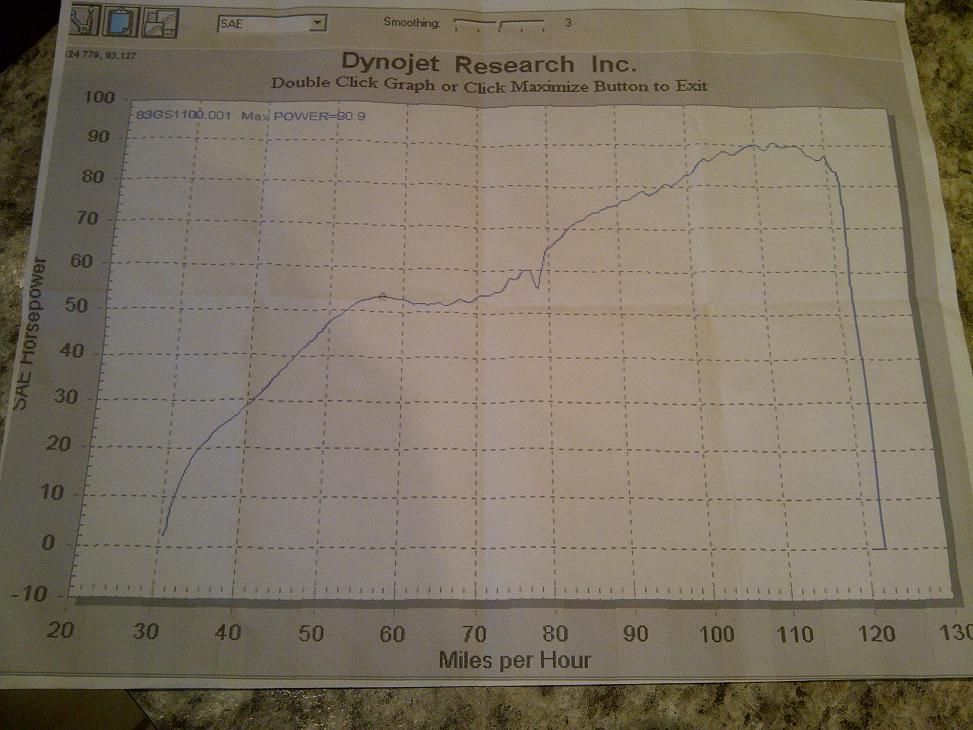
Leave a comment:
-
4:1 pipes are famous for high end power at the expense of midrange. Something to do with flow harmonics. Even on 4:2 set ups, manufacturers like Suzuki made those crossover tubes, or dump chambers in the exhaust to improve midrange. The entire business is very finicky. Make the header pipes too large, too small, not the right length, and you loose power. That's why so many of the cheaper pipes resulted in power losses, not a gain. That chart comparing pipes along with the stock airbox references that.Leave a comment:
-
to many idiots out there that has never been to a drag strip..
seat of the pants feel plus lower ET's and higher MPH should be proof enough.
the DJ kits have changed greatly sense 1981 or so.
DJ would have been out of business long ago if there parts did nothing.
koolaide you just can't tell some people anything...
sometimes they just need smacked up side the head
Leave a comment:
-
Guest repliedEd, my Kerker is ceramic coated, so no worries there. And with my Kerker the sound is a bit louder than stock, but is certainly not objectionable. I agree, though, that too many let their pipes rust and like to unpack their pipes or remove the baffle. But we know the brand of the biggest offender, by far, and it is not made in Japan.Leave a comment:
-
Guest repliedJim, that is horsepower, not percentage. You make a valid point, though, about the weight advantage. I will bring that up also.
Ed, it's too bad that all the data is not available.
Since the carb is the same except for jetting, would you conclude that the dip in the middle is due to the pipe? Perhaps the shape, curvature, collector design, etc.? Or could it be the needle/main transition in the CV carb?
An overall improvement of 6% peak is still far more than the Cycle World data, which saw virtually no improvement any where in the rpm range.Leave a comment:
-
It's HP Jim.
$100+/hp
Weight savings is good. Rusting carbon steel pipes is not. Just about every carbon steel pipe I've ever seen was covered in rust down between the pipes, if not everywhere.
A nice stainless Supertrap, or something like you have is cool.
Noise is not cool. Most of the pipes that make extra power also make way too much noise. Power at the expense of noise is BAD. Not cool. Irresponsible.
Leave a comment:
-
Sorry, but don't think a full dyno chart is available for that particular test. I do remember reading countless articles on pipes/pods/jetting though and the bikes typically, as in almost all cases, had a mid range power dip. The 4.9 hp advantage is next to nothing until the bike gets up and pulling hard in the last 1/3 of the rev range.Leave a comment:
-
Is the 4.9 percentage or hp?
It is ironic as looking at this data, one could easily conclude "what is the point" when in reality there is a significant impact to improved acceleration (due to drop in weight)even if hp changes are negligible.
For example consider a 550 lbs bike with 200 lbs rider. A 50 lbs weight savings would account for a 7% improvement in acceleration. Even if at higher speeds the windage effects would start to dominant. For stop and go riding it should be noticeable. Add in a gearing change and acceleration could easily be improved by 15% in total. And so the quest for speed begins.......
Leave a comment:

Leave a comment: