• Required reading for all forum users!!!

    Welcome!
    Register to access the full functionality of the GSResources forum. Until you register and activate your account you will not have full forum access, nor will you be able to post or reply to messages.

    A note to new registrants...
    All new forum registrations must be activated via email before you have full access to the forum.

    A Special Note about Email accounts!
    DO NOT SIGN UP USING hotmail, outlook, gmx, sbcglobal, att, bellsouth or email.com. They delete our forum signup emails.

    A note to old forum members...
    I receive numerous requests from people who can no longer log in because their accounts were deleted. As mentioned in the forum FAQ, user accounts are deleted if you haven't logged in for the past 6 months. If you can't log in, then create a new forum account. If you don't get an error message, then check your email account for an activation message. If you get a message stating that the email address is already in use, then your account still exists so follow the instructions in the forum FAQ for resetting your password.

    Have you forgotten your password or have a new email address? Then read the forum FAQ for details on how to reset it.

    Any email requests for "can't log in anymore" problems or "lost my password" problems will be deleted. Read the forum FAQ and follow the instructions there - that's what we have one for...

  • Returning Visitors

    If you are a returning visitor who never received your confirmation email, then odds are your email provider is blockinig emails from our server. The only thing that can be done to get around this is you will have to try creating another forum account using an email address from another domain.

    If you are a returning visitor to the forum and can't log in using your old forum name and password but used to be able to then chances are your account is deleted. Purges of the databases are done regularly. You will have to create a new forum account and you should be all set.

Bent Camshaft or Uneven Wear?

rustyspoon

Forum Apprentice
Hello!

I picked up a 1981 GS650G recently that had issues stalling when I pulled in the clutch with no throttle input. After some research on here, I found this thread that offered a solution:
https://www.thegsresources.com/_for...-info/18300-still-won-t-idle-i-think-i-m-done
And it worked! Bike runs with no stalling now, though there is some valve noise from where I overadjusted for a tappet with no clearance.

However, when doing the tappet adjustment I ran into something interesting, and not in a good way. The Suzuki Service Manual gives two positions the tappet clearance can be measured from - with the cam perpendicular to the engine or with the cam parallel to the engine pointing towards the intake or exhaust, depending on if the valve is an intake or exhaust valve.

That's fine and understandable; it lets you check more than one tappet at a time which make life easier. However, the issue I ran into was that for all of my tappets the clearance was different depending on which position (A or B) the cam was in.
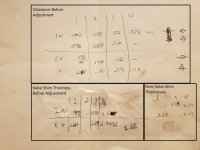
Click image for larger version  Name:	Valve Adjustment Info GS650G 2023-06-26.jpg Views:	0 Size:	69.5 KB ID:	1728604


When adjusting, I erred on the side of caution and adjusted to the tightest tolerance on each valve, but I'm concerned about what caused this. My thoughts are their either the camshaft is bent, or there has been uneven wear on the cams during engine operation.

If the camshaft was bent, I would expect to see a pattern where the outer tappets are further out of clearance while the inner tappets are mostly fine, or vice versa. This seems to be somewhat true of the left tappets, but the right tappets have the tightest clearances.

But I can't think of what might cause the cams to be subjected to uneven wear during engine operation, especially on the clearance surfaces that shouldn't be in contact with anything during engine operation.

Is this something I should be concerned about, or is this a common occurrence?
 
Interesting - and something I've not seen before. First question I have is - are they stock cams ? If they're hot regrinds it's possible the lift ramps are extended to the point where they should only be measured "straight up".
Next question - and probably more likely - clearance in the cam bearings. If those are worn, the cam will move as the spring loads come on it - giving different clearances.

If you still have the cam cover off, and feel like it, pull the cams right out. Then pull the buckets - keeping them organised so they will go back in the same place.
It's then possible to either use plastigage on the cam bearings to check the clearances - or measure with a bore gauge. Check against the manual for your model.
 
My understanding is that the clearance depends on where the cams are because of the cam journal clearance.
This why Suzuki specify the cam position when measuring the 'official clearance' ?
 
There's nothing unusual or uncommon about what you have found.
You will always get different readings with the cam in different positions and they will always get tighter the closer you get to the cam lobe.
Forget the manual and set the clearance one at a time with the lobe pointing directly away from the shim ( 180 degs ) and you can't go wrong.
This ensures that you are fully on the base circle and away from the quieting ramp.
 
Last edited:
This simplified instructions replicate the official Suzuki method. Positioning the cams this way is best, because it places two adjacent valves on their base circle. Failing to do this results in the adjacent valve being depressed, which pushes up on the cam, skewing it in the journal clearance, which results in incorrect measurements.

Rotate the engine until the 1 Exhaust lobe is parallel to the gasket surface, then adjust 1E and 2E.
Rotate the engine until the 4 Exhaust lobe is parallel to the gasket surface, then adjust 4E and 3E.

Rotate the engine until the 1 Intake lobe is 90 degrees to the gasket surface, then adjust 1I and 2I.
Rotate the engine until the 4 Intake lobe is 90 degrees to the gasket surface, then adjust 4I and 3I.

Measuring with the lobe pointing directly away from the bucket will result in false readings, too high, because the adjacent valve will be depressed, pushing up on the cam. On the plus side, though, this method is very simple to remember. If using this method, shoot for a higher clearance than specified in the manual. Suzuki specs .03-.08mm, but running up to .12mm is safe. Kawasaki KZ bikes, run up to .15mm clearance, and they don't spit shims.
 
Last edited:
Unfortunately, the picture in the manuals (Suzuki, Clymer, Haynes) are not all that clear for positioning the cams. Also unfortunately, the advice given so far in this thread isn't helping, either.

Do NOT simply point the lobe away from the valve to measure clearances. The 'trick' is to make sure that neither lobe is pushing on a valve on the side you are working on.
If you position EX1 pointing FORWARD and EX2 pointing UP, neither one is pushing on a valve and you can check both valves without moving the cam.
Rotate the crank 180? using the 19mm nut on the right end of the crank, you will find that IN1is pointing UP and IN2 is pointing REARWARD. Check both valves.
Rotate the crank another 180?, check EX3 and EX4.
Rotate the crank a final 180?, check IN3 and IN4.

Disturbingly easy procedure, but not explained well in any manual. The basic concept is that if a lobe is pushing on a valve, you obviously can't check THAT valve, but the cam will be pushed slightly away from the adjacent valve, giving a false clearance there. You need to have BOTH lobes pointing away from the valves. The valves are not quite at a 45? angle from vertical, but it's close enough that you can use forward, up and rearward references for pointing the lobes.
 
Interesting - and something I've not seen before. First question I have is - are they stock cams ? If they're hot regrinds it's possible the lift ramps are extended to the point where they should only be measured "straight up".
Next question - and probably more likely - clearance in the cam bearings. If those are worn, the cam will move as the spring loads come on it - giving different clearances.

If you still have the cam cover off, and feel like it, pull the cams right out. Then pull the buckets - keeping them organised so they will go back in the same place.
It's then possible to either use plastigage on the cam bearings to check the clearances - or measure with a bore gauge. Check against the manual for your model.

I believe the cams are stock, but this is a new-to-me bike so I can't say for sure. I do not have the cam cover off at this point in time, but I will probably get it off at some point to fix the valve noise caused by the larger clearance. I'll take a look at the cam bearings and journals when I do so.​


This simplified instructions replicate the official Suzuki method. Positioning the cams this way is best, because it places two adjacent valves on their base circle. Failing to do this results in the adjacent valve being depressed, which pushes up on the cam, skewing it in the journal clearance, which results in incorrect measurements.

Rotate the engine until the 1 Exhaust lobe is parallel to the gasket surface, then adjust 1E and 2E.
Rotate the engine until the 4 Exhaust lobe is parallel to the gasket surface, then adjust 4E and 3E.

Rotate the engine until the 1 Intake lobe is 90 degrees to the gasket surface, then adjust 1I and 2I.
Rotate the engine until the 4 Intake lobe is 90 degrees to the gasket surface, then adjust 4I and 3I.

Measuring with the lobe pointing directly away from the bucket will result in false readings, too high, because the adjacent valve will be depressed, pushing up on the cam. On the plus side, though, this method is very simple to remember. If using this method, shoot for a higher clearance than specified in the manual. Suzuki specs .03-.08mm, but running up to .12mm is safe. Kawasaki KZ bikes, run up to .15mm clearance, and they don't spit shims.


Unfortunately, the picture in the manuals (Suzuki, Clymer, Haynes) are not all that clear for positioning the cams. Also unfortunately, the advice given so far in this thread isn't helping, either.

Do NOT simply point the lobe away from the valve to measure clearances. The 'trick' is to make sure that neither lobe is pushing on a valve on the side you are working on.
If you position EX1 pointing FORWARD and EX2 pointing UP, neither one is pushing on a valve and you can check both valves without moving the cam.
Rotate the crank 180? using the 19mm nut on the right end of the crank, you will find that IN1is pointing UP and IN2 is pointing REARWARD. Check both valves.
Rotate the crank another 180?, check EX3 and EX4.
Rotate the crank a final 180?, check IN3 and IN4.

Disturbingly easy procedure, but not explained well in any manual. The basic concept is that if a lobe is pushing on a valve, you obviously can't check THAT valve, but the cam will be pushed slightly away from the adjacent valve, giving a false clearance there. You need to have BOTH lobes pointing away from the valves. The valves are not quite at a 45? angle from vertical, but it's close enough that you can use forward, up and rearward references for pointing the lobes.

This is what I did eventually, using the Suzuki manual as reference. Initially I simple rotated each cam into each position, which is when I noticed the discrepancy. I will say that it's relieving to hear that this is at least explainable even if it's not common. Thank you all so much!
 
This is what I did eventually, using the Suzuki manual as reference. Initially I simple rotated each cam into each position, which is when I noticed the discrepancy. I will say that it's relieving to hear that this is at least explainable even if it's not common. Thank you all so much!

Look at it this way.
Tight is bad and mainly why we go in there to open things up a bit.
If tight is bad, the last thing you want is the cam being pushed up at the side you are measuring, making the gaps appear wider than they are.*
The day will come when you measure, then measure again and get different numbers, replace shims and get not what you expected.
Most, if not all, of this can be explained by us amateurs lack of experience feeling the drag and shims not being exactly the thickness marked on them.
I would go further and say that if the numbers come up exactly the same on a second measurement then someone is being economical with the truth.
Nessism makes a very important point. 03-08mm is slightly crazy imho. But you can go up a bit in safety.
When in doubt, let it out.

*The Suzuki method is a bit strange. Most other motors of this type have procedures where the cam is loaded or the lobe is 180 degrees from the valve.
Maybe Suzuki looked at the cam journal clearances and thought differently about how to treat this assembly 'stack'.
 
Last edited:
Back
Top