• Required reading for all forum users!!!

    Welcome!
    Register to access the full functionality of the GSResources forum. Until you register and activate your account you will not have full forum access, nor will you be able to post or reply to messages.

    A note to new registrants...
    All new forum registrations must be activated via email before you have full access to the forum.

    A Special Note about Email accounts!
    DO NOT SIGN UP USING hotmail, outlook, gmx, sbcglobal, att, bellsouth or email.com. They delete our forum signup emails.

    A note to old forum members...
    I receive numerous requests from people who can no longer log in because their accounts were deleted. As mentioned in the forum FAQ, user accounts are deleted if you haven't logged in for the past 6 months. If you can't log in, then create a new forum account. If you don't get an error message, then check your email account for an activation message. If you get a message stating that the email address is already in use, then your account still exists so follow the instructions in the forum FAQ for resetting your password.

    Have you forgotten your password or have a new email address? Then read the forum FAQ for details on how to reset it.

    Any email requests for "can't log in anymore" problems or "lost my password" problems will be deleted. Read the forum FAQ and follow the instructions there - that's what we have one for...

  • Returning Visitors

    If you are a returning visitor who never received your confirmation email, then odds are your email provider is blockinig emails from our server. The only thing that can be done to get around this is you will have to try creating another forum account using an email address from another domain.

    If you are a returning visitor to the forum and can't log in using your old forum name and password but used to be able to then chances are your account is deleted. Purges of the databases are done regularly. You will have to create a new forum account and you should be all set.

Fuel and oil temp gauges - interesting connections?

  • Thread starter Thread starter ianralph
  • Start date Start date
I

ianralph

Guest
I've been working on the gauges from my '79 GS1000SN.

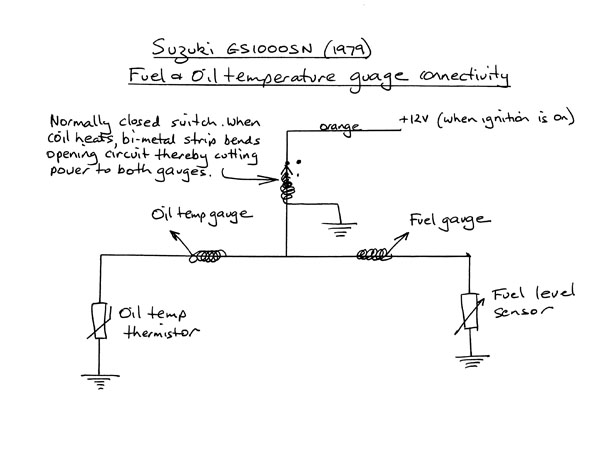
Can anyone explain the interesting way they are electrically connected to each other - it appears that they share a common power supply that has a bi-metal type switch that cuts the power to both gauges intermittently irrespective of the load drawn by the 2 gauges.

I have done a search for other posts and found nothing - it's bit tricky to know what to use as a search term.....

I think I've captured the essence of the connections in this diagram:
fuel-oiltempconnection.jpg
 
I've been working on the gauges from my '79 GS1000SN.

Can anyone explain the interesting way they are electrically connected to each other - it appears that they share a common power supply that has a bi-metal type switch that cuts the power to both gauges intermittently irrespective of the load drawn by the 2 gauges.

I have done a search for other posts and found nothing - it's bit tricky to know what to use as a search term.....

I think I've captured the essence of the connections in this diagram:
fuel-oiltempconnection.jpg

Are U sure what you are calling a Bimetallic spring not really some type of voltage regulator? I guess it could be a bimetallic spring, but it would need to choppy fast enough to not see the current pulses on the needles. What you would expect is that the common point has a regulated voltage relative to ground. That regulated voltage will be part of the calibration to make the two needles deflect the appropriate amount relative to the gauger face markings.

While I guess there are different implementations, A bimetalic spring like in a house thermostat opens and closes a contact based on the room temperature. Off hand can't think of any that runs current through them and is calibrated to open based on current flow. Also it just seems the guages would go off for too long when the spring is open. Have you measured the voltage at the common leg?

Have you looked in your manual? It normally explains operation of the guages.
 
Posplayr...You are correct...it's a voltage regulator...
Was used in Autos for MANY years.
Not sure if the ones for our bikes are still available but I've built some very simple electronic ones for antique cars when an original can no longer be found. Radio Shack carries a very simple Chip that can be adjusted to whatever voltage you need.(1-12V on our systems) they work great for gauges.
 
I have not measured the regulated voltage on our bikes, but others I have seen were typically 7 volts to ensure that the input voltage to the regulator was consistently higher than the output.

.
 
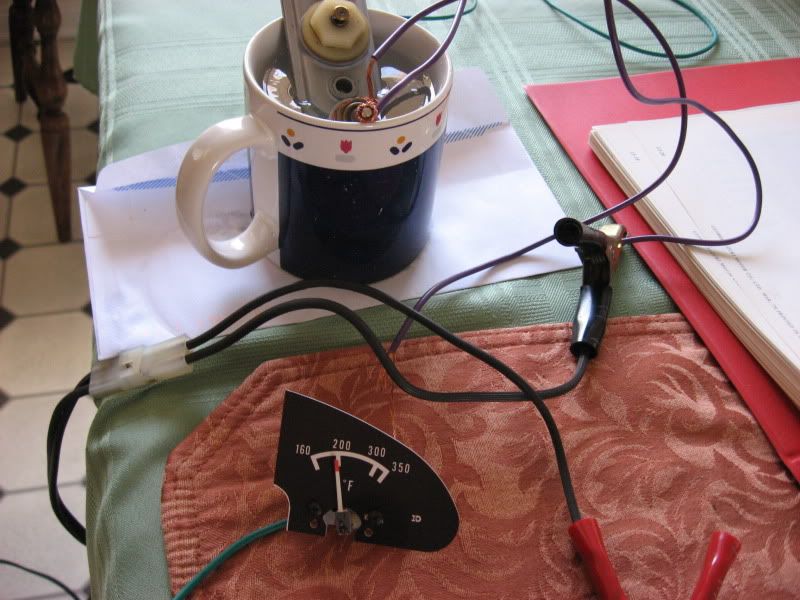
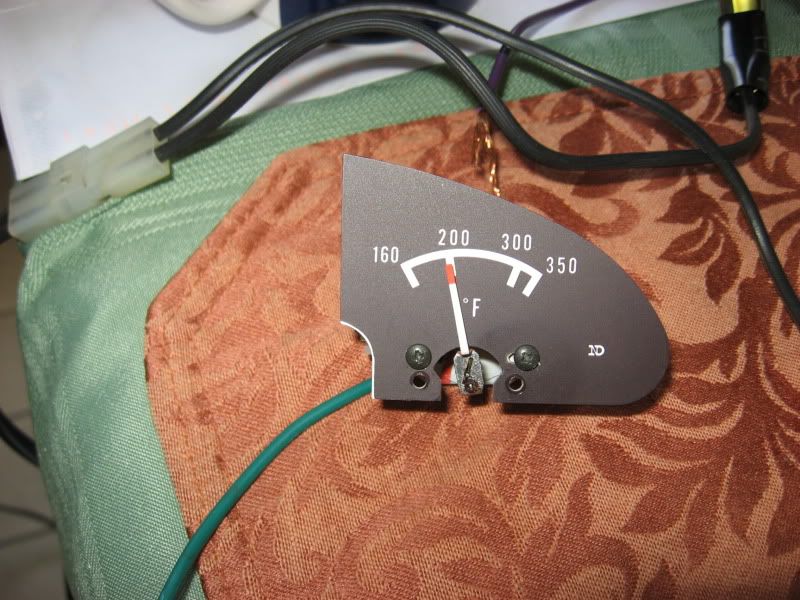
The fuel gauge has the VR but it feeds power into both the fuel gauge and the oil temp gauge. The bimetalic strip broke on both gauges on my 1000S, so I replaced them with modified fuel gauges from a different GS model. Interestingly, the base gauge is identical between the oil temp and the fuel gauge so apparently both sensors operate though the same resistance range. It took some fiddling around with the mounting and circuitry but both gauges function perfectly now.

First photo shows fuel gauge with broken bimetal spring.

IMG_1241.jpg


instruments.jpg


Tested the converted fuel gauge (oil temp gauge) using boiling water and it read perfectly without having to fool around with calibration.

V002.jpg


V003.jpg
 
Last edited:
Thanks everyone. As usual - answers to hard questions and alternative solutions are generously and quickly supplied.

I should have looked in my service manual, rather than rely on my Haynes!

I think the problem with my gauges is that the voltage regulator contact is burnt resulting in low readings for both gauges. I'll try cleaning the contact before thinking about alternative voltage regulation mechanisms.
 
From experience I can tell you one thing whether it applies to this or not. There is enough voltage going to the fuel level send that it will power a coil to run the bike! Ask me how I know lol
 
Posplayr...You are correct...it's a voltage regulator...
Was used in Autos for MANY years.
Not sure if the ones for our bikes are still available but I've built some very simple electronic ones for antique cars when an original can no longer be found. Radio Shack carries a very simple Chip that can be adjusted to whatever voltage you need.(1-12V on our systems) they work great for gauges.

Hcritz:
I downloaded the manual from BikeCliff's website (a GS1000S supplement). It is interesting (to me at least) that all three devices operate off thermal bi-metallic springs.

I was going to adapt a GSXR water cooler, temp gauge to a GSXR oil temp guage and these and the 16V GS 1100/GS750 gauges all operate off magnetic fields in a kind of whetstone bridge configuration.

So the reason the bi metallic spring regulator works (why it is not too slow in switching) is because the other gauges operate in the same time scale. These gauges are probably very smooth operating and essentially no bounce. In cold weather your fuel might guage might be a little sensitive, but compared to the thermal expansion of the gas and the sloshing factor who would ever know.


Ed:

Nice job getting that guage set back together. Now that I see the schematic and read the text I understand it better.
 
OK, Kid, how do you know? :D

.

When cole was trying to get that death trap
of a 750 running we couldn't figure out why it was only running on two cylinders. Keep in mind he was also trying to run it off those car coils remember? Well I finally convinced him to put real coils I had on it to eliminate the coils from the equation and come to find out he had the coils hooked up to the fuel tank wires. Doh! Heh
 
Good way to get one set up accurately.
Here is a link to the Radio Shack voltage reg...it's $2.29 and you need a trimmer... about a $1.50... to make it adjustable...works great for these kinds of applications.
http://www.radioshack.com/product/index.jsp?productId=2062601


Looks like you need a couple decoupling caps, a resistor and a pot. You put these on a little peice of vector board and then just replace the regulator or put a separate regulator on each gauge?

http://www.datasheetcatalog.org/datasheet2/1/03cgthpfat4t4ly5kfp5lpwladfy.pdf
 
Hey Posplayr:
Yep...it's a simple little circuit...you can dial in whatever voltage you need and tweak it to get your gauges spot on.
I can't remember...but I think that it will put out over an amp...so one should be fine for both guages...Unless you want to tweak each one seperately for acuracy.
The old bi-metalic guages worked fine for MANY years...they function slowly so the fuel sloshing and such didn't cause them to jump around like the magnetic ones would. I suspect temperature did cause some changes in accuracy though.
 
Back
Top