
I've been concerned about making sure the frames on my bikes are straight or not?
After trying the string method and finding it not only difficult to perform but unsatisfactory, I decided to try something different
The basic idea is to create a reference plane that's (almost) parallel to the plane that cuts the bike into two lengthwise and then take measurements from this plane.
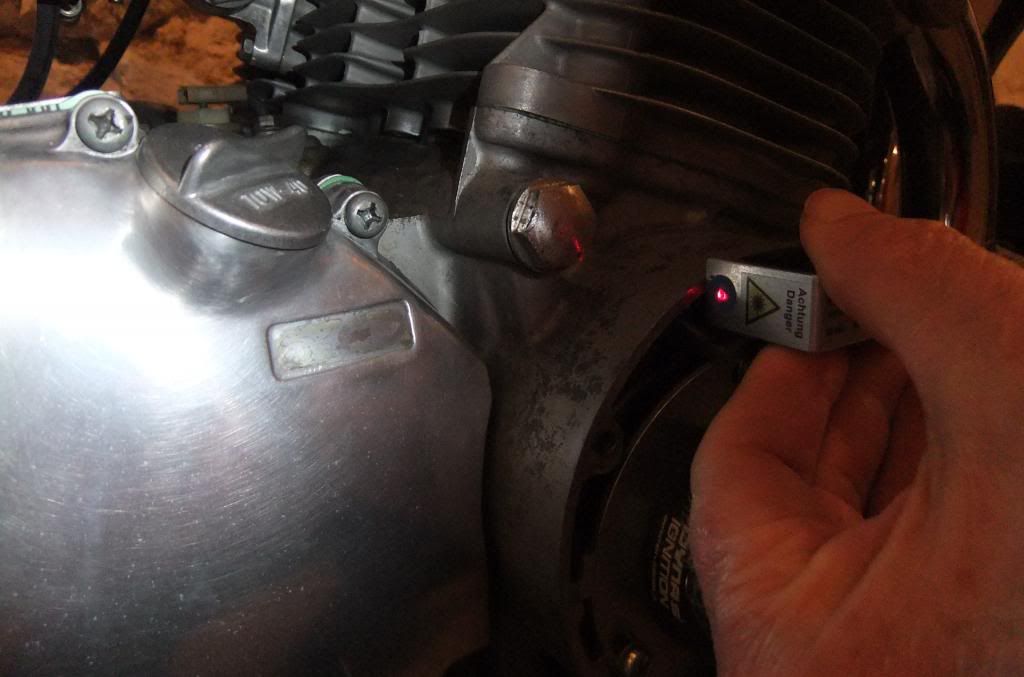
This reference plane is simply the plane of the laser beam that's positionned on the RH side of the engine case after removing the contact breaker cover.
I'm using the GS 1000/1100 bikes as an example here but it must be possible on other bikes.
The laser beam I'm using is the Profi CAT laser chain alignment tool.
The process is the following:
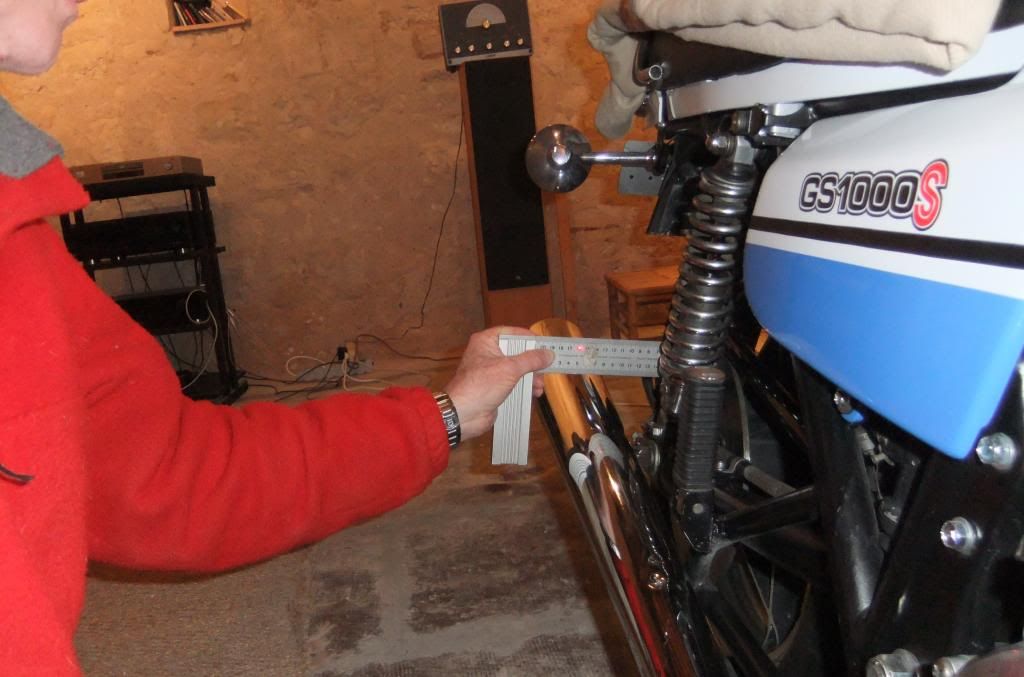
1) you shine the laser beam to the rear of the bike and measure the distance between the beam and the rear disk surface.
2) you measure the distance between the outside surface of the disk and the wheel center to compute the distance between the laser beam ( i.e. the reference plane) and the rear wheel center.
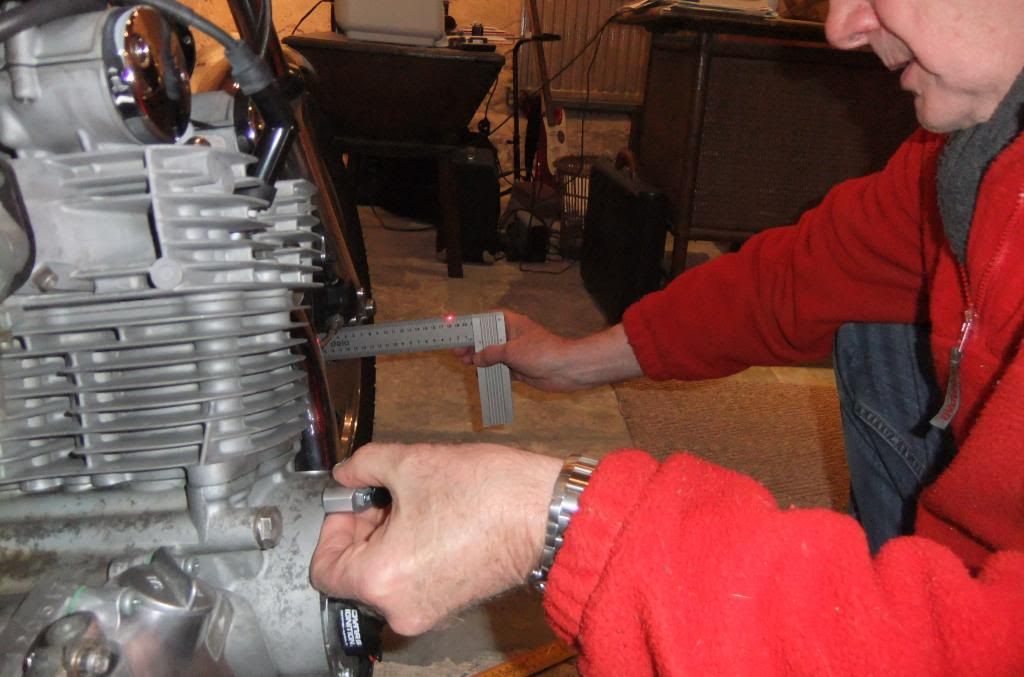
3) you shine the laser beam to the front of the bike and you measure the distance between the front disk and the beam.
To get an accurate measurement you must measure the distances at two points on the disk: one ahead of the fork stanchions and the other behind the fork stanchions.
You try to equalize the two readings by turning the bike's handlebar left or right.
4) you measure the distance between the outside of the disk and the wheel center to compute the total distance between the reference plane ( the laser beam) and the front wheel center.
You are almost there except that it's not garanteed that the measurement plane is parallel to the bike's longitudinal plane of reference.
To lift that uncertainty you need to measure the distance of the reference plane to the center of the engine.
We now have three points of which we know the coordinates:
Rear wheel center, Engine center and Front wheel center
By computing the line that goes from the rear wheel center through the engine center, we can determine if it crosses the front wheel center.
In the case of my GS 1000 skunk I came up with the following:
Rear wheel center taken as the origin of the X and Y axis
Engine center: Y1=a*X1
with Y1= 5 mm and X1 = 860 mm ( the distance between the rear wheel spindle and the engine crankshaft)
The gives a=0.0058 rad or .33? of angle between the bike's center plane and the reference plane.
By projecting this line out to the front wheel the distance ought to be :
Y2=0.0058*(860+660)= 8.23 mm
660 beeing the distance from the crankshaft to the front wheel spindle.
On my bike I measured 8 mm.
In other words my frame is perfectly straight
Here are a few pictures:
After trying the string method and finding it not only difficult to perform but unsatisfactory, I decided to try something different
The basic idea is to create a reference plane that's (almost) parallel to the plane that cuts the bike into two lengthwise and then take measurements from this plane.
This reference plane is simply the plane of the laser beam that's positionned on the RH side of the engine case after removing the contact breaker cover.
I'm using the GS 1000/1100 bikes as an example here but it must be possible on other bikes.
The laser beam I'm using is the Profi CAT laser chain alignment tool.
The process is the following:
1) you shine the laser beam to the rear of the bike and measure the distance between the beam and the rear disk surface.
2) you measure the distance between the outside surface of the disk and the wheel center to compute the distance between the laser beam ( i.e. the reference plane) and the rear wheel center.
3) you shine the laser beam to the front of the bike and you measure the distance between the front disk and the beam.
To get an accurate measurement you must measure the distances at two points on the disk: one ahead of the fork stanchions and the other behind the fork stanchions.
You try to equalize the two readings by turning the bike's handlebar left or right.
4) you measure the distance between the outside of the disk and the wheel center to compute the total distance between the reference plane ( the laser beam) and the front wheel center.
You are almost there except that it's not garanteed that the measurement plane is parallel to the bike's longitudinal plane of reference.
To lift that uncertainty you need to measure the distance of the reference plane to the center of the engine.
We now have three points of which we know the coordinates:
Rear wheel center, Engine center and Front wheel center
By computing the line that goes from the rear wheel center through the engine center, we can determine if it crosses the front wheel center.
In the case of my GS 1000 skunk I came up with the following:
Rear wheel center taken as the origin of the X and Y axis
Engine center: Y1=a*X1
with Y1= 5 mm and X1 = 860 mm ( the distance between the rear wheel spindle and the engine crankshaft)
The gives a=0.0058 rad or .33? of angle between the bike's center plane and the reference plane.
By projecting this line out to the front wheel the distance ought to be :
Y2=0.0058*(860+660)= 8.23 mm
660 beeing the distance from the crankshaft to the front wheel spindle.
On my bike I measured 8 mm.
In other words my frame is perfectly straight
Here are a few pictures:

