• Required reading for all forum users!!!

    Welcome!
    Register to access the full functionality of the GSResources forum. Until you register and activate your account you will not have full forum access, nor will you be able to post or reply to messages.

    A note to new registrants...
    All new forum registrations must be activated via email before you have full access to the forum.

    A Special Note about Email accounts!
    DO NOT SIGN UP USING hotmail, outlook, gmx, sbcglobal, att, bellsouth or email.com. They delete our forum signup emails.

    A note to old forum members...
    I receive numerous requests from people who can no longer log in because their accounts were deleted. As mentioned in the forum FAQ, user accounts are deleted if you haven't logged in for the past 6 months. If you can't log in, then create a new forum account. If you don't get an error message, then check your email account for an activation message. If you get a message stating that the email address is already in use, then your account still exists so follow the instructions in the forum FAQ for resetting your password.

    Have you forgotten your password or have a new email address? Then read the forum FAQ for details on how to reset it.

    Any email requests for "can't log in anymore" problems or "lost my password" problems will be deleted. Read the forum FAQ and follow the instructions there - that's what we have one for...

  • Returning Visitors

    If you are a returning visitor who never received your confirmation email, then odds are your email provider is blockinig emails from our server. The only thing that can be done to get around this is you will have to try creating another forum account using an email address from another domain.

    If you are a returning visitor to the forum and can't log in using your old forum name and password but used to be able to then chances are your account is deleted. Purges of the databases are done regularly. You will have to create a new forum account and you should be all set.

valve adjustment- Camshaft Lobe placement

  • Thread starter Thread starter TyeGuy
  • Start date Start date
T

TyeGuy

Guest
Alright guys, I need to take a poll, because I've seen/read 3 different answers on the internet. I am trying to check my valve clearances and I have contradicting information. I have torqued down my cylinder head nuts and bolts, and now ready to check valve clearances. However, my manual says one thing, another detailed (with photos) instructions from the internet says another, and a youtube video says another.

Question is; what direction is the camshaft lobe supposed to face when checking valve clearance? My manual shows straight up, a detailed instruction from the internet says I should point the cam lobe forward and parallel with the top of the head. And a youtube video says to have the lobe perpendicular to the shim.

Which one is correct? Do both intake and exhaust lobes face the same or are they different?

I've attached a photo for easy reference.
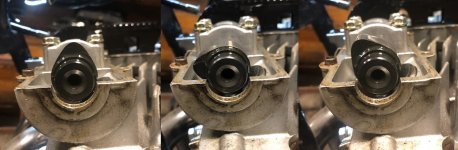
IMG_1067 copy.jpg
 
You should follow the instructions in the factory Suzuki service manual. Period. Basscliff has a download of the manual for free if you don't already have it.

Key element to the way the factory positions the cams is that you put two adjacent valves on the base circle at the same time, thus you check the valves in pairs at the same time. This is the best method because if you follow the Clymers method and just point the cam lobe away from the valve the adjacent valve will be depressed and skewing the cam in the journal clearance, thus leading to incorrect readings. If you use the cam pointing away method you should increase the effective lash range up by about .03-.04mm because of this.
 
Alright guys, I need to take a poll, because I've seen/read 3 different answers on the internet. I am trying to check my valve clearances and I have contradicting information. I have torqued down my cylinder head nuts and bolts, and now ready to check valve clearances. However, my manual says one thing, another detailed (with photos) instructions from the internet says another, and a youtube video says another.

Question is; what direction is the camshaft lobe supposed to face when checking valve clearance? My manual shows straight up, a detailed instruction from the internet says I should point the cam lobe forward and parallel with the top of the head. And a youtube video says to have the lobe perpendicular to the shim.

Which one is correct? Do both intake and exhaust lobes face the same or are they different?

I've attached a photo for easy reference.
View attachment 54746
If you set the #1 cylinder to TDC and point the cam lobes outward from each other and point to the gasket surface. You can check both ex and intake valves on 1, intake on 2 and exhaust on 3 or is it exhaust on 2, intake on 3. Either way, once you check them, rotate the engine 180 so #4 cylinders at TDC and the cam lobes point outward to the gasket surface and check the other remaining four valves.
 
You should follow the instructions in the factory Suzuki service manual. Period. Basscliff has a download of the manual for free if you don't already have it.

Key element to the way the factory positions the cams is that you put two adjacent valves on the base circle at the same time, thus you check the valves in pairs at the same time. This is the best method because if you follow the Clymers method and just point the cam lobe away from the valve the adjacent valve will be depressed and skewing the cam in the journal clearance, thus leading to incorrect readings. If you use the cam pointing away method you should increase the effective lash range up by about .03-.04mm because of this.

I don't agree with this. Any lobe as long as it's still on the base circle will work. There is just over 180 degree of base circle on symmetrical cam lobes.
th
 
If you set the #1 cylinder to TDC and point the cam lobes outward from each other and point to the gasket surface. You can check both ex and intake valves on 1, intake on 2 and exhaust on 3 or is it exhaust on 2, intake on 3. Either way, once you check them, rotate the engine 180 so #4 cylinders at TDC and the cam lobes point outward to the gasket surface and check the other remaining four valves.
That is (mostly) the way to check the 16-valve engines, not the 8-valve engines. :-k

Nessism has it right, FOLLOW THE SUZUKI MANUAL.

Here is a quote from a post I made a couple of weeks ago:
(the page references will be different, they are for a 650G)

You don't get to choose one of two positions to check the clearance.

On the other hand, when you follow the factory manual, you will see that you choose the correct position and check two valves.

I am going to assume that you have the factory manual downloaded from BassCliff's site, since you mentioned it. Look on manual page 2-5, which is PDF page 24. The first thing to do is to IGNORE that goofy drawing at the top of the right column. Start with instruction #1 just below that, then continue through instruction #4 on page 2-6.

An easy way to remember how to position the cam lobes is to realize that in those positions, neither lobe on that side of the cam is pushing on a valve. If either one is pushing on a valve, it will push the cam away from it, into the bearing cap. The clearance for the oil film is only about a thousandth of an inch, but one thousandth of an inch is half of the allowable range on the valve clearance. You can easily add that amount to your clearance reading, which will give you a false reading and false sense of security.

The clearance check procedure is so easy to do, I don't know why the instructions are so hard.
1. Set EX1 cam lobe FORWARD, check EX1 and EX2.
2. Rotate the crank 1/2 turn, check IN1 and IN2.
3. Rotate the crank 1/2 turn, check EX3 and EX4.
4. Rotate the crank 1/2 turn, check IN3 and IN4.

After you have them all measured, they you can go through the process of removing shims ONE AT AT TIME to inventory them and enter the sizes in the spreadsheet. Then you can see if you have some that can be moved around to minimize how many you need to acquire from the GSR Shim Club.

By the way, the Suzuki manual is the only one that specifically says to position the cams, then measure BOTH valves on that side. The others (Clymer and Haynes) only show that goofy drawing and say "position the cams like this ...".

.
 
I don't agree with this. Any lobe as long as it's still on the base circle will work. There is just over 180 degree of base circle on symmetrical cam lobes.
th


This "180 degree base circle" is that why the accepted clearance is between 0.03-0.08? I feel the heel of the lobe is pretty subjective. Am I correct in thinking this?
 
This "180 degree base circle" is that why the accepted clearance is between 0.03-0.08? I feel the heel of the lobe is pretty subjective. Am I correct in thinking this?
The accepted clearance as you posted gives you a range that is an acceptable clearance. The base circle is constant until the lift ramp. Most shoot for a loose clearance, which would be .08. That give the valve more time until it needs to be adjusted again. .03 is in range but it will constantly get tighter so it will need adjustment sooner. Shims come in .05 increments unless you have used shims. The shims should always be checked with a micrometer to get the accurate thickness.
Example would be if you have a cam that is at .03, which is in spec, but if you have a shim that will put it at .08, that would be a better clearance than leaving it at .03. If it measures at .05 or greater, leave it alone. Anything less and I try to move shims around that will give me the best I can get. It wont hurt if it's .09 or .10. A little loose just out of spec is ok.
 
That is (mostly) the way to check the 16-valve engines, not the 8-valve engines. :-k

Nessism has it right, FOLLOW THE SUZUKI MANUAL.

Here is a quote from a post I made a couple of weeks ago:
(the page references will be different, they are for a 650G)

That's not what I was taught, but I'll let it lie until I check one of my 8V engines and see if I get different readings from the two methods.
 
Key element to the way the factory positions the cams is that you put two adjacent valves on the base circle at the same time, thus you check the valves in pairs at the same time.


So adjacent values would be exhaust #1 and #2, or exhaust #1 and intake #1? (sorry its late, been a long day and my brain is fried:apologetic:)
 
So adjacent values would be exhaust #1 and #2, or exhaust #1 and intake #1? (sorry its late, been a long day and my brain is fried:apologetic:)

Point 1E forward at the gasket surface, then measure 1E and 2E.
Point 4E forward at the gasket surface, then measure 3E and 4E.

Point 1I at 90* to the valve, then measure 1I and 2I.
Point 4I at 90* to the valve, and measure 3I and 4I.

Again, key element is to have two adjacent valves on the base circle at the same time.

Good luck.
 
That's not what I was taught, but I'll let it lie until I check one of my 8V engines and see if I get different readings from the two methods.
I was never "taught", I had to read the manual(s). It took a while to realize why the position was so specific, but it's easy to understand now.

Also, you mentioned bringing the piston to TDC and pointing the cam lobes outward from each other. Which lobes?

In the 8-valve manuals, there is no mention of TDC. I have never checked for TDC. I have never checked to see where the piston was, as it was not a requirement for the procedure. What is really important is that two adjacent valves are BOTH on their base circles, then measure the clearance on BOTH valves. It's easy to visualize, because the valve is pointing down at roughly a 45? angle, so one cam lobe (EX1, for example) will be pointing forward, while EX2 will be pointing up, both of them about 45? away from pointing away from their respective valves.

On the 16-valve engines, the manual does say to rotate the crank to the timing mark and note the NOTCHES in the end of the cams. When the NOTCHES are away from each other, check the clearance on certain valves. Roate the crank 360? (not 180) so the NOTCHES are pointing toward each other, then check the rest of the valves. This procedure works for the 16-valve engines ONLY.

.
 
Point 1E forward at the gasket surface, then measure 1E and 2E.
Point 4E forward at the gasket surface, then measure 3E and 4E.

Point 1I at 90* to the valve, then measure 1I and 2I.
Point 4I at 90* to the valve, and measure 3I and 4I.

Again, key element is to have two adjacent valves on the base circle at the same time.

Good luck.

Thanks Nessism. I really appreciate you clarifying, it?s very helpful. Not to be a D#%!, but that doesn?t follow the instructions in the Clymer manual like you said in your first comment.
 
Thanks Nessism. I really appreciate you clarifying, it’s very helpful. Not to be a D#%!, but that doesn’t follow the instructions in the Clymer manual like you said in your first comment.

I said to use the factory Suzuki method, not Clymer's.
 
Back
Top