• Required reading for all forum users!!!

    Welcome!
    Register to access the full functionality of the GSResources forum. Until you register and activate your account you will not have full forum access, nor will you be able to post or reply to messages.

    A note to new registrants...
    All new forum registrations must be activated via email before you have full access to the forum.

    A Special Note about Email accounts!
    DO NOT SIGN UP USING hotmail, outlook, gmx, sbcglobal, att, bellsouth or email.com. They delete our forum signup emails.

    A note to old forum members...
    I receive numerous requests from people who can no longer log in because their accounts were deleted. As mentioned in the forum FAQ, user accounts are deleted if you haven't logged in for the past 6 months. If you can't log in, then create a new forum account. If you don't get an error message, then check your email account for an activation message. If you get a message stating that the email address is already in use, then your account still exists so follow the instructions in the forum FAQ for resetting your password.

    Have you forgotten your password or have a new email address? Then read the forum FAQ for details on how to reset it.

    Any email requests for "can't log in anymore" problems or "lost my password" problems will be deleted. Read the forum FAQ and follow the instructions there - that's what we have one for...

  • Returning Visitors

    If you are a returning visitor who never received your confirmation email, then odds are your email provider is blockinig emails from our server. The only thing that can be done to get around this is you will have to try creating another forum account using an email address from another domain.

    If you are a returning visitor to the forum and can't log in using your old forum name and password but used to be able to then chances are your account is deleted. Purges of the databases are done regularly. You will have to create a new forum account and you should be all set.

Peer Review - New Carb Rebuild Tutorial

so for gs1100ez bs34ss carbs ss bolts you need are 32 of m5 x 16, 8 of m5 x 12, and 8 of m6 x 16
 
so for gs1100ez bs34ss carbs ss bolts you need are 32 of m5 x 16, 8 of m5 x 12, and 8 of m6 x 16
2010_11060025.jpg

If you have this style choke cable attachment you need 30 5mx16 and 25mx20.Ask me how I know.
 
Excellent work, nothing less than I would expect from you, truly spectacular.

A couple minor notes;

1. The old tutorial showed the use of a special tool, a pick made from a wooden stick and a piece of wire used to probe the small holes in carb body as well as the needle jet emulsion tubes and pilot jets. I still find this invaluable when cleaning carbs to ensure that these passages are spotless.

2. A little discussion of the fuel valve operation, at least checking the spring rebound of the plunger and the seat for wear may be warranted. I know these are small details, but most users are only going to use one guide for reference so they may not check this out.

3. It may be important to note which jets are fully seated and which are adjustable. One would hope they paid attention to this detail when disassembling carbs but sometimes carbs were a previous owners problem.

Thanks for updating this. I predict it will downloaded worldwide.
 
Hi Mr. Nessism, et al,

There is now a copy of the latest revision posted up on my little website. It's been compressed a little more and is only about 9MB in size.

Great work Ed! Thanks for sharing your expertise. You are one of the true gurus in this community. Your King-Fu is much better than mine.
bowdown.gif


Thank you for your indulgence,

BassCliff
 
The tutorial is great! Among other things, it's amazing how much clearer the photos are with today's technology.

I am currently re-building my carbs. ('80 GS750E) My newest tool on the workbench is my laptop, with both the old and new tutorials open. So I'm having the chance to put this to good use as you have been perfecting it. (Service manual also close at hand.)

I needed to refer to the Bloemer to be sure I had the pilot (air mixture) screw parts in the correct order. IE: screw, spring, metal washer then gasket. Might be good to add that to the new tutorial.

Question, Does the rubber gasket just hold the spring on, or does it serve another purpose?

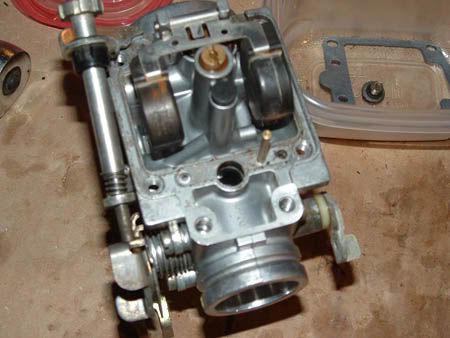
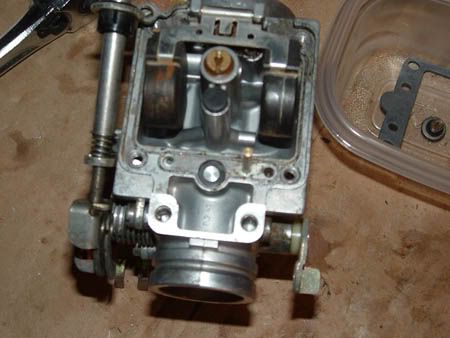
Second unanswered puzzle, don't want to hijack, maybe I should have started a new thread. During the soaking process, on 2 of my carbs, a aluminum plug fell out from the body next to the choke rod (see picture). Do I just put it back in the hole or do I need to seal it some how? Also there was (and I replaced) a rubber washer/spacer that sits on the plug. Does that need to be replaced? I don't see any reference to it anywhere. Maybe this is unique to my year/model.
carb_with_whole.jpg

carb_with_plug.jpg
 
Last edited:
Updating to add...

- order of assembly of pilot screw (the rubber O-ring provides the seal)

- screw information

- instructions on how to inspect float needle/seat

Regarding those plugs that fell out, yes they are necessary. Clean them really well and reinstall with JB Weld or similar.
 
Having just rebuilt my first set of carbs (still off the bike so who knows how it will turn out) I found this new tutorial very helpful. Reading through it I was clear on everything I had done.

Nice work, it will help a lot of newbies!
 
My comments:
Page 2: BS 30 SS (30MM) carbs are used by GS 250 & 400 twin bikes.

Page 4: Maybe take a macro shot of the JIS screwdriver/screw inset on the page showing how close the fit should be.

Page 40: Maybe mention that the cross drilled holes need to be free and clear of crud as they are important for aeration of fuel.

Also perhaps consider looking into showing where each pathway goes. When fuel goes in the pilot jet, it comes out at the pilot needle taper. Same goes for the pilot air and the main emulsion air jet as they are pretty important too.

Other than that, I can't think of anything. It looks pretty thorough to me.
 
My comments:
Page 2: BS 30 SS (30MM) carbs are used by GS 250 & 400 twin bikes.

Page 4: Maybe take a macro shot of the JIS screwdriver/screw inset on the page showing how close the fit should be.

Page 40: Maybe mention that the cross drilled holes need to be free and clear of crud as they are important for aeration of fuel.

Also perhaps consider looking into showing where each pathway goes. When fuel goes in the pilot jet, it comes out at the pilot needle taper. Same goes for the pilot air and the main emulsion air jet as they are pretty important too.

Other than that, I can't think of anything. It looks pretty thorough to me.

Mike,

Are the 30mm version the same internally? Do they take the same O-rings and such. If so, it would be easy to add them to the title page.

A photo of a phillips tip into a screw is not very descriptive. Frankly, a regular #2/#3 phillips is perfectly acceptable as well so a photo of that would look the same.

Regarding all the various passages...guess that could be added but where do I stop?
 
Regarding all the various passages...guess that could be added but where do I stop?

Agreed. Besides, I understand there are some passages you cannot see yet must be very clean to operate correctly, right? How would a person take a picture of those?

Ed,
I'd suggest that maybe you put a deadline for accepting modifications right now and get it posted. Then, as things are found after some testing, make the changes then?
 
As to the carbs, i'm not entirely sure about what the part #'s are and what ones are uniform and what are not, but a link to a parts schematic/list is here). It might be best for you to give it a quick check as you've gone over your document a hundred times already and are more likely to be able to get it right than i am.

Poor fit vs accurate fit, i guess i was thinking along the lines of schematic diagrams where the different angles are noticeable, etc.

As to the extra information, your a bit right about that. I was just thinking along the lines of "well my bike sucks doing x-y-z, what part do i need to re-clean to sort it?" if you get my drift. If you want to not bother with that extra bit of docco, then perhaps skip it. A suggestion I've got is to add a brief mention of having a length of 2-4lb fishing line in your bag of tricks as it is certainly softer than brass/aluminium and flexible enough to help clean pretty far into the carb passages.
 
Ed,
Just bumping the thread up to the top as I noticed you had updated the PDF.

Could you do a bump post after every update, then we will automatically see it, otherwise no one will know.
Thanks!
 
Have a new version with (most of) the suggested improvements. Compressed it a little too.

Will post the new link as soon as the new file is uploaded.

EDIT: deleted the old file and uploaded the new one... (see above)

Please keep the suggestions coming.


I have a a copy of Adobe that can probably do a global version of compacting the images with minimal loss of quality.

I will process the file and make it available for you if you wish.

Slide 6 Vise-Grips not Vice grips. I think the latter may be handcuffs.


Slide 21 photo is out of focus. It really sticks out from the rest.

Slide 49 makes a belated reference to the paint being removed by the dip. I know people should read the presentation fully but this should be clearly introduced in slide 48 as the mess and associated exhaustion of chemistry can be avoided.


Slide 52 Snugly not Snuggly.

Slide 59 A link to other sources for the tools should be given for those who cannot fabricate their own.

Slide 72 A side by side picture would be a better way of making a comparison. it prevents flipping from page to page and makes and instant impression.

All in all 17 meg is not huge and if this is refered to a friend on dial-up they could be assured of its quality and bite the bullet on the download.

I think you could go one step beyond and link to video snippets that show each skilled task being performed. The use of a Dremel tool and the safe removal of the float pins are a potential source for heartache.

It is a very nice piece of work. The ultimate test of its usefullness would be to observe and record the use of the document by a total newbie.
If they can perform the necessary tasks from beginning to end then the work is perfect.
 
Last edited:
Hi,

There is a 9 MB version of the file on my little website. It should be the latest version available. I'll update it if Ed makes any more changes.


Thank you for your indulgence,

BassCliff
 
Thank you Ed, this is going to be extremely helpful tonight!

Dave
 
Excellent work, nothing less than I would expect from you, truly spectacular.

A couple minor notes;

1. The old tutorial showed the use of a special tool, a pick made from a wooden stick and a piece of wire used to probe the small holes in carb body as well as the needle jet emulsion tubes and pilot jets. I still find this invaluable when cleaning carbs to ensure that these passages are spotless.

2. A little discussion of the fuel valve operation, at least checking the spring rebound of the plunger and the seat for wear may be warranted. I know these are small details, but most users are only going to use one guide for reference so they may not check this out.

3. It may be important to note which jets are fully seated and which are adjustable. One would hope they paid attention to this detail when disassembling carbs but sometimes carbs were a previous owners problem.

Thanks for updating this. I predict it will downloaded worldwide.
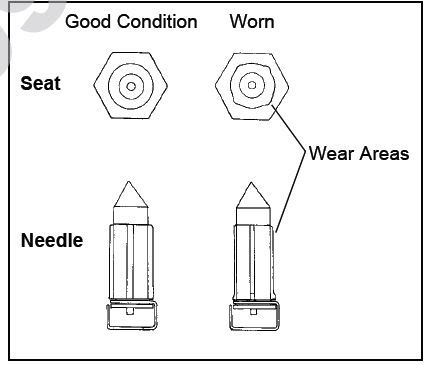
Good point.

The wire used in the old tutorial is the most important tool for cleaning jets.
Just because someone can see light thru a jet doesn?t make it clean.
A jet rolled for a minute with the wire thru it will clean most residue from the inside of the jet and restore it to the original size.

All passages should be blown clear with compressed air to remove any remaining carb cleaner.

If any float needle dosen't stop fuel flow 100% after cleaning then it should be replaced.
Don't forget float needle wear.
floatneedle.jpg
 
Back
Top