-
 Guest repliedI have a Fluke 333. It might be good enough for relative measurements.
 -
Guest repliedYou are correct, I missed it. That would be what you want.Leave a comment:
-
Maybe you missed this bit on that page... Or maybe I'm reading it completely wrong!
 (I'm a know enough to be dangerous sort of electrical guy & I think I am reading volts & you were perhaps concerned about the current).
AC Volts (50hz - 500hz) Ranges: 4V, 40V, 400V, 600V

There are plenty of Fluke models that will do 400hz at their limit on current (such as the 321) as well as amprobe, klein etc.
Fluke specs:
Range: 0 - 400 A
Resolution: 0.1 A
Range: 0 - 40 A (Fluke 322 only)
Resolution: 0.01 A
Accuracy: 1.8% ± 5 counts (50 - 60 Hz)
Accuracy: 3.0% ± 5 counts (60 - 400 Hz)
AC Response: Averaging

If you can measure using one of those at 400hz (at less than 5k rpm) then perhaps I'll get one if EBay can turn one up cheap enough...
Last edited by salty_monk; 10-15-2012, 08:28 PM.Leave a comment:
-
Guest repliedNo, that one does 50Hz (Europe) and 60Hz (USA).
Your best bet would be to find one that works on military aircraft (600 Hz).
This one would probably work: 400 Hz clamp meter
Just don't rev the engine quite as high.Leave a comment:
-
So we need to find a budget version of this Fluke.... (Actually this is not expensive either at $105.)
Leave a comment:
-
Dan,Originally posted by salty_monk View Post
When you compare a Shunt to a SERIES R/R you should see much less current in each leg of the stator with the SERIES. I plotted the comparison I observed between the FET and CF a while back.
So all you need is for something to measure average AC current. Most cheap AC current clamps are designed for 60 hz only. At 5000 RPM you will be looking at 500 hz for an 18 pole stator. So the question is whether an AC clamp has any effectiveness at this frequency and even if not accurate can it compare the SERIES to SHUNT R/R on a relative basis at least.
A bunch of ifs
JimLeave a comment:
-
I'd really like to see what on a scope... Posplayr also suggested to me that a decent clamp meter might be able to show the necessary info, you wouldn't get the nice graph obviously but you could physically witness it.
You are basically looking for when it goes open circuit.
Dan
Leave a comment:
-
Well, this is all great news! I'm glad I've gotten a hold of one of these fine scores, and didn't have to spend $200 on a new Compufire or CE602 unit to get this technology!Leave a comment:
-
I just picked one up new for $35. I have a FH009 installed that I'm pretty impressed with as far as super-stable regulation is concerned; it looks like this will plug in as a direct replacement, and I can compare the two.
What I can't compare, unfortunately, is current draw from any of the stator legs to watch the serial regulation in action. I'm guessing that'd take a scope.
So, one will be the operational unit and the other will be a spare. Odds are I won't need a spare, but...Leave a comment:
-
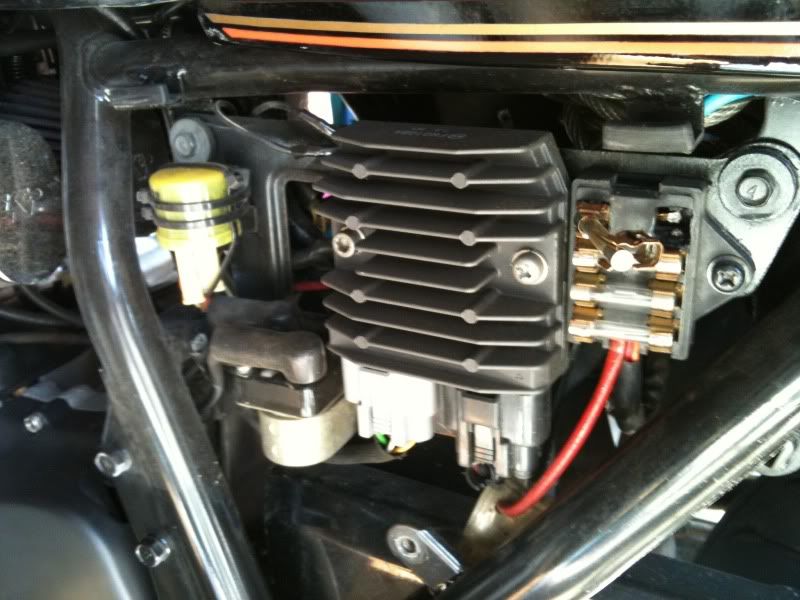
I tested both of the sh775s I have. One is on my 78 1000 and the other on my 83 1100.
Wiring is the same as pictured above. DIY style.
Both work great with constant and even voltage readings at each rpm setting indicated in the quick check/stater papers test.
I'm quite happy with this unit and would recommend it.
NicLeave a comment:
-
Guest repliedGot mine two days ago, so the delivery was a bit long, but perhaps understandable as it came from Texas. Unfortunately, the weather has turned to crap lately, so I might not be digging too far into this project before the snow falls. I have no garage to work in, and a honey-do list that seems predicated on fine weather, but if the weather turns nice for a bit, I might just ride it up the road to work and swap it out there. It would be nice, as I have access to a Fluke FLIR IR camera.


No indications of polarity for the output terminals at all, so I guess I'll try the wiring from the picture above when the time comes. I notice that the last numbers on the bottom seem to indicate a later modeal than the first pic in this thread, so maybe there are some subtle upgrades inside.
My apologies to Chuck78. I missed your PM, as I miss almost all of them. I rarely log in if I'm just browsing the thread.Leave a comment:
-
Well my current regulator is barely charging at 12.2V no matter what rpm's, and stator seemed to check out fine. I got a used SH775 last week and plan to put it on later today! I can't tell you much about engine temps, but I am really glad to have scored a series R/R for a very affordable price (about $45 used for a 1 year old piece from a wrecked Polaris 800)Originally posted by salty_monk View Post
Anyhow, I am going to install it as the photo above shows, 3 stator phases going into the connector with 3 terminals, and for the other connector, the red 14V output on the left, and the ground on the right. I sure hope they are consistent with their wiring!Last edited by Chuck78; 10-14-2012, 05:35 PM.Leave a comment:
-
Guest repliedPolaris RR
Hi Everyone,
I have been looking at the RR posts, my 1150EF only charges at 13v with the headlight on, but 14v without it; I have been saving for a compufire so the Polaris RR at $65 is tempting...
BUT there is evidently a problem with their units on 2010 sleds, replaced under warranty, but... different pt #, 4012476, so maybe quite different, found a thread at snowandmud.com when I did a search..
Should I be concerned now that its 2012??
Still pondering
Trevor T.,
1984 1150EF in Durham OntarioLeave a comment:
-
If it's the same as the FHO12 etc shunt ones then it should look like this...Originally posted by Chuck78 View Post

If there is a connector in the middle on the right then just ignore it. It's for an ECU hook-up I believe & not necessary on our bikes. (I have fitted 2 in this way, ignoring the middle leg & both worked fine).
Last edited by salty_monk; 10-02-2012, 01:01 PM.Leave a comment:
-
Well I was going to wait and see how Roger did with his, but after troubleshooting mine today to determine that my r/r was definitely the source of my low voltage problems, I jumped the gun when I found a used SH775 on ebay from a motorsports salvage vendor...
When installing this, I assume that the connector with three male spade terminals will be the stator connections, and the other two will be the battery positive and the negative ground. To determine which is which if they aren't labeled, would I just be safe to assume that the negative would have continuity to ground? If so, should be a no brainer to swap!
Also, the wire on my wife's 77 GS550 that goes from the stator to the headlight switch and then back to the regulator/rectifier, can both of those wires to the switch just be abandoned?Leave a comment:
.png "Powered by vBulletin")
Required reading for all forum users!!!
Welcome!
Register to access the full functionality of the GSResources forum. Until you register and activate your account you will not have full forum access, nor will you be able to post or reply to messages.A note to new registrants...
All new forum registrations must be activated via email before you have full access to the forum.A Special Note about Email accounts!
DO NOT USE sbcglobal.net, att.net, bellsouth.net or email.com email addresses when registering for the forum! Email that our system sends out to these email servers is treated as SPAM and you will never receive your activation email, or any other email that our system may send out. Use an email address from gmail.com or some other email server.A note to old forum members...
I receive numerous requests from people who can no longer log in because their accounts were deleted. As mentioned in the forum FAQ, user accounts are deleted if you haven't logged in for the past 6 months. If you can't log in, then create a new forum account. If you don't get an error message, then check your email account for an activation message. If you get a message stating that the email address is already in use, then your account still exists so follow the instructions in the forum FAQ for resetting your password.Have you forgotten your password or have a new email address? Then read the forum FAQ for details on how to reset it.
Any email requests for "can't log in anymore" problems or "lost my password" problems will be deleted. Read the forum FAQ and follow the instructions there - that's what we have one for...
New users should be sure to read the FAQ as well as the posts in the Announcements forum. This will answer many of the questions you may have about how this forum works.
Before posting questions in the forums be sure to use the forum search function!!! Odds are your question has already been asked and answered before. And when posting, please make sure that you post to the correct forum.
Finally, be sure to check out BassCliff's website here. He has useful information that can't be found on this site. His welcome page containing useful GS information can be found here. Be sure to check it out!
If you are a returning visitor to the forum and can't log in using your old forum name and password, chances are your account is deleted. Just create a new forum account and you should be all set.

Leave a comment: