The were light tan for other reasons, the pipe was not among the reasons.
Get the pipe on, warm it up, and do a few runs in 3rd or 4th at high RPM and then cut the engine. Do not idle it down. Coast to a stop and pull the plugs.
Do this in a safe location where you can safely coast to a stop and work without being hit. I tested mine on a really tall hill and I cut power at the top. I coasted to a stop on a driveway at the top off the main road. 3rd gear up hill requires the mains full on with max airflow at high RPM. It's a little safer than 120 MPH.
I dunno how fast the 650 will go at high rpm in third gear but just about any GS I've ridden (750 on up) high rpm in third gear would be well over most areas legal limits short of the interstate....not busting your balls or anything...
To be clear, you can achieve the same thing in 2nd as well and slightly less illegal speeds...
RPMs, while part of the equation, are not what you're going for here..you need to do chops in the different circuits of the carbs. RPMs can mean nothing in this respect. It's more about throttle position. On CV carbs, which your bike has if it was a 1980 or later model, there is a throttle blade in each carb that is opened directly by twisting the throttle. Think of this as a "primary" valve in a 4 barrel carb in a muscle car (if you're old enough to remember those

). There is also a slide valve, which requires vacuum from the motor to pull air in quickly enough to cause it to lift. This would be similar to a vacuum secondary in that same 4 barrel... Anyway, as RPMs climb, so would the slide. At the bottom of the slide sits the needle, and it rests in the needle jet. The needle jet is fed by the main jet (as is the pilot jet) The needle is tapered, so as the slide lifts, the needle lifts out of the needle jet, and the more it lifts, the more the taper allows fuel to be picked up.
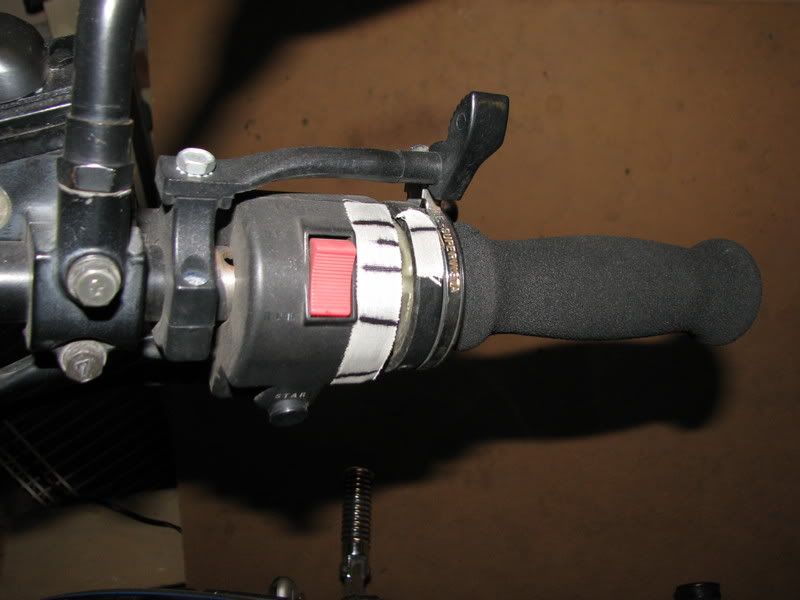
Ok so back to the throttle position. To do accurate plug chops, an good way to know what circuit(s) are being used is to mark your throttle off with tape in 1/4 turn increments starting from closed and ending at WOT (wide open throttle).
Doing this will let you see what position the throttle is in, so that you can keep it there to get an accurate plug chop for the corresponding circuit.
To simply rely on RPMs isn't necessarily accurate because you can be spinning 5K rpm, but once you get up there, you don't need to keep the on the throttle to keep it there...you could be using the pilot or pilot/needle transition circuit just to cruise along at that RPM, but it took a lot more of the needle to get there originally...
Anyway, so mark your throttle sleeve off as I said.
From idle to approx 1/4 turn is mainly the pilot circuit
1/4-3/4 is the needle circuit, and 3/4 to WoT is main jet.
If youre looking to do a plug chop in a particular circuit, you can now simply look down and see that you're staying within the ranges above..
If you're having a problem with the way the bike runs, this will also point you to which circuit may need looked at first, but keep in mind with the CV carbs that they are tuned from the main down. Meaning the main jet must be correct or close to before you move on to the next circuit (needle, then pilot) because the main feeds those other circuits. If the main is too small, it won't feed enough fuel to adequately supply the other circuits.
As to needing to re-jet for just a pipe alone (and retaining the stock airbox) in general you usually have to make some change in the main to get it to respond crisply throughout the rev range. The bike, in second gear when the circuits all are in order, should pull cleanly and crisply from 2K rpm to redline. If there is stutter or stumble, something needs corrected...at which point you can look down at your little taped off throttle gauge and say "oh the needle circuit is breaking up a bit.."
As brought up by duaneage in another thread, we will agree to disagree on this subject. Changes in exhaust flow can have effect on carburetion, as no pipe I've ever used has matched back pressure/scavenging of the stock GS system.
Having said that, the change, depending on the pipe, may be as minor as shimming the stock needle (Doing a search on this will bring up many how to threads) or a bump of a size or two larger on the main, or both.
BUT, and I've said this time and time again; the stock systems flow quite well. They knew what they were doing when they designed them. Especially if youre sticking with the stock box, don't expect a noticeable HP gain. There might be some "seat of the pants" feel changes as the torque band may move around some, but appreciable HP increase isnt much. The biggest advantage to running a 4-1 is weight savings. They're about half as heavy as the stock system...
Hope it helps...sorry if it doesn't