• Required reading for all forum users!!!

    Welcome!
    Register to access the full functionality of the GSResources forum. Until you register and activate your account you will not have full forum access, nor will you be able to post or reply to messages.

    A note to new registrants...
    All new forum registrations must be activated via email before you have full access to the forum.

    A Special Note about Email accounts!
    DO NOT SIGN UP USING hotmail, outlook, gmx, sbcglobal, att, bellsouth or email.com. They delete our forum signup emails.

    A note to old forum members...
    I receive numerous requests from people who can no longer log in because their accounts were deleted. As mentioned in the forum FAQ, user accounts are deleted if you haven't logged in for the past 6 months. If you can't log in, then create a new forum account. If you don't get an error message, then check your email account for an activation message. If you get a message stating that the email address is already in use, then your account still exists so follow the instructions in the forum FAQ for resetting your password.

    Have you forgotten your password or have a new email address? Then read the forum FAQ for details on how to reset it.

    Any email requests for "can't log in anymore" problems or "lost my password" problems will be deleted. Read the forum FAQ and follow the instructions there - that's what we have one for...

  • Returning Visitors

    If you are a returning visitor who never received your confirmation email, then odds are your email provider is blockinig emails from our server. The only thing that can be done to get around this is you will have to try creating another forum account using an email address from another domain.

    If you are a returning visitor to the forum and can't log in using your old forum name and password but used to be able to then chances are your account is deleted. Purges of the databases are done regularly. You will have to create a new forum account and you should be all set.

Acceptable stator output???

chuck hahn

Forum LongTimer
Past Site Supporter
When testing the AC voltage between legs of the stator what's a good voltage to see? I usually go between two legs with the meter then make sure I've done every mix to be sure I've covered all 3 legs. Is it possible all 3 legs make voltage but it's just too low for adequate charging?
 
The simplest answer tho' unsatisfying, is, when you are testing stator for voltage, current is basically zero apart from driving the multimeter. but, Voltage testing is not useless-it tells you that the windings are the same, comparing them....and can pinpoint to the shorted winding* BUT it doesn't say much about amperage...
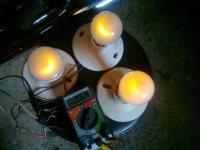
So, you really need to use a load across each leg test both (Vac and Amps) at the same time...as you know, MOST times it suffices to just goto test the charging battery voltage and test as DC to be happy or not but there are AC ammeters too if you get really determined...I have one but before I did, I found hooking up some household 110VAC bulbs across the legs to see if I was getting amperage AND voltage...try 60 watts though I think i went to 40watt to really be assured I wasn't getting a brightness difference....You need some household stuff to play with this- a few sockets,some bulbs....:)

75-80vac is how suzuki wound them. but 65VAC can be just fine when all legs show this and other conditions are "all good"

More than anyone here actually knows per Suzuki...but I think they're using just less than 18ga I think because my calipers say so AND 18 ga is a very tight fit in my limited but somewhat practised experience... so in the "worst" stator winding of mine, made 65VAC with these heavier windings and I'd say it will work fine if your 4 cylinder bike can suffer through a stoplight (idling,headlight,turnsignalbrakelight on) with 12.5VDC at the battery and 13.8 down the road...(saves water in the battery! and does charge the battery so near full it don't matter....4 cyliinder bikes might use more current at their coils ?...because my twin 400's have no such low reading...also the 4 cylinder fuse box setup is a voltage loser compared to the simpler twins..all empirical beyond my caring now...:)

*which by the way, each of three legs is two stator windings in series aka "wye" connected stator, so you can see how the trhee possible leg Voltage tests migh isolate the weak winding?
 
Last edited:
here's three 60 watt bulbs at 2500 rpm but if you used one at a time and measured light.....the picture is crummy but the meter is showing 36.8VAC I think.

.StatorTest-3x60wattandACvoltPer2500RPM.jpg
 
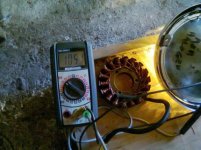
These tests never revealed anything wrong because theseexamples are rewound stators ... I was tinkering to devise simpler, um "better" tests...but there's this, too. as an idea to compare stator legs with some real current in the circuit without needing the engine spinning. It also uses voltage drop but applies a better load than a multimeter can...headlight,battery,stator leg...again apology for quality but basically,comparing each leg's voltage drop should reveal if there's a difference in one of the legs. It should also give an approximation of a leg's resistance when ohms law applied...not perfect but it's the comparisons you want to discover a bad leg...
testVDstatorleg with headlamp.jpg
 
Your better off checking the DC output at the voltage regulator, as that's where it's really going to count in the end. Unless your having charging problems, then you can check to see if the impedance of the stator windings are the same. :)
 
AC output tests between phases should be in the 75-80V range, as Gorminrider mentioned, but in my experience, no-load testing like this isn't a foolproof test. I've had stators that seemingly put out good voltage, but when underload, with an R/R in the system, the DC charging voltage at the battery was lower than desired.
 
That's why the lightbulb tests are somewhat reassuring per the stator ALONE... It's closer to a short circuit across the leg so there's a load that approaches its real world use without being complicated by any of the bike's issues. ...you can see that with the bulbs in the above that 80VAC isn't the stator's voltage when connected to any real load ...and given you can come up with more than 150 watts, and all three legs the same, the issue very probably isn't going to be specifically your stator.
 
I used to use light bulbs when T.V's would blow fuses. It would give me time to find the smoking, or hot part. I got an Isolation Transformer, and that stopped that. A light isn't good because the element will just go brighter or duller, not offering really any load. A T.V. working properly just passes the light through the bulb, it takes no load at all. It isn't a valid method for testing Stators.. As Nessism​ said, "under load", the best test is to see what the R/R is putting out. The stator could read the right impedance, but fail under load. :)
 
I did say that in my first response to chuck's question...
.as you know, MOST times it suffices to just goto test the charging battery voltage and test as DC to be happy or not but there are AC ammeters too if you get really determined..


I don't get this
A light isn't good because the element will just go brighter or duller, not offering really any load.

I'd need an explanation.while (especially!) a shunt R/R might keep impedance/load pretty steady, it's still subject to rpm and obviously it and all the other components entrained add doubt.
I suppose a lightbulb to be a load that conveniently is visible,simple, and doesn't need rectification to work... Brighter or duller" is cogent to a generator..spin it faster, the light gets brighter...if it's work, it's a load and if it can't light a bulb it's broken- it's failed before needing more elaborate tests...which is all I'm suggesting because within the realm of possible repair to the generator, there aren't practical options beyond winding insulation, connections and magnets anyways....

While it might pass my 'test" but still fail on the bike, I can't see any possibility it could fail my test and still work on the bike.
 
The bulb is just releasing the amperage as visible light. If you put a light in a series circuit, you will see a light go brighter, but the amperage will stay the same. The Power (Power=Watts) goes up,the voltage may too (if increased by a potentiometer, or the voltage source, thus increasing the Voltage and watts, if you change one aspect of Ohm's Law the other values change), but the amperage will stay the same, in a series circuit that's unaltered. It's basic ohm's Law, if the voltage remains the same, and the watts will be whatever they are. A bulb is a good way to save on fuses, but not for diagnosing live circuits as it is adding a variable value into a circuit that wasn't designed for it. ;)
 
The bulb is just releasing the amperage as visible light. If you put a light in a series circuit, you will see a light go brighter, but the amperage will stay the same. The Power (Power=Watts) goes up,the voltage may too (if increased by a potentiometer, or the voltage source, thus increasing the Voltage and watts, if you change one aspect of Ohm's Law the other values change), but the amperage will stay the same, in a series circuit that's unaltered. It's basic ohm's Law, if the voltage remains the same, and the watts will be whatever they are. A bulb is a good way to save on fuses, but not for diagnosing live circuits as it is adding a variable value into a circuit that wasn't designed for it. ;)

Spoken like a TRUE sparky. Well said Ian! :cool:
 
Nothing wrong with using three incandescent 110V 60W bulbs as indicative loads - they provide some reassurance the generator is working at least until that point.
 
All that bulb and techy stuff is great but maybe my original question needs clarification. What voltage is expected to be seen across the legs Service manual...far as I could find...doesn't mention any specific AC voltage between legs
.All I want to know is that I should see between XX and XX volts. Thanks.
 
I honestly have never checked voltage at the stator, and I have replaced many of them. The insulation wears down, and the voltage you get when measuring is not indicative of what happens under load. Only the DC output after passing through the R/R is what matters. It's your time, but you're kind of wasting it. ;)
 
No load, across the legs, Haynes says something like a minimum of 55VAC. Better to have 70VAC. I always suspected the Haynes figure was a misprint.
 
Had two stators on the 850. One, possibly the original, gave ~75 V, the other, an aftermarket job, gave ~55V open cct. at 5000rpm
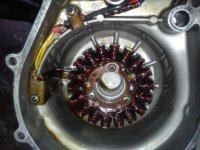
Both charged fine with an SH775 and SPG setup. Only got the second one because I thought the original was toast until I found somebody had used bullet connectors inside the generator casing and the wires had fried. The stator survived and was fine after a proper wiring job.
DSC_0043.jpg
 

Attachments

  • DSC_0043.jpg
    DSC_0043.jpg
    83.1 KB · Views: 0
When I rewired my Stator, I ran all three legs directly to the R/R and the +/- DC from the R/R directly to the battery (with a fuse on the positive side). I haven't had a problem in over 8 years. I used an Electrosports Stator,puts out 20% more power, and a R/R from a Kawasaki XD1100, it had huge cooling fins, and that I mounted where the useless tool tray was. :)
 
I'm pretty sure it was from the 1979 to '84 series Yamaha XS1100 Model. They were all the same. The R/R did not have leads coming off of it. If had three Male tabs for the plug wires from the Stator (which I wired directly, bypassing the harness), and two Male tabs on the side for the DC output (again, I bypassed the harness and hooked it directly to the battery with a fuse in series on the positive DC wire). I crimped connectors and just plugged everything in. Any 1100 will work. I'm pretty sure the one I have is made by Shindengen. It was really inexpensive. Less than $ 30 bucks. They are all over EBAY, and very inexpensive.
:)
 
Last edited:
Back
Top