AEM "UEGO" wideband o2 sensor and AFR gauge for carb tuning on modified engines
Just wanted to put in a plug for a very helpful $165 tuning tool that I had first read about from BoontonMike's GS550 673cc barebones street racer thread. I decided to forego a lot of the other wideband o2 sensor setups, as they required expensive controllers and/or were not a simple Air-Fuel-Ratio gauge readout, and the price was definitely right on this. It is more tailored for car installations (dash mount gauge with no pod, very long wiring harness), but is a very useful tool in getting your jetting in the ballpark without ever having to do plug chops or even pull your spark plugs to read them (until you get your mains close to 12.8-13.2 AFR, still need to read WOT plug chop then to confirm).
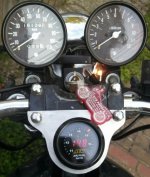
I made a quick aluminum mounting plate for this gauge to clamp to my GS650GT upper triple's elevated handlebar mounts (my stocker would not have had the height to keep the back of the gauge off of the center bolt that goes into the lower triple's steering stem). This worked pretty well, although the gauge being tilted back more would have made the VERY FAST high speed acceleration wide open throttle main jet readings a bit safer and easier.
The only complaint with this is that I had to go to Jeg's High Performance store and get a $6 threaded plug for the weld-in o2 bung, as I didn't want this as a permanent install. Other downside is that I have not looked into a tailpipe inserted clamp on sensor as the LM1 wideband o2 setup has as an option, so I got an extra o2 bung and plug from Jeg's for $9.99 for my spare bike parts pile project or my wife's 550-673cc project with gixxer/katana carbs.
Instantly I was able to determine that I was a slight bit rich at idle, and very rich all across the board, never getting above 11:1 on acceleration or cruising, only decel. This told me I needed a lower fuel level by raising the float heights, lower the needles half or 1 clip slot, reduce my main size a few sizes down, as well as turn in my pilot fuel screws or drop my pilot jet from 17.5 to 15. This was so quick and simple, literally just a 3 minute warm up and then cruise for 3 minutes to determine air fuel mixture at all throttle positions.
In the picture of my just-welded o2 bung, you can see I snapped it immediately after welding, as the bung is still glowing red hot! Due to the exhaust being 16 gauge or so metal and the bung being 1/8" or 3/16" thick, I pre-heated the bung with my oxy-acetylene torches red hot, which made it expand so much that it no longer fit in the loose fitting hole I drilled in my vance and hines muffler's mid-pipe section, so I let it cool slightly, tapped it in the hole, and then heated it red hot again. Then away with the millermatic 185 180amp mig welder set on the recommended settings for 1/8" steel with .023 wire and 75/25 argon co2 mix. I did two quick tac welds 180 apart and then welded it real quickly, focusing the arc puddle mostly on the bung, and just dashing it down to the thinner exhaust real quick and then back, as to not melt a hole through the thinner of the two metals (exhaust). Worked pretty darn well.
Photos:


The sensor mounted nicely under my swingarm where the center stand used to be, and the weld on the muffler in the center made me not mount it horizontally, so I acidentally mounted it as the instructions (that I did not read!) said, 10 degrees or more up from horizontal - so condensation does not collect on the sensor, but rather drains down and off the end. I wired it off of my Dyna-S power feed wire, so that if my kill switch is in the run position, the sensor and gauge are powered. You must not run the engine with the sensor installed but not powered up, as they have a heating element to keep them to proper temperature, otherwise the sensor would soot up and not function. Therefore I have a small heating element's electrical drain on the system if I leave the kill switch and ignition switch on with the engine not running, but saves me from fouling the expensive Bosch wideband o2 sensor.
Overall I am very happy with this. The only downfall is the welding part, but I am totally capable of welding, and am totally fine with having a bung and threaded plug in my exhaust. I painted it with POR-20 hi-temp exhaust paint, as well as a road rashed area of my used vance and hines muffler. Works AWESOME!
Once warmed up, rough figures for an air cooled carbeureted engine would idle anywhere from 10:1 (hot cams) or for more efficient engines at idle, 12-13.5, for half throttle to 3/4, richer aroun 12-13.4, and high rpm wide open throttle 12.8 (max torque)-13.2 (max hp on mains) (richer for hot running high compression engines on the mains), and in the mid 13's for low throttle cruising. tune the stumbles out of the throttle movements from there. The default display on power up shows 14.8 - the perfect stoichiometric afr, this is not ideal for an air cooled engine, but is closer for a water cooled engine, and more pertinent for a water cooled car engine.
Hope this helps. It is a HUGE time saver that eliminates so many plug chops and plug readings...
Just wanted to put in a plug for a very helpful $165 tuning tool that I had first read about from BoontonMike's GS550 673cc barebones street racer thread. I decided to forego a lot of the other wideband o2 sensor setups, as they required expensive controllers and/or were not a simple Air-Fuel-Ratio gauge readout, and the price was definitely right on this. It is more tailored for car installations (dash mount gauge with no pod, very long wiring harness), but is a very useful tool in getting your jetting in the ballpark without ever having to do plug chops or even pull your spark plugs to read them (until you get your mains close to 12.8-13.2 AFR, still need to read WOT plug chop then to confirm).
I made a quick aluminum mounting plate for this gauge to clamp to my GS650GT upper triple's elevated handlebar mounts (my stocker would not have had the height to keep the back of the gauge off of the center bolt that goes into the lower triple's steering stem). This worked pretty well, although the gauge being tilted back more would have made the VERY FAST high speed acceleration wide open throttle main jet readings a bit safer and easier.
The only complaint with this is that I had to go to Jeg's High Performance store and get a $6 threaded plug for the weld-in o2 bung, as I didn't want this as a permanent install. Other downside is that I have not looked into a tailpipe inserted clamp on sensor as the LM1 wideband o2 setup has as an option, so I got an extra o2 bung and plug from Jeg's for $9.99 for my spare bike parts pile project or my wife's 550-673cc project with gixxer/katana carbs.
Instantly I was able to determine that I was a slight bit rich at idle, and very rich all across the board, never getting above 11:1 on acceleration or cruising, only decel. This told me I needed a lower fuel level by raising the float heights, lower the needles half or 1 clip slot, reduce my main size a few sizes down, as well as turn in my pilot fuel screws or drop my pilot jet from 17.5 to 15. This was so quick and simple, literally just a 3 minute warm up and then cruise for 3 minutes to determine air fuel mixture at all throttle positions.
In the picture of my just-welded o2 bung, you can see I snapped it immediately after welding, as the bung is still glowing red hot! Due to the exhaust being 16 gauge or so metal and the bung being 1/8" or 3/16" thick, I pre-heated the bung with my oxy-acetylene torches red hot, which made it expand so much that it no longer fit in the loose fitting hole I drilled in my vance and hines muffler's mid-pipe section, so I let it cool slightly, tapped it in the hole, and then heated it red hot again. Then away with the millermatic 185 180amp mig welder set on the recommended settings for 1/8" steel with .023 wire and 75/25 argon co2 mix. I did two quick tac welds 180 apart and then welded it real quickly, focusing the arc puddle mostly on the bung, and just dashing it down to the thinner exhaust real quick and then back, as to not melt a hole through the thinner of the two metals (exhaust). Worked pretty darn well.
Photos:
The sensor mounted nicely under my swingarm where the center stand used to be, and the weld on the muffler in the center made me not mount it horizontally, so I acidentally mounted it as the instructions (that I did not read!) said, 10 degrees or more up from horizontal - so condensation does not collect on the sensor, but rather drains down and off the end. I wired it off of my Dyna-S power feed wire, so that if my kill switch is in the run position, the sensor and gauge are powered. You must not run the engine with the sensor installed but not powered up, as they have a heating element to keep them to proper temperature, otherwise the sensor would soot up and not function. Therefore I have a small heating element's electrical drain on the system if I leave the kill switch and ignition switch on with the engine not running, but saves me from fouling the expensive Bosch wideband o2 sensor.
Overall I am very happy with this. The only downfall is the welding part, but I am totally capable of welding, and am totally fine with having a bung and threaded plug in my exhaust. I painted it with POR-20 hi-temp exhaust paint, as well as a road rashed area of my used vance and hines muffler. Works AWESOME!
Once warmed up, rough figures for an air cooled carbeureted engine would idle anywhere from 10:1 (hot cams) or for more efficient engines at idle, 12-13.5, for half throttle to 3/4, richer aroun 12-13.4, and high rpm wide open throttle 12.8 (max torque)-13.2 (max hp on mains) (richer for hot running high compression engines on the mains), and in the mid 13's for low throttle cruising. tune the stumbles out of the throttle movements from there. The default display on power up shows 14.8 - the perfect stoichiometric afr, this is not ideal for an air cooled engine, but is closer for a water cooled engine, and more pertinent for a water cooled car engine.
Hope this helps. It is a HUGE time saver that eliminates so many plug chops and plug readings...
Attachments
Last edited:
kBRqRuO5f7g~~60_35-500x500.JPG)