• Required reading for all forum users!!!

    Welcome!
    Register to access the full functionality of the GSResources forum. Until you register and activate your account you will not have full forum access, nor will you be able to post or reply to messages.

    A note to new registrants...
    All new forum registrations must be activated via email before you have full access to the forum.

    A Special Note about Email accounts!
    DO NOT SIGN UP USING hotmail, outlook, gmx, sbcglobal, att, bellsouth or email.com. They delete our forum signup emails.

    A note to old forum members...
    I receive numerous requests from people who can no longer log in because their accounts were deleted. As mentioned in the forum FAQ, user accounts are deleted if you haven't logged in for the past 6 months. If you can't log in, then create a new forum account. If you don't get an error message, then check your email account for an activation message. If you get a message stating that the email address is already in use, then your account still exists so follow the instructions in the forum FAQ for resetting your password.

    Have you forgotten your password or have a new email address? Then read the forum FAQ for details on how to reset it.

    Any email requests for "can't log in anymore" problems or "lost my password" problems will be deleted. Read the forum FAQ and follow the instructions there - that's what we have one for...

  • Returning Visitors

    If you are a returning visitor who never received your confirmation email, then odds are your email provider is blockinig emails from our server. The only thing that can be done to get around this is you will have to try creating another forum account using an email address from another domain.

    If you are a returning visitor to the forum and can't log in using your old forum name and password but used to be able to then chances are your account is deleted. Purges of the databases are done regularly. You will have to create a new forum account and you should be all set.

All there is to know about TSCC

  • Thread starter Thread starter ohgoodtimes
  • Start date Start date
O

ohgoodtimes

Guest
TSCC (Twin Swirl Combustion Chamberr)

SUZUKI has introduced a new breed of 4-valves-per-cylinder high-performance 4-stroke engines -- The TSCC series. TSCC describes the heart of the engine, the Twin Swirl Combustion Chamber.

What the TSCC engine series does better than conventional 4-stroke eninges, either 2 valve or 4 valve, is to improve on the two major factors which affect engine performance, charge burning efficiency and intake charging efficiency.

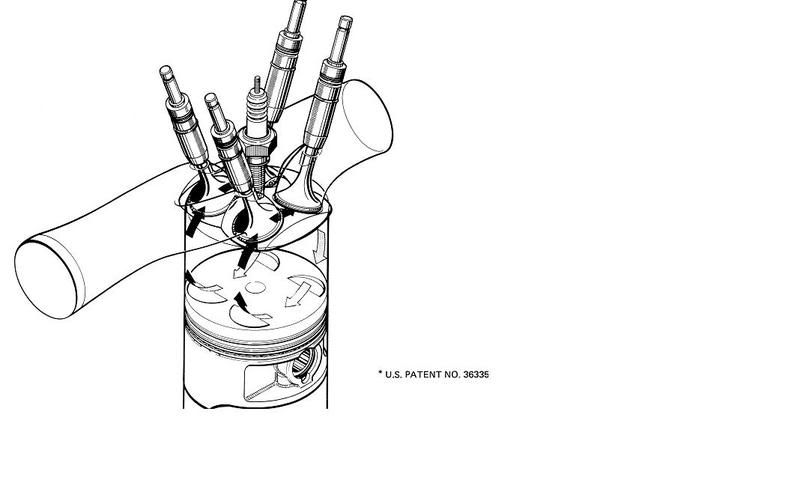
First, charge burning efficiency. The TSCC system consists of a subtle, yet unique shape machined into the head. Each of the two intake valves is set into adjoing semi-hemispherical depressions in the head. During the intake stroke these depressions channel the incoming fuel/air mixture to form two seperate high-speed swirls.

During the compression stroke the squish areas machined in the front and the rear of the cylinder head's combustion chamber accelerate the speed of the swirls. Thus, when the spark plug ignites the mixture, the flme spreads rapidly and completes the combustion more quickly.

To further aid burning efficiency, the spark plug is centrally located, the ideal location. This results in the shortest possible path for the flame to travel.
bike.jpg
 
What's cool is that the same TSCC tech introduced in the GS series is still being used on all Suzuki's 16 valve modern bikes, like the GSXR, Bandit etc. :)
 
Too bad the TSCC concept didn't develop beyond 1983. Twin swirl was not significant compared to the compact combustion chamber design brought on by the shallow included valve angle combustion chamber shape.

Four valve per cylinder is a superior design, no doubt. Which matters not when it comes to classic vehicles - we don't love them because they have the best technology, but rather because they have character.:)
 
Too bad the TSCC concept didn't develop beyond 1983. Twin swirl was not significant compared to the compact combustion chamber design brought on by the shallow included valve angle combustion chamber shape.

Four valve per cylinder is a superior design, no doubt. Which matters not when it comes to classic vehicles - we don't love them because they have the best technology, but rather because they have character.:)

Doesn't the compact combustion chamber just increase the compression ratio slightly. The R1 went from 12.4 to 12.7. Also CCS uses TSCC as well. I dont think the are competing technologies. And for the most part isn't CCS applied to turbines?
 
Too bad the TSCC concept didn't develop beyond 1983. Twin swirl was not significant compared to the compact combustion chamber design brought on by the shallow included valve angle combustion chamber shape.

Four valve per cylinder is a superior design, no doubt. Which matters not when it comes to classic vehicles - we don't love them because they have the best technology, but rather because they have character.:)

What's the shallow included valve angle combustion chamber shape? Do modern engines use this? The Gixxers still use TSCC. :)
 
The big reason for compact combustion chambers with relatively flat roofs is to use flat pistons while still retaining desired compression ratios. Flat topped pistons retain less heat and don't interfere with the flow of gasses in the cylinder or flame spread upon ignition.
 
Back when Suzuki started with 4 valve heads and they coined the TSCC concept, the head (combustion chamber) had little ramps around the valves and the valves sat down in pockets, so as to promote rotation of the mixture as it flowed into the combustion chamber. These same ridges/ramps don't seem to be present in the heads anymore on modern Suzuki’s. I think Suzuki stayed with the marketing concept of TSCC to try to create some marketing separation from the other manufacturers so as to maintain the concept as part of their heritage. Not trying to say Suzuki doesn't make a nice engine, they do, just saying that TSCC is just a marketing concept these days. The real technology is in the shallow combustion chamber shape, not the silly ramps they used to use.
 
TSCC is indeed a tech advance for the GSs and later bikes. I have never once knocked the concept, its sound, and proven. My 1100, and your 1100, are TSCC motors. My knock is the **** poor oiling design Suzuki used in the TSCC 750 motors from 80-82. The one blemish on an otherwise outstanding line of motorcycles thru the brand years, and it was rectified rather quickly. Think of this, with as much as we KNOW how Suzuki didnt like to re-tool for anything if they could help it, the fact that the 83 and on 750 motors were a near complete re-design speaks volumes about their realization of the problems with the predecessor. The update in 83 was significant, and the motor was a much more sound design. Compact, lightweight and better flow thru the oiling system.
 
I had wondered what that meant. It's on the side of my motor but I never Googled it. Thanks ohgoodtimes!
 
TSCC is indeed a tech advance for the GSs and later bikes. I have never once knocked the concept, its sound, and proven. My 1100, and your 1100, are TSCC motors. My knock is the **** poor oiling design Suzuki used in the TSCC 750 motors from 80-82. The one blemish on an otherwise outstanding line of motorcycles thru the brand years, and it was rectified rather quickly. Think of this, with as much as we KNOW how Suzuki didnt like to re-tool for anything if they could help it, the fact that the 83 and on 750 motors were a near complete re-design speaks volumes about their realization of the problems with the predecessor. The update in 83 was significant, and the motor was a much more sound design. Compact, lightweight and better flow thru the oiling system.


I recently bought a '83 750 and did the valves today. Bike only has 11k miles but is reputed to be an old magazine test bike so I suspect it's been used hard. Was very pleased to see the condition of the cams; they truly look like brand new. Was expecting to see some wear since they use rocker arms which are not as durable as the 8v engines bucket and shim valve train. At any rate, the '83+ 750 engines does seem to be pretty solid from what I can tell so far.
 
RFVC = honda radial four valve configuration
YICS = yamaha yamaha induction control system
TSCC = suzuki we know

the late 70s' what a time to have technology..
 
RFVC = honda radial four valve configuration
YICS = yamaha yamaha induction control system
TSCC = suzuki we know

the late 70s' what a time to have technology..
If I remember correctly in the early 80's Porsche was the first to use a variable valve timing - vtec to Honda people.
 
unfortunatly Honda never took the radil four valve system beyond the thumpers as it is a very good system.
MV Agusta uses radial four valve combustion chambers on their bikes.

Szuki added a unusual twist to the 08 SV650 engine. a second sparkplug on the side, you have one plug in the middle between the valves and a second one on one side.

SV uses TSCC but the combustion chamber is alot smaller.

061c_1.JPG
 
I recently bought a '83 750 and did the valves today. Bike only has 11k miles but is reputed to be an old magazine test bike so I suspect it's been used hard. Was very pleased to see the condition of the cams; they truly look like brand new. Was expecting to see some wear since they use rocker arms which are not as durable as the 8v engines bucket and shim valve train. At any rate, the '83+ 750 engines does seem to be pretty solid from what I can tell so far.

I love my 83 and it has more than twice the mileage yours does and it it still keeps up with all the other bikes i ride with fine. I am sure mine has seen abuse, I ride it hard sometimes but she keeps on going and going.
 
I love my 83 and it has more than twice the mileage yours does and it it still keeps up with all the other bikes i ride with fine. I am sure mine has seen abuse, I ride it hard sometimes but she keeps on going and going.
I have an '85 700 I've hammered hard its entire life. Over-revved it so badly one time it spun the threaded adjusters out of a couple of rockers. It just keeps coming back for more. At 42,000 miles the speedo drive quit working and I left it that way for probably 5,000 miles. I now have GSX-R gauges and have maybe another 10k on them.
 
If I remember correctly in the early 80's Porsche was the first to use a variable valve timing - vtec to Honda people.
Or VVTI to Toyota people...

Actually, variable valve timing, valve exclusion and cylinder management (shutting off cylinders when not needed) has been tech that has been worked on for a LOOONG time. The advent of "drive by wire" tech has made it a reality, and now days, there are MANY cars that simply shut 2 or 4 cylinders down when the vehicles computer decides it doenst need them to maintain a given velocity.
 
TSCC is indeed a tech advance for the GSs and later bikes. I have never once knocked the concept, its sound, and proven. My 1100, and your 1100, are TSCC motors. My knock is the **** poor oiling design Suzuki used in the TSCC 750 motors from 80-82. The one blemish on an otherwise outstanding line of motorcycles thru the brand years, and it was rectified rather quickly. Think of this, with as much as we KNOW how Suzuki didnt like to re-tool for anything if they could help it, the fact that the 83 and on 750 motors were a near complete re-design speaks volumes about their realization of the problems with the predecessor. The update in 83 was significant, and the motor was a much more sound design. Compact, lightweight and better flow thru the oiling system.

I disagee. The engine was redesigned in '83 because at that time, three years was a pretty long production run for a Japanese model. Remember, this was during the era when the Big Four of Japan accounted for almost 90% of motorcycle sales worldwide. The sky was the limit for R&D, and they kind of lost sight of their business model, producing new designs not so much to increase their profitability, but rather for bragging rights at the tracks and in the magazine reviews. It was the time when a new design was only cutting edge for a year, maybe eighteen months, before it was rendered obsolete by a newer competing design.

Honda had come out with the V-Four Sabre in '82, and it was no secret that the engine was going to be put into a monoshock, full on sportbike for '83 (the Interceptor). Kawasaki was coming out with a monoshock GPZ750 for '83, and Suzuki knew that if they were going to play in the 750 field (the AMA superbike class was 750cc at the time, and the 750 class was the biggest seller in the showroom) and be competitive with the Kaw and Honda, the current GS750 engine and frame designs weren't going to get it done. Going to a monoshock design required a physically smaller engine, and Suzuki was also working on the oil-cooled GSXR design. The '83 GS750 engine was kind of a bridge between the traditional air cooled GS designs of the '70s and early '80s, and the first-gen GSXR designs of the mid '80s.

Remember, for '83, the GS750T and GS750S Katana still used the '80 design GS750 engine. If Suzuki thought it was truly an inferior design by then, I doubt if they would have continued producing it.

That being said, I agree that there can be some top end oiling issues with the '80 GS750 engine (and the 1100 as well). Premature exhaust cam wear seems prevalent, but can also be minimized by ensuring correct valve clearances, more frequent oil changes, and the use of modern synthetic oils. I plan on making my '81 GS750E my daily rider, which means that unless I get another bike next year (there's always the chance...), within two years the mileage should be increased from about 16,000 where it is now, to about 35,000 miles. I am documenting cam lobe diameters, and will do so at every valve adjustment to track cam wear.
 
Back
Top