• Required reading for all forum users!!!

    Welcome!
    Register to access the full functionality of the GSResources forum. Until you register and activate your account you will not have full forum access, nor will you be able to post or reply to messages.

    A note to new registrants...
    All new forum registrations must be activated via email before you have full access to the forum.

    A Special Note about Email accounts!
    DO NOT SIGN UP USING hotmail, outlook, gmx, sbcglobal, att, bellsouth or email.com. They delete our forum signup emails.

    A note to old forum members...
    I receive numerous requests from people who can no longer log in because their accounts were deleted. As mentioned in the forum FAQ, user accounts are deleted if you haven't logged in for the past 6 months. If you can't log in, then create a new forum account. If you don't get an error message, then check your email account for an activation message. If you get a message stating that the email address is already in use, then your account still exists so follow the instructions in the forum FAQ for resetting your password.

    Have you forgotten your password or have a new email address? Then read the forum FAQ for details on how to reset it.

    Any email requests for "can't log in anymore" problems or "lost my password" problems will be deleted. Read the forum FAQ and follow the instructions there - that's what we have one for...

  • Returning Visitors

    If you are a returning visitor who never received your confirmation email, then odds are your email provider is blockinig emails from our server. The only thing that can be done to get around this is you will have to try creating another forum account using an email address from another domain.

    If you are a returning visitor to the forum and can't log in using your old forum name and password but used to be able to then chances are your account is deleted. Purges of the databases are done regularly. You will have to create a new forum account and you should be all set.

Basic Motogadget M-Unit Wiring Diagram

  • Thread starter Thread starter hjacobmiller13
  • Start date Start date
H

hjacobmiller13

Guest
I am trying to finalize the re-wiring of my 82 GS300 project and I am installing a Motogadget M-unit.

Does anyone see a problem with this simple diagram? The m-unit related components are according to the m-unit manual.

https://s1256.photobucket.com/user/...Install/MUnit Diagram_V2_zpsdxpqtria.png.html

The main things I'm concerned about are the wiring for the SH775 R/R and the toggle switch for the LED volt meter.

Is 30A too large for the battery to handle?

The goal of the volt meter is to be able to monitor the charging voltage as the bike is running. I have had issues in the past with the R/R going bad and frying other components. I'm also using an Anti-Gravity AG-801 battery which are sensitive to over charging, so I want to protect the battery.

By monitoring the voltage of the battery itself measure the charging voltage? Or do I need to put the voltmeter between the R/R and the battery?

Thanks,
J
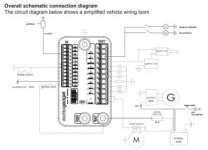
MUnit Diagram_V2.jpg
 
Two things:
1.) you have shown liberal use of a groudn symbol without explaining what that is so it is difficult to identify the groudn return path to R/R (-)
2.) I would recommend the stock GS power distribution strategy of forming a "T" at the input of the R/R (+) and using a single 15 amp fuse. (more the wire from M-Unit -BAT to the "T")

15 amp fuse is a whole lot better protection than 15 amps, and in this configuration there is typically only 10-11 amps flowing through that fuse.
 
I did not open the attachment to see what was there, but a couple other things caught my eye.

Is 30A too large for the battery to handle?
The fuse does not control the battery. The battery does not control the fuse.
The fuse is there to protect the bike's wiring, in case a device fails.


The goal of the volt meter is to be able to monitor the charging voltage as the bike is running. I have had issues in the past with the R/R going bad and frying other components. I'm also using an Anti-Gravity AG-801 battery which are sensitive to over charging, so I want to protect the battery.

By monitoring the voltage of the battery itself measure the charging voltage? Or do I need to put the voltmeter between the R/R and the battery?
You evidently don't understand the function of a voltmeter. :-k
If you think of electricity as water, you can think of the voltmeter as a pressure meter. Or you can think of it as a level meter, like a gas gauge. Voltage will remain pretty much the same, wherever you put the meter. If your charging system fails, you will see the voltage ("pressure") drop, but you will not be able to see how quickly it is dropping, which is what an ammeter would do. Taking that analogy a bit further into the fuel gauge scenario, would you rather know that you are using fuel at half a gallon an hour, or would you rather know that you have 1/4 tank left?

.
 
Thanks for the quick reply!

I'm not sure I follow your first comment. Everything that shows a ground symbol gets connected back to the negative (-) terminal of the battery, either through a direct connection (engine ground, m-unit GND terminal) or by frame grounding.

For your second point, is this what you are thinking for the revised diagram?

 
I am not expecting the fuse to control the battery or vice versa. I am wondering if a 30A fuse is too high amperage of a fuse in that it will not provide sufficient protection to the battery. I noticed that EasternBeaver uses a 30A fuse between the R/R and battery. I believe the OEM fuse was either a 10A or 15A between the R/R and battery, so an extra 15A fuse will increase the amount of amps that could potentially flow through the circuit before blowing the fuse therefore hurting the battery.

The purpose of the voltmeter on my diagram is to monitor the voltage of the charging circuit as the bike is running. If my R/R fails and the charging voltage exceeds 14.4v on the voltmeter then I would shut the bike off to protect the other components on the circuit. I'm not sure you understood my question. I am not expecting the voltmeter to provide any protection - just inform me as to the voltage of the charging circuit so I can shut off the bike if the R/R fails. I'm wondering if where I placed the volt meter would only be reading voltage of the battery or just for the charging circuit. I believe that the charging circuit and the battery would have the same voltage but wanted to confirm.
 
Last edited:
Thanks for the quick reply!

I'm not sure I follow your first comment. Everything that shows a ground symbol gets connected back to the negative (-) terminal of the battery, either through a direct connection (engine ground, m-unit GND terminal) or by frame grounding.

For your second point, is this what you are thinking for the revised diagram?


Yes on teh "T"
So your "ground" of battery (-) is the thick starter ground cable?

and so where do you run the R/R(-) to the engine or direct to the battery?
Your nomenclature is ambiguous a person is left to guess.
 
Yes, the engine ground to battery is 6AWG. This is the exact product I used.

https://www.amazon.com/gp/product/B01BK0NE0G/ref=ppx_yo_dt_b_search_asin_title?ie=UTF8&psc=1

The R/R would be grounded directly to the battery (-) terminal.

Sorry about the question on the "T". You do not touch anything coming from the BAT + unless it goes through the fuse.

The "T" shoudl be on the other side of the fuse.

The way you have it, if the R/R shorts you have a fire.

You will need to rely on Ed for power and grounding advice.

As i said, your schematic is ambiguous as to what you can ground and what connections are to be made.
 
Back
Top