• Required reading for all forum users!!!

    Welcome!
    Register to access the full functionality of the GSResources forum. Until you register and activate your account you will not have full forum access, nor will you be able to post or reply to messages.

    A note to new registrants...
    All new forum registrations must be activated via email before you have full access to the forum.

    A Special Note about Email accounts!
    DO NOT SIGN UP USING hotmail, outlook, gmx, sbcglobal, att, bellsouth or email.com. They delete our forum signup emails.

    A note to old forum members...
    I receive numerous requests from people who can no longer log in because their accounts were deleted. As mentioned in the forum FAQ, user accounts are deleted if you haven't logged in for the past 6 months. If you can't log in, then create a new forum account. If you don't get an error message, then check your email account for an activation message. If you get a message stating that the email address is already in use, then your account still exists so follow the instructions in the forum FAQ for resetting your password.

    Have you forgotten your password or have a new email address? Then read the forum FAQ for details on how to reset it.

    Any email requests for "can't log in anymore" problems or "lost my password" problems will be deleted. Read the forum FAQ and follow the instructions there - that's what we have one for...

  • Returning Visitors

    If you are a returning visitor who never received your confirmation email, then odds are your email provider is blockinig emails from our server. The only thing that can be done to get around this is you will have to try creating another forum account using an email address from another domain.

    If you are a returning visitor to the forum and can't log in using your old forum name and password but used to be able to then chances are your account is deleted. Purges of the databases are done regularly. You will have to create a new forum account and you should be all set.

bike wont charge...again

  • Thread starter Thread starter Guest
  • Start date Start date
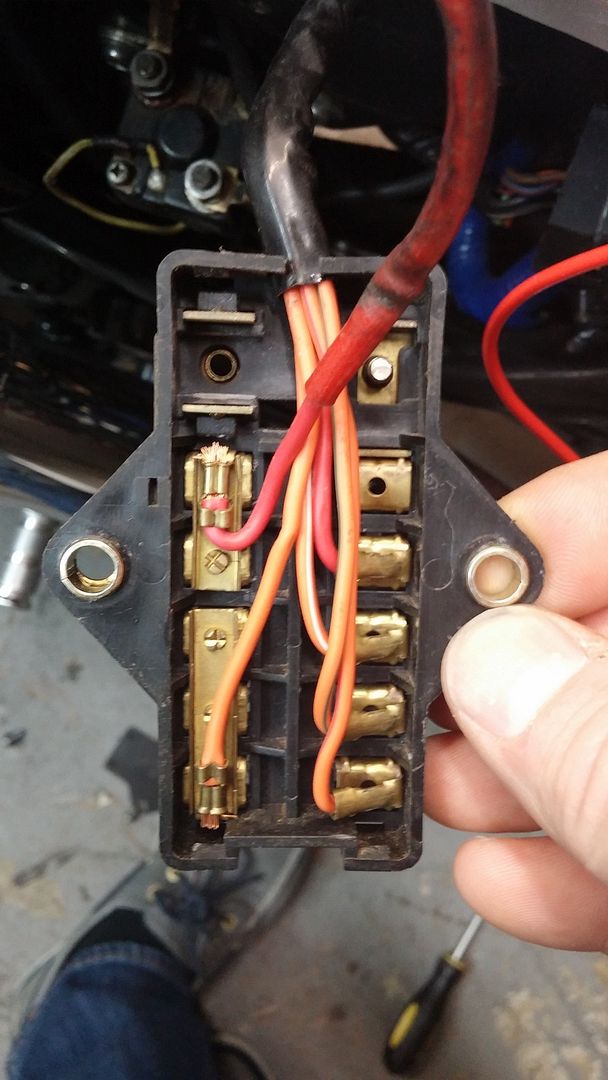
OK, now i have 12v across all the fuse blocks...but...the bike wont power up. I put it back just like the pic. Maybe the short is close in proximity to the fuses. I'll keep looking.
 
OK, now i have 12v across all the fuse blocks...but...the bike wont power up. I put it back just like the pic. Maybe the short is close in proximity to the fuses. I'll keep looking.

You are wandering..................................

Go back and make sure you are doing what was recommended.

The bike is lot a laptop, what does "wont (sic) power up" mean?
 
There is no power at the key or to the ignition. No way to continue testing. Its the same 15 amp circuit that kept blowing the fuse. There is 12 v to the fuse box. I must have put something back incorrectly. I'll post a pic.
 
Wiring is my nemisis. Sorry if Im not clear. I just dont know much about this. Once I get it to run again the first thing I will do is the stator test. I appreciate the help and don't want to wear out my welcome.
 
these systems are not designed to charge the battery - only cover the total draw .

these systems are not designed to charge the battery - only cover the total draw .

DC tests only tell a small part of the story - they confirm there is not enough electricity to cover the loads but is from not making enough or using too much ? - which is why I also do Amperage tests in conjunction with voltage.

static tests are OK but fully heated dynamic tests will show you everything. operating heat can contribute to insulation breakdown failure but after the varnish melting is done the winding is usually married to ground - I would save a magic stator that works cold and fails hot for teaching purposes if I ever find one.

lack of magnetism from the rotor will cause low AC induction (I do have one of those) tricky tricky --

YOU FIRST NEED to know if you are making enough power and I am stating a bare minimum of 28ACV@stator = 14.0DCV@battery // 26ACV@stator =13.0DCV@battery - with zero loads drawing off of the system no matter the 12V battery size. no ignition - no lights no nothing - and 24 will rectify to just make 12. - in theory. now add ignition and lights and signals - lacking EMF to go for a ride.

theory and reality do not live in the same neighborhood.

toss that stator out the window if it is under 30ACV on any of the 3 phase legs at idle.

Turbojohn - you have more than 1 problem get a test light and track your DC positive connectivity and switched control of positive battery power. from battery positive - to ignition switch and back to the fuse block. and from fuse block to rest of system - the base plate of the ignition switch is a common problem too ..

most important colors to test on.... red - orange - orange white tracer - orange red tracer - orange green tracer.

are you using a 15 amp main fuse? your inner mental light bulb will eventually switch on -- keep at it
 
Last edited:
YOU FIRST NEED to know if you are making enough power and I am stating a bare minimum of 28ACV@stator = 14.0DCV@battery // 26ACV@stator =13.0DCV@battery - with zero loads drawing off of the system no matter the 12V battery size. no ignition - no lights no nothing - and 24 will rectify to just make 12. - in theory. now add ignition and lights and signals - lacking EMF to go for a ride.

theory and reality do not live in the same neighborhood.

You might clarify if you are talking about Open loop AC tests v.s. Closed Loop AC tests being related to DC output.

Also while that "rule" is simple it has little basis in theory and is not really very accurate either. You "rule" suggests that it takes in the ideal case 1600 RPM to avoid discharging your battery. This is way too much as a typical charging system only needs about 1200 RPM to not discharge the battery. If your rule is teh best case, that suggests that it is takes as much as 2000 RPM to not discharge the battery. That way overstates the case and the reason is the rule more accidental than based on any theory.

According to the rule:

VAC necessary to not discharge at idle when VDC= 12.8 VDC required a stator VAC of: VDC* 2 = 12.8*2=25.6 VAC.

By spec the factory charging systems spec the VAC open circuit is 80 VAC/5K RPM of 16VAC/KRPM implying that
it takes 1600 RPM to achieve 25.6VAC : RPM=16VAC/KRPM*25.6/16=1600 RPM.

The reality is that charging systems operate at 12.8VDC at about 1200 RPM not 2000 RPM. The factor of two in the "simple rule" does not exist in any theory but there are differences between open loop and closed loop tests and conversion losses v.s. an ideal conversion that account of the differences, however it is not a constant and it is not 50% (as implied by the factor of two).
 
Last edited:
Small update; bad fuse caused the dead circuit. Note to self- do not buy cheap fuses again. One of the end caps on the fuse fell off when pulled it out of the panel. I'll test the rest on Sat. Thanks again for all the help.
 
I just tested the stator. It put out 7 volts on two of the legs and 11 and a half on the 3rd. I pulled the stator and put in a Ricks stator. It shows 0 volts across any of the three legs. I don't think I have the IQ for this to figure out the troubleshooting guide. Unless somebody knows something obvious I'm doing wrong I'm taking it to the shop. It suck to be a bit dim.
 
Imeasured the legs by setting the volt meter to 20v dc and putting the positive lead onthe leg and the black lead to battery ground.
 
You are measuring Alternating Current (AC) which will be labeled AC on your meter or with a wavy line. Set it to the 200 VAC setting and re do the tests.

VDC stands for Voltage Direct Current. (VDC) - Use this to measure the battery or anything being driven by the battery.
VAC stands for Voltage Alternating Current. (VAC) - Use this for stator testing when it says VAC.

You can tests the VAC setting of the meter by putting the probes in to opposite sides of the electrical outlet. You should read about 120VAC.

Only touch the plastic part of the probe. Is this a $3 HF meter??? Maybe better to spend $500 at your mechanic.
 
Tester read 110 in the outlet. 16v in 2 of the legs and 22 in the third. Each one of the 3 stators I installed today net almost zero increase in charging as rpm increased.
Theres a green wire with a yellow stripe that i found. Its switched and not hooke to anything?
 
Tester read 110 in the outlet. 16v in 2 of the legs and 22 in the third. Each one of the 3 stators I installed today net almost zero increase in charging as rpm increased.
Theres a green wire with a yellow stripe that i found. Its switched and not hooke to anything?
 
Tester read 110 in the outlet. 16v in 2 of the legs and 22 in the third. Each one of the 3 stators I installed today net almost zero increase in charging as rpm increased.
Theres a green wire with a yellow stripe that i found. Its switched and not hooke to anything?

The results suggest bad stator, but 3 bad stators???? Are you shorting out each stator by pinching wires? Do they look burned?

A new R/R is not going to change these results.

The green with yellow stip is part of the headlamp loop that you removed from the stator leg circuits. It does nothing now.

You are basically at teh point oif trying to get a positive result from the stator testsing at least. Getting bad results is not good and a new R/R or any other wireing changes will affetc this.

You are disconnecting the stator from the R/R to do the tests correct??? If not you wont get very good results. :)
 
Last edited:
I was thinking maybe something got pinched or shorted untill I put in the third stator. Its truly perplexing. Maybe I'm just taking the readings incorrectly. Still, I can watch the meter barely budge when I rev it so maybe the rr is keeping it from raising voltage? Tomorrow I'll try to figure out if I have the rr hooked up correctly.
 
I was thinking maybe something got pinched or shorted untill I put in the third stator. Its truly perplexing. Maybe I'm just taking the readings incorrectly. Still, I can watch the meter barely budge when I rev it so maybe the rr is keeping it from raising voltage? Tomorrow I'll try to figure out if I have the rr hooked up correctly.

Simple Question; How did you do the stator tests?

If you are doing leg to leg tests the R/R must be disconnected. You will never get to 80 VAC with the R/R connected. With the R/R connected you will get not much more than an AC reading comparable to the DC battery voltage.
 
Here's the pic.

On the surface this doe not look too bad, but it is probably oxidied in a measurable way. It needs to be cleaned and treated.

That big fat Red wire from teh battery also looks like it has been getting a little hot. That will not help one bit.
 
I cut the 3 stator wires and put the red lead on the stator leg and the black lead to the battery ground.
 
Back
Top