• Required reading for all forum users!!!

    Welcome!
    Register to access the full functionality of the GSResources forum. Until you register and activate your account you will not have full forum access, nor will you be able to post or reply to messages.

    A note to new registrants...
    All new forum registrations must be activated via email before you have full access to the forum.

    A Special Note about Email accounts!
    DO NOT SIGN UP USING hotmail, outlook, gmx, sbcglobal, att, bellsouth or email.com. They delete our forum signup emails.

    A note to old forum members...
    I receive numerous requests from people who can no longer log in because their accounts were deleted. As mentioned in the forum FAQ, user accounts are deleted if you haven't logged in for the past 6 months. If you can't log in, then create a new forum account. If you don't get an error message, then check your email account for an activation message. If you get a message stating that the email address is already in use, then your account still exists so follow the instructions in the forum FAQ for resetting your password.

    Have you forgotten your password or have a new email address? Then read the forum FAQ for details on how to reset it.

    Any email requests for "can't log in anymore" problems or "lost my password" problems will be deleted. Read the forum FAQ and follow the instructions there - that's what we have one for...

  • Returning Visitors

    If you are a returning visitor who never received your confirmation email, then odds are your email provider is blockinig emails from our server. The only thing that can be done to get around this is you will have to try creating another forum account using an email address from another domain.

    If you are a returning visitor to the forum and can't log in using your old forum name and password but used to be able to then chances are your account is deleted. Purges of the databases are done regularly. You will have to create a new forum account and you should be all set.

can some kind person explain to me relationships

  • Thread starter Thread starter Boriqua
  • Start date Start date
B

Boriqua

Guest
Its wonderful that there are so many that can offer guidance on repairs but I truly want to understand how these things work. Kind of the "Teaching a man to fish" thing.

So here is my problem and here is my question. I picked up an 82 750E. It was left in someones backyard for 2 years. I brought it home not being able to run it. I knew first thing I had to do was address the gas. It sounded like it was starving. On inspection the tank had bad rust, there was rust in the lines, the petcock was broken and the carbs looked like they were dipped in epoxy.

I cleaned and lined the tank, put in a new petcock, changed out the fuel and vacuum line to the carbs and cleaned and rebuilt the carbs all for the float and needle emulsion tube which were just cleaned and reinstalled and I put a new fuel cap. First few short trips were fine and only this Saturday the wife went for an uneventful 20 mile ride and had run it up to 75mph. Since then I cannot go more than 6 miles before it will stall out when I pull the clutch at a stop sign or light. It starts fine and idles beautifully and will run right up to redline until its really warm.

So with that out of the way here is my question/s. I can get the bike home by opening the choke about half way. It doesnt run great but it gets me home. My understanding is that when I apply choke I am leaning out the mixture meaning it is getting more gas and less air ... Right?

When I rebuilt the carbs I set the air screws at 2.5 turns from lightly seated like the tutorials specified. What is the relationship between the airscrews, the choke and the idle adjustment knob on the bottom of the carbs?

I'm thinking the jets are going to put a set limit on how much gas can pass through so really the only adjustment is the airscrews to match what is being delivered through the jets .. but .. I'm not sure. Its great when I read responses like turn it to 3 full turns but I truly want to understand in a newbie way how things work so I can learn. Always been an inquisitive type. Thank you for any help. I am a hard head so I will get this damn thing working correctly if it takes me 5 years.
 
The plugs will tell you a lot about whats happening in the jugs. If they are covered in fuzzy black soot it rich. If the electrodes are chalky ash grey its lean. Maybe take the plugs out and lay them in order from left side to right..left being cylinder 1. This will help us guide you as to what we see there.

If it wont run past redline or pull itself after warming up Im suspecting a lean condition.
 
put a new fuel cap. changed out the fuel and vacuum line. I cannot go more than 6 miles before it will stall out

Is the "new" cap vented ? or plugged ? Make sure the new fuel and vac lines are not kinked. Just throwing out the easy things first.
 
What is the relationship between the airscrews, the choke and the idle adjustment knob on the bottom of the carbs?

The airscrews adjust the mixture at idle, the choke is an enrichment circuit that puts more fuel in the mix when opened, and the idle adjustment knob simply adjusts the idle RPM.

As bonanzadave has alluded, you might still have a cap venting issue - best way to check is to run the bike until it splutters then open the fuel cap and see if it comes good.
 
The idle adjustment screw is a mechanical stop to hold all 4 throttle plates in a spot where engine can get enough mixture to keep running thru little tiny holes in carb bore.( The carb throttles must be sync to other so they are all equally participating.) The mixture screws let more or less mixture in thru those tiny holes - not just at idle but as throttle plates swing open as engine load increases. Eventually the throttle plates open further and main jet/ needles take over.
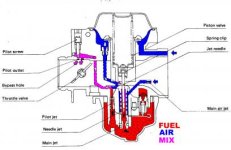
At cold start,engine needs more mixture to start and run - the enricher circuit (the choke) feeds an additional dose of mixture into carb throats. This circuit gets fuel from a tiny hole running up from fuel bowl and some air thrown in thanks to choke plunger gizmo.
 

Attachments

  • image.jpg
    image.jpg
    20.3 KB · Views: 0
My understanding is that when I apply choke I am leaning out the mixture meaning it is getting more gas and less air ... Right?

No. The "choke" is actually an enrichment circuit that adds more gas to the mixture, making it RICHER, not leaner.

It doesn't change the amount of air, it just changes the ratio between the two by adding more gasoline.
 
Did you replace those intake/carb holder rubber things and the O-rings? Sounds like you develop a lean condition after full engine temp is developed (makes things worse)
 
yes, per enricher/choke. It's the one thing on the bike you can use to quickly enrich the mix to engine (more gas per air). You can turn the idle mixture screw in and out all day long and its not going to "enrich" much. It just delivers more or less through the idle jet. as a proportion versus what the main system is adding see Toms decription above. The idle system is independent of the main jet system (the throttle and setting the idle speed is the throttle being opened a little more but they both work together....higher idle rpm is sucking more mix from both.

Maybe your high speed run dislodged crapola and you'll have to do the carbs again but also as above (smilin'brad), the rubber boots are a very common problem being so old-you didn't mention them.
Just a thought- make sure the little screws are still in the boots...the ones for "Carb synching". These can let a lot of air in! if they fall out.

Add:there's some pretty good diagrams in shop manuals. This one I have for a gsx250 has separate descriptions and diagrams for each of the three circuits (idle, main, and enrichment ("starting" they call it)
 
Last edited:
Thank you so much .. I didn't change the plugs so I am afraid that any clues on the plugs will be mute since they are there since before the rebuild. I will pull them out and clean them so I can get some new evidence. The odd part for me is if it were stuff left in the carbs because I didn't get all the junk out why does it run so perfectly right up until the oil temp gauge reads about 208. That is when the trouble starts. Until then it runs like a new bike. I would think if it was shmultz in the carbs it would affect it from start to finish.

I charged the battery over night and took it out again this morning but ... same thing .. once the gauge reaches about 208... done and I have to restart with the choke and limp it home with the choke part way engaged. Im older now so I am trying to be smarter and not just throw money at it not knowing what it might be. I did the WD 40 test for leaks at the boots going to the engine from the carb and the header clamps and no change in idle at all.
 
Some of the information presented above is quite accurate, some is pretty close, but nothing is really "wrong", so I will toss my two cents into the arena.
I cleaned and lined the tank, put in a new petcock, ...
I can understand the "clean", but why did you line the tank?


... and cleaned and rebuilt the carbs all for the float and needle emulsion tube which were just cleaned and reinstalled and I put a new fuel cap.
Just how did you "clean and rebuild" the carbs? You mention the float and emulsion tubes specifically, which leads me to believe it might not have been a complete job.


I can get the bike home by opening the choke about half way. It doesnt run great but it gets me home. My understanding is that when I apply choke I am leaning out the mixture meaning it is getting more gas and less air ... Right?
You are right in that you get more gas and less air, but that is a RICHER mixture, not a leaner mixture. Also note that this is not accomplished in the same manner as most older automobiles. Their choke was a plate that actually choked off the intake of the carb. The increased suction also sucked more gas through the normal jets, which resulted in a richer mixture. Our bikes do not have that choke plate, they have a separate circuit that provides a set amount of air and a set amount of fuel that is a richer mixture. This is the "Enrichener" circuit or "starting" circuit. Since it does not have a plate that blocks the carb intake, I always refer to it as the "choke", in quotes.


When I rebuilt the carbs I set the air screws at 2.5 turns from lightly seated like the tutorials specified. What is the relationship between the airscrews, the choke and the idle adjustment knob on the bottom of the carbs?

I'm thinking the jets are going to put a set limit on how much gas can pass through so really the only adjustment is the airscrews to match what is being delivered through the jets .. but .. I'm not sure. Its great when I read responses like turn it to 3 full turns but I truly want to understand in a newbie way how things work so I can learn. Always been an inquisitive type. Thank you for any help. I am a hard head so I will get this damn thing working correctly if it takes me 5 years.
OK, first of all, 2.5 turns might be good for some carbs. It might be where your carbs actually need to be to run properly, but they might be carbs that need to be at 2.75 turns, not 2.5. The bike will run a lot better on a mixture that is a bit too rich than it will on a mixture that is slightly too lean. With a lean mixture, it can run poorly enough that you don't know WHAT is causing the problem, so I always start with a rich mixture. After all, you use a richer mixture when you apply the "choke", right? I have found that 3 full turns is a good starting point.

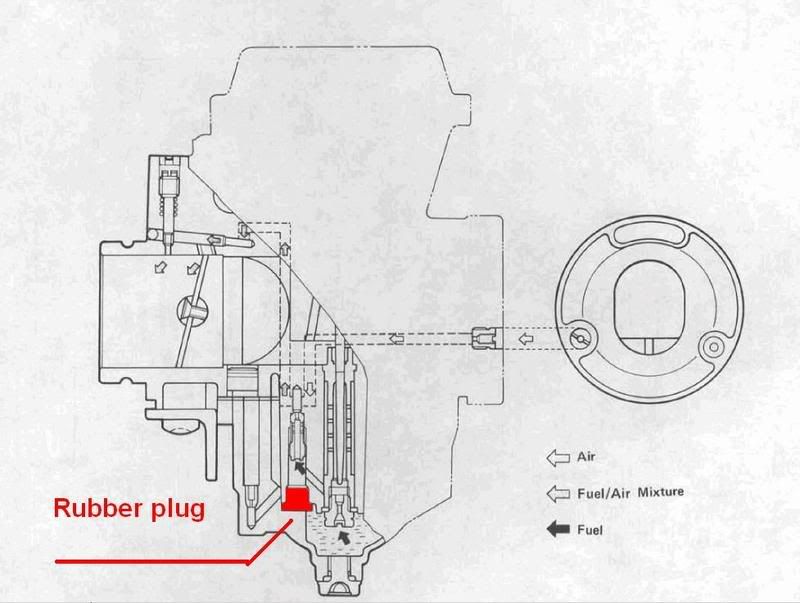
What do those 3 full turns do for you? Tom203 posted a diagram of a carb. It is similar, but not exact for a GS, so here is a proper picture:
CarbRubberplug.jpg

Looking at the right side, you can see the pilot air jet in the 8 o'clock position in the carb intake. It admits a certain amount of air through the passage to the pilot fuel jet, which is directly above the rubber plug. Together, they provide a set mixture to the passage that runs over the throttle plate. Note the two outlets at the top of the throttle plate. One is exposed all the time, but can not provide enough fuel for the bike to run at idle, so you need to add some by turning the mixture screw out. It controls how much of a pre-set mixture is admitted to the air stream, so more mixture will be a RICHER mixture, overall. As you slightly open the throttle, the 'hidden' outlet is uncovered, so it will provide a bit more mixture, as well. That usually handles the mixture until the throttle is opened enough to draw fuel up the needle circuit.

As somebody already mentioned, the throttle plates need to be synchronized to ensure that they are all contributing equally. I do that first, then will tweak the mixture by turning each screw IN a little, listening for a drop in engine speed. When it drops, back the screw out a bit, continue to the next one.

The idle speed knob below the carbs controls ... well ... idle speed. Most of the bikes like the speed to be between 1000 and 1200.

As to your stalling issue: it has been suggested to pop the fuel cap to see if you have a venting issue. Good suggestion, just listen for a big WHOOSH when you open the cap.

Another thing is that there might be a piece of crud that has come loose and is blocking one of those small ports in the carbs. Might be worth your time to remove the carbs and spray some cleaner BACKWARD through the passages. Take out the mixture screws and the pilot jets, spray from the mixture screw port back toward the pilot jet. You stand a better chance of disloging something that might be stuck.

.
 
thank you for the pix and education .. I have read some 100 or more posts but it helps to understand them by understanding the terminology and how all the parts work together.

Steve .. I did a chem dip for 12 hours per carb, then sprayed carb cleaner through the passages. then I cleaned them under running water and then blew them all out with compressed air. I could not save most of the parts and bought a K&L kit but it doesnt come with emulsion tube or floats so those were cleaned and put back in. I am wondering if I got that emulsion tube as clean as I could. I did NOT poke with wire but think I will when I do it again. The previous owner had put some type of stabilizer in the tank and the inside of the carbs looked like they had epoxy in it. It wasnt varnish .. it was something else.
 
With that "epoxy" look, I would not have settled for a 12-hour dip. I automatically do a 20-24 hour dip anyway, even when things look pretty good.

I know the directions on the can say to dip for "15 to 30 minutes", but I think those directions were written many, MANY years ago, when the chemicals inside the can could still do the job in that time frame. I think they need to revise that to "15 to 30 HOURS" for what's in the can now.

Poking a wire through the emulsion tube holes is a good idea, but it's really only air that goes through them. However with the condition those carbs must have been in, even air might not have made it through.

.
 
If the bike runs well for a few minutes then starts to play up you can pretty much rule out dirty carbs. If the pilot (or any other) circuits where blocked it would run like crap all the time.

You either have a fuel delivery problem (non venting tank) or maybe the intake rubbers / o rings are leaking when the bike gets hot. You also may have defective coils as they will start to break down when hot, but I would first start with ruling out the fuel delivery problem. Run the bike til it starts to play up then undo the gas cap. If it comes good you know that's the problem, if it continues to run poorly then move on to checking for leaks at the intake rubbers, and so on.
 
So I was taking out the carbs to try cleaning again although I am in agreement with hillsy .. if it were dirty carbs it would be crappy all the time not just when it got hot but .. I am game for anything so I was taking them apart and discovered that I left 2 screws on the top of number 3 carb only hand tightened. I was fitting the bracket back in that holds the throttle cable and choke cable when I reinstalled the carbs last time and I guess I meant to come back and tighten them but when I went to take off the bracket just now I realized they were loose. I mean take them out with your hand loose.

I dont think that would cause my issue but ... Could it?

DSCF7442sm.jpg

I am going to drain my gas tank and strain the gas through a pantyhose and see if I catch anything. I am thinking I may remove the petcock and rinse the tank and screen and then reinstall before I go to clean the carbs again. Like I said. It fires right up first try on choke, lower the choke to half after about 20-30 seconds and idles fine after about 90 seconds. Runs perfect through every gear up to about 6500 rpm. Smooth as silk actually and my wife was very happy with our outing. Then after I last filled the tank .. once it hits proper operating temp it stalls out. I can restart only with choke and run it home only with choke.
alex
 
My coils look a bit on the rough side as do the contacts and I know I passed a tutorial or 2 that outlined how to test them. So maybe that is next. I read in some old archived posts that heat was affecting the coils and causing the bike to stall but none of the posts I read mentioned being able to start on choke and run it like I can. All the posts I read said that either the bike wouldnt start again .. and it was a charging issue and I dont think I have that .. or once they let the bike cool for 30 minutes it started right up.

coil%201.JPG


coil%202.JPG


Coil%203.JPG
 
Last edited:
Always, always, always get the electrics right 1st. If not, everything else is a clusterf*ck. To begin with, your coils are really sorry looking pieces and coils can do all sorts of things. They can be crap when cold, ok warmed up.....or do the exact opposite. Get some good coils & wires on it, paying attention to the resistor issue with them. How's the wiring on the rest of the bike? You may have insufficient juice TO the coils. You can check that out by running a hotwire to the coils off the battery or fusebox. If it doesn't puke when warmed up you know where the problem lies. As far as the carbs go, you said it ran fine the 1st few times. You may have something getting clogged up but they don't just walk out of adjustment.
 
crazy question .. I am using 3/16 prestone fuel line for my vacuum line from the petcock to the carb. It appears in cross section to be reinforced with cord but ... is there something else I should be using? Is the fuel line rigid enough? Seems thick enough that it wouldnt collapse but I have the tank off and figured I would ask.

I rinsed out the tank and the petcock screen and I am going to remount and head out tomorrow with the tank open and just a couple of gallons of gas and see what happens before I dig back into the carbs. I tightened up the two loose screws at the top of carb 3. May buy new coils just to have new coils.
 
Back
Top