• Required reading for all forum users!!!

    Welcome!
    Register to access the full functionality of the GSResources forum. Until you register and activate your account you will not have full forum access, nor will you be able to post or reply to messages.

    A note to new registrants...
    All new forum registrations must be activated via email before you have full access to the forum.

    A Special Note about Email accounts!
    DO NOT SIGN UP USING hotmail, outlook, gmx, sbcglobal, att, bellsouth or email.com. They delete our forum signup emails.

    A note to old forum members...
    I receive numerous requests from people who can no longer log in because their accounts were deleted. As mentioned in the forum FAQ, user accounts are deleted if you haven't logged in for the past 6 months. If you can't log in, then create a new forum account. If you don't get an error message, then check your email account for an activation message. If you get a message stating that the email address is already in use, then your account still exists so follow the instructions in the forum FAQ for resetting your password.

    Have you forgotten your password or have a new email address? Then read the forum FAQ for details on how to reset it.

    Any email requests for "can't log in anymore" problems or "lost my password" problems will be deleted. Read the forum FAQ and follow the instructions there - that's what we have one for...

  • Returning Visitors

    If you are a returning visitor who never received your confirmation email, then odds are your email provider is blockinig emails from our server. The only thing that can be done to get around this is you will have to try creating another forum account using an email address from another domain.

    If you are a returning visitor to the forum and can't log in using your old forum name and password but used to be able to then chances are your account is deleted. Purges of the databases are done regularly. You will have to create a new forum account and you should be all set.

Carb help please

  • Thread starter Thread starter BurtyMcSquirt
  • Start date Start date
I will have to really sit down tomorrow to absorb all of this. What tremendous info. I will answer all the question I can for you and fill you in on some other things. Wow! I am impressed.
 
Haha yeah Chuck! What a crazy amount of info.

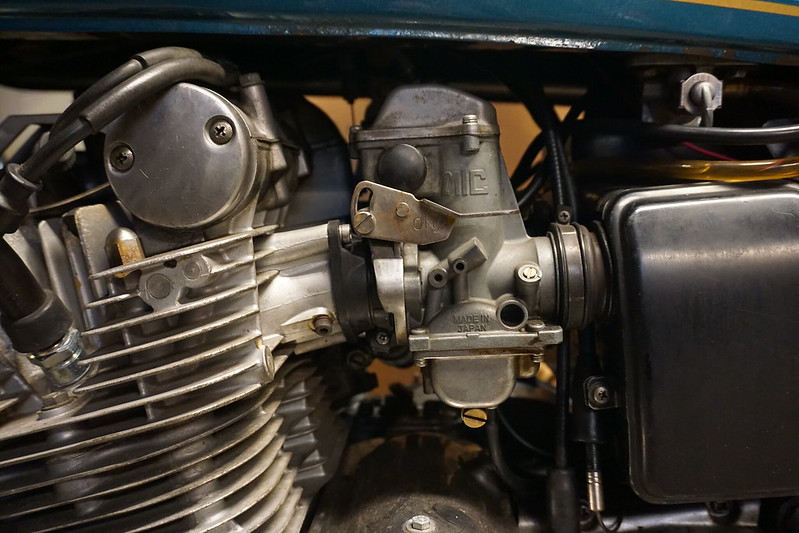
For a comparison, here is a similar picture that I happened to have on my flickr of the stock vm26's on my '77 GS750:

26486796759_6543168c20_c.jpg
 
I will have to really sit down tomorrow to absorb all of this. What tremendous info. I will answer all the question I can for you and fill you in on some other things. Wow! I am impressed.

Wow is right, don't feel bad, most of us are way behind the technical prowess of Chuck78!
 
Hey I just thought of something else obvious/necessary... are you certain you are getting plenty of fuel flow???? And not too much on cylinder #3???

Your vacuum petcock may not be operating properly. Are you sure the vacuum line that goes to the petcock from carb #3 is not dripping fuel out of it? And that the petcock is opening fully upon applying vacuum to it???

Your symptoms are pretty drastic, so I wanted to check more obvious issues.
You can disconnect and plug off the vacuum hose from the petcock (dove a pin or nice round nail or fine thread screw into hose), then turn the petcock to "Prime," & then try to ride the bike, see if anything different happens.

the float needles are critical to check and replace if you haven't already. They need to seal well. Or else you will be rich everywhere.


Thank you for the kind words, allojohn.. I'm just a huge 2 wheeled mechanical geek, really. I'm still learning... lots more to learn. Guys like GregT, rapidray, 49er, wera90ex, etc are the true technical wizards of these bikes...
 
i've rebuilt the petcock and tested it to the best of my ability. I installed all clear fuel lines so that I can see whats happening and its moving through. I have tried to ride it on prime with the vacuum line plugged and its still the same issue. I've replaced all the float needles as well. I'm beginning to wonder if it may be something more drastic like a bent valve or lost compression. I don't get much smoke from it but there is some, not enough to alarm me based on the dirtbikes I've worked on. It does throttle well when it isn't under load its only dying when engaged with the transmission.
 
Yes, another thing I was going to say, do you have access to a compression testing gauge? You have to have compression, fuel, spark, and proper timing of ignition and camshafts to make everything work.

Do a compression test after adjusting the valves properly. Put the compression test gauge in one cylinder at a time with the other spark plugs all out, and crank engine over with electric start if possible, while you hold throttle open all the way. Record results. Then squirt a little bit of engine oil into each cylinder through the spark plug hole, this helps if you have an old school oil squirter canister. You can just drizzle some in from the cap of a 1 quart oil jug if needed. Then kick the engine over many times with the KICKSTARTER (avoid Hugh speeds and electric to try and not get any oil on the valve seats/faces) to get the oil spread around as best as possible on the cylinder walls and around the full circumference of the rings. Then repeat, put the compression test gauge in one cylinder at a time with the other spark plugs all out, and over with electric start if possible, and hold throttle open all the way, record results.

If your numbers are low on the first test, below 120 or below 110, and they are high on the second test, say 180 everywhere, you know you have some bad rings somewhere, or damaged pistons or cylinder walls. If you didn't use too much oil on the west test, and your numbers are still low, you know the Rings are ceiling, but you have burnt valves or lots of carbon buildup on the valve seats and faces. If the valves were hanging open, Carbon can get built up on them and cause them not to seal. I have rejuvenated engines from dumping a very liberal amount of oil into the cylinders and running them, which helps break loose the carbon without dismantling the head. Perhaps automatic transmission fluid might help loosen the carbon more, just as it does help loosen rusted/stuck rings? That's another thing, you could also have some sticking piston rings if the bike has not been ridden much. Carbon buildup on the valves or a burnt valve is more likely.


Doing a top end rebuild on these isn't really that difficult, but some steps are a bit tedious (taking great care not to bang up pistons, damage gasket surfaces, etc. Ring gaps, bore clearances if just re-ringing yourself, ring clocking, & most of all, cam timimg, are pretty particular. Taking the head to a machine shop for a proper valve job and possible resurfacing is the highly skilled part that most of us will source out. And boring/decking the cylinders.

If you find that you have to pull the head and cylinders, you may want to look into boring a Wiseco K844 kit into the cylinders, and decking the block about .010"/0.25mm. The kit can be had for as cheap as about $418, and I believe that is with head gasket.
Several years ago, MTC Engineering still had a few sets of discontinued +2mm (67mm) overbore high compression 798cc piston sets available for $250. No head gasket. These would be pretty nice in there. Or cruizin_image_co in Japan (ebay) remakes OEM style cast pistons for GS's, I have an 870cc gs850 +1mm set that I was going to install. It was less than $200 shipped! TheY may make 66mm overbore pistons for the 750 as well. If not, a standard bore set of 850 pistons from them will also bore right into the 750 cylinders. That is the ABSOLUTE MAX you can bore them out however.
Or get an 850 cylinder off ebay if you want to put more effort into it, bore it +1mm to 870cc, resurface the deck ( pretty much always needed on 850 cylinders because of the original OEM head gaskets deteriorating). You will have to spend some time clearancing the crankcase, which means is best to dismantle the entire bottom end to do this, and then install new seals everywhere down there while it is a part, and then clean the case halves and RTV silicone and back together with special case sealer RTV. It is possible to clearance the cases to fit the bigger 850 cylinder without dismantling the bottom end, but not recommended. You have to be very tedious to not get metal shavings down there. It only rubs in a few spots per cylinder. The Wiseco kit bored into your stock cylinders will be much easier but cost more up front. Because your cylinders already fit the current case.
vroom vroom!
I love modifying bikes (GS, KZ, 2 stroke dirtbikes) for better performance. Engine, chassis, brake, wheel, suspension, you name it... is it obvious?
 
A while back, you were showing the settings that you had, then mentioned VM29 carbs, which got another flurry of activity. Now that the hubbub has settled down a bit, let's re-visit those settings, just to establish a baseline.

- Set the float level to the stock 24mm. I think you mentioned some other number.
- Set the pilot fuel screw (the one on the bottom) to 1 full turn out from lightly seated. Stock is 3/4 to 7/8, the extra bit is for the pods.
- Set the pilot air screw (the one on the side) to 1 1/2 turns out from lightly seated. After fine-tuning, it might end up about double the fuel screw setting, but starting at 1 1/2 will give a slightly richer mixture for easier starting.
- Treat your bike to some new NGK B8ES spark plugs.
- Make sure the valves are properly adjusted.

With those basic items addressed, you can do some fine-tuning, but it will be from a known, established baseline.

.
 
Test compression first before going any further with carb adjustments.

Then proceed with carb adjustments, with float height check, and bench synchronization first and second.
 
Last edited:
just a thought but perhaps the mechanical advance should be checked for proper operation
 
I'm not sure I know what that is or how to do it?

It's time for you to walk away from your bike, find a comfy chair and spend a day or two reading through the workshop manual. Everything you need to know about your bike is in there.
 
mechanical advance is the thing the behind the timing plate that spins. mark your timing plate so it can be put back in at the same spot and remove it by taking out the 3 big bolts. Twist the mechanical advance to see that the weights open AND it snaps back when released. also a good time to give it a smear of a LIGHT grease on the shaft.
 
Happy Thanksgiving everyone. Today I'm thankful for all the help and great people I've experienced in this community. Enjoy your friends and family today and I'll update you when I've had time to tinker. God Bless.
 
Well fellas I just road my bike all over town and through all gears with no loss of power and it feels GREAT!!!!
 
FANTASTIC!!! CONGRATULATIONS!!!! What did you do to it this time to get it going right? Float height, slide needle position, & dialing the fuel screws on the bottom in to around 7/8 to 1-1/16 turns out?

55 degrees here, great for late November in Ohio. wow I wish I were riding dirt bikes today... got roped into doing side jobs though... $$$$
 
Last edited:
FANTASTIC!!! CONGRATULATIONS!!!! What did you do to it this time to get it going right? Float height, slide needle position, & dialing the fuel screws on the bottom in to around 7/8 to 1-1/16 turns out?

55 degrees here, great for late November in Ohio. wow I wish I were riding dirt bikes today... got roped into doing side jobs though... $$$$

I took the carbs out and cleaned them again, did a very particular bench synch, put 115 mains in with the 17.5 pilots, really took the time to dial in the air and fuel mix screws, and took the mods i made out of the pods. Now I've got a problem where carb #1 is pumping fuel out of the overflow tube with the bike on or off. Its a steady pump of fuel for 1 second and then a pause for 3-4 seconds and then repeat.
 
Your float needle is probably sticking. Try gently tapping on that bowl with a screwdriver handle or rubber mallet. If that doesn't do it, you can take that bowl off (with the carbs on the bike) and shoot some carb cleaner up there to try and dislodge/clean out what is hanging it up.
 
I took the carbs out and cleaned them again, did a very particular bench synch, put 115 mains in with the 17.5 pilots, really took the time to dial in the air and fuel mix screws, and took the mods i made out of the pods. Now I've got a problem where carb #1 is pumping fuel out of the overflow tube with the bike on or off. Its a steady pump of fuel for 1 second and then a pause for 3-4 seconds and then repeat.

Could be a sticking needle jet, leaky petcock, or the theres a leak around or on the brass overflow tube like I had on mine. It was a hairline crack, but it would dump fuel through the crack. I just jb weld the crack, how long will it last? i dont know, but it worked for me.

Also i pretty much have the same setup as you right now, do you mind telling me what your settings are turn wise and where your jet needle clip is on? im running 115 mains and 17.5 pilots too. I keep bogging after 4500 or so.

Edit: my bad i meant float needle lol (thanks chuck)
 
Last edited:
Could be a sticking needle jet,
^ ^ ^ I believe he meant to say a sticking float needle or sticking float. The needle jets do not stick, they are fixed to the slide which moves with the throttle cable action


or the theres a leak around or on the brass overflow tube like I had on mine. It was a hairline crack, but it would dump fuel through the crack. I just jb weld the crack, how long will it last? i dont know, but it worked for me.

YES... this is definitely a possibility, as this is very common. I probably have 7 or 10 fuel bowls here that have cracks in that overflow tube, which always tricks you into thinking your carb is overflowing. Really, the fuel is just leaving through a crack and may already be at or near the proper level, and not actually overflowing.
J-B Weld is not gasoline resistant unless you let it cure for a long period of time, several days or a week. Knowing this, the last time I ran across this for a friend's bike, we got a small plumbing torch and soldered the entire exterior of the overflow tube that is in contact with fuel, after sanding it down substantially to clean it.

You could still have a sticking float or float needle, or just misadjusted float. Checking the actual fuel height while the bike is running using a small clear hose shaved down to a point to jam into the drain screw hole of the fuel bowl will tell you if your carb is actually overflowing or if the overflow tube is just leaking.

If you have an air compressor, what do you want to do is take a blow gun air nozzle with a rubber tip, remove the fuel bowl off of the carb, fill it with water, put your finger over the top of the overflow tube, and put the blow gun rubber tip nozzle on the bottom outlet of the overflow tube. Hold your finger capping off the tube really well and blow high pressure air through the tube. Look for bubbles anywhere on the tube where it would be submerged in fuel. I do this as a standard test on every single set of VM carbs that I work on now, since I have ran into so many that are cracked. It seems to correlate with bikes that live in cold climates or have a lot of extreme temperature swings, hot to cold.


Hope this helps ya, Burty.


Let me know if you ever make any riding trips West or Southwest of Pennsylvania. I know an immense amount of incredible twisty roads in Southeast Ohio and West Virginia, learning more in Eastern Kentucky. I love getting down that way as much as possible. The Appalachian Hills lend themselves to a lot tighter twisty roads once you get south of Pennsylvania. Most of Ohio is really flat, but I can show you some of the best roads in the east in Southeast Ohio! I don't think the stuff in Pennsylvania compares whatsoever to the stuff bordering in West Virginia or Southeast Ohio
 
Back
Top