• Required reading for all forum users!!!

    Welcome!
    Register to access the full functionality of the GSResources forum. Until you register and activate your account you will not have full forum access, nor will you be able to post or reply to messages.

    A note to new registrants...
    All new forum registrations must be activated via email before you have full access to the forum.

    A Special Note about Email accounts!
    DO NOT SIGN UP USING hotmail, outlook, gmx, sbcglobal, att, bellsouth or email.com. They delete our forum signup emails.

    A note to old forum members...
    I receive numerous requests from people who can no longer log in because their accounts were deleted. As mentioned in the forum FAQ, user accounts are deleted if you haven't logged in for the past 6 months. If you can't log in, then create a new forum account. If you don't get an error message, then check your email account for an activation message. If you get a message stating that the email address is already in use, then your account still exists so follow the instructions in the forum FAQ for resetting your password.

    Have you forgotten your password or have a new email address? Then read the forum FAQ for details on how to reset it.

    Any email requests for "can't log in anymore" problems or "lost my password" problems will be deleted. Read the forum FAQ and follow the instructions there - that's what we have one for...

  • Returning Visitors

    If you are a returning visitor who never received your confirmation email, then odds are your email provider is blockinig emails from our server. The only thing that can be done to get around this is you will have to try creating another forum account using an email address from another domain.

    If you are a returning visitor to the forum and can't log in using your old forum name and password but used to be able to then chances are your account is deleted. Purges of the databases are done regularly. You will have to create a new forum account and you should be all set.

Charging system questions

  • Thread starter Thread starter Guest
  • Start date Start date
G

Guest

Guest
The R/R sends current to the battery via the fuse board and it also sends unprotected current to the bike components directly. Wouldn't it be better to wire the +ve red lead of the R/R direct to the battery, then it would better charge the battery (without any fuse box voltage drops) and any over currents produced by the R/R would be protected by the fuse box on the return path to the rest of the bike.

Cheers

Dave
 
The wiring and charging scheme changed a bit over the years, it would help if we knew which year and model we were discussing.

.
 
Maybe :)
The way I look at it the r/r runs the bike. Charging the battery is a secondary function.
It makes sense to let the r/r see the bike before the battery.
If you were to run the r/r output direct to the battery you then have a unprotected path through the r/r if a diode fails.
If you want good battery charging then it will be better to make sure that the difference between battery and r/r ground is as small as possible.
 
bike information

bike information

The wiring and charging scheme changed a bit over the years, it would help if we knew which year and model we were discussing.
.


Mines a 1980 GS1000G European model, I would say German, but the wiring diagram from BRD is completely different to my bike.
 
I was thinking that the battery runs the bike since it is a stable reservoir of charge, whereas the R/R depends on engine speed. Sometimes a 'bad charging' light glows when the bike ticks over on some bikes. But interesting this comment on "unprotected path through the r/r if a diode fails", from what I see of the wiring diagram the only protected path is from the battery & the starter/solenoid (is that what you mean by diode?) to the R/R. So I guess a starter motor malfunction could produce a large voltage that if the R/R was wired direct to the battery (if without inline fuse) which could damage the R/R.
 
The battery can run the bike but not for long. In addition it will be supplying 12.6 Volts initially which will fall as time goes on. The r/r supplies 14 Volts pretty much all the time giving brighter lights and hotter sparks. The battery has three main functions. Starting current, reservoir at idle and a capacitative filter to smooth the ripples from the r/r output. It has to put out at a higher voltage than the battery otherwise it would take forever to recharge the battery after starting as a battery has internal resistance that must be overcome before any charge flows back in.
The diodes in question are in the r/r. A short there would be unprotected unless you fit an inline fuse between the r/r and battery +ve terminal. Many have done exactly that.
You could say that we are discussing Angels on the head of a pin here. My personal preference is the Single Point Ground story. I just like it :)
The r/r gets as uninterrupted a view of the bike and battery as possible but the battery is secondary and sits in parallel with the main load.
It's important to bring the returning currents directly to the r/r -ve avoiding voltage drops in the frame for example.
 
The battery can run the bike but not for long. In addition it will be supplying 12.6 Volts initially which will fall as time goes on. The r/r supplies 14 Volts pretty much all the time giving brighter lights and hotter sparks. The battery has three main functions. Starting current, reservoir at idle and a capacitative filter to smooth the ripples from the r/r output. It has to put out at a higher voltage than the battery otherwise it would take forever to recharge the battery after starting as a battery has internal resistance that must be overcome before any charge flows back in.
The diodes in question are in the r/r. A short there would be unprotected unless you fit an inline fuse between the r/r and battery +ve terminal. Many have done exactly that.
You could say that we are discussing Angels on the head of a pin here. My personal preference is the Single Point Ground story. I just like it :)
The r/r gets as uninterrupted a view of the bike and battery as possible but the battery is secondary and sits in parallel with the main load.
It's important to bring the returning currents directly to the r/r -ve avoiding voltage drops in the frame for example.

I think what might be a good solution is to wire the R/R upstream of the fuse box at the fuse box's bullet connector with the battery input, that way the R/R current to the components is protected and the bike still gets the current before the battery (which will be good for high load items such as heated grips).

I notice that the fuse box has a second 10 Amp fuse on the positive input but can't understand how this is supposed to function (the positive current is also in parallel going to the frame or to the box itself to charge the fusebox up?! isn't this just going to drop voltage for no good reason?), I don't really understand what the + symbol in a circle is supposed to represent here.
 
I notice that the fuse box has a second 10 Amp fuse on the positive input but can't understand how this is supposed to function (the positive current is also in parallel going to the frame or to the box itself to charge the fusebox up?! isn't this just going to drop voltage for no good reason?), I don't really understand what the + symbol in a circle is supposed to represent here.
That "extra" fuse is for accessory items. Unless, and until, you connect something to that terminal, NO current flows through there. It is unswitched, so power is available without turning the key ON. It is a convenient place to connect your heated clothing and your battery tender.

.
 
Taking on board the single point ground and the relay for ignition mod, I've come up with the following plan, what do you think?

modifiedWiringGS100G.jpg
 
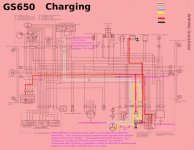
Look at OEM diagram. Mods aren't required. Regulator direct to red which goes through keyswitch to orange. Orange supplies all 10amp fused circuits. Red also charges battery through 15 amp MAIN fuse. EXTRA Fuses are not required on charge output.

Charge output is greater than the chemical battery can ever supply. Therefore, charge output is running the bike.


13-Charging.jpg

Starter circuit is different. It is momentary, until motor spins stator magnets... "starting" is the only time "+" is supplied by battery...that is, when it "flows out" of battery.
 
Last edited:
It's important to bring the returning currents directly to the r/r -ve avoiding voltage drops in the frame for example.

I take issue with this. There are no "voltage drops" in a steel motorcycle frame.
 
In <my> opinion (for what that's worth ), the frame could be used as the "single-point ground" as long as you can GUARANTEE that there is a corrosion-free path between any of the devices and the ultimate ground to the battery.

There are some devices that do ground to the frame, but most have their own wire that already gets pretty darn close to the battery. It is actually a simple matter of gathering all those black/white wires that are near the battery, connecting them together ("single-point"), then adding another wire from that point to the battery - terminal. Ideally, there will be a total of just three wires connected to the battery. Two of them will be on the - terminal, one will be the large one that goes to the back of the engine block to ground the starter, the other will be a more-modest size one to ground everything else. The third wire on the battery will be the large one on the + terminal that goes to the starter solenoid. The red wire that goes to the fuse box should come from the solenoid end of that wire to minimize the wires you need to keep track of at the battery.

.
 
Look at OEM diagram. Mods aren't required. Regulator direct to red which goes through keyswitch to orange. Orange supplies all 10amp fused circuits. Red also charges battery through 15 amp MAIN fuse. EXTRA Fuses are not required on charge output.

Charge output is greater than the chemical battery can ever supply. Therefore, charge output is running the bike.


View attachment 61734

Starter circuit is different. It is momentary, until motor spins stator magnets... "starting" is the only time "+" is supplied by battery...that is, when it "flows out" of battery.

Yes, you're right nothing damageable is between the reg and the fuses. I will stick to the oem wiring for this .
 
In <my> opinion (for what that's worth ), the frame could be used as the "single-point ground" as long as you can GUARANTEE that there is a corrosion-free path between any of the devices and the ultimate ground to the battery.
.

That's the way I look at it. At every connection into and back out of the frame you have three, possibly four, dissimilar metals just waiting to have the galvanic talk with each other plus they are out of sight which is out of mind. My SPG is one of the start relay mount screws.
 
The way I look at it is comparison to every other vehicle or motor I have owned .They have very little trouble with corrosion at ground points... Excepting boats... in saltwater where there is always trouble brewing somewhere...but it's not the grounds to motor or battery thats common- it's usually the lug itself-versus copper wire-versus salt electrolyte..add some solder or tin or silver or stainless(nickel) and watch it bloom! The + side is just as prone if not more so.

But it's simple to check anytime. Zero the meter, touch the Bat- and the frame connection.... =0 ohms or redo it...

But that's merely a preference. Cosmetic -I don't like extra wire,extra lugs... Stackem 10 high if you like....Thing is, with stacked lugs (ring or openU) of an SPG or + connections, each lug needs to be rotated a bit to sit flat.... Removing one component needs shepherding a bunch of lugs...sure, I can stack a couple of + rings on the Solenoid BAT or a couple of - on a grounded bolt and that's "ok" but more can be tight and awkward...
 
Last edited:
Back
Top