• Required reading for all forum users!!!

    Welcome!
    Register to access the full functionality of the GSResources forum. Until you register and activate your account you will not have full forum access, nor will you be able to post or reply to messages.

    A note to new registrants...
    All new forum registrations must be activated via email before you have full access to the forum.

    A Special Note about Email accounts!
    DO NOT SIGN UP USING hotmail, outlook, gmx, sbcglobal, att, bellsouth or email.com. They delete our forum signup emails.

    A note to old forum members...
    I receive numerous requests from people who can no longer log in because their accounts were deleted. As mentioned in the forum FAQ, user accounts are deleted if you haven't logged in for the past 6 months. If you can't log in, then create a new forum account. If you don't get an error message, then check your email account for an activation message. If you get a message stating that the email address is already in use, then your account still exists so follow the instructions in the forum FAQ for resetting your password.

    Have you forgotten your password or have a new email address? Then read the forum FAQ for details on how to reset it.

    Any email requests for "can't log in anymore" problems or "lost my password" problems will be deleted. Read the forum FAQ and follow the instructions there - that's what we have one for...

  • Returning Visitors

    If you are a returning visitor who never received your confirmation email, then odds are your email provider is blockinig emails from our server. The only thing that can be done to get around this is you will have to try creating another forum account using an email address from another domain.

    If you are a returning visitor to the forum and can't log in using your old forum name and password but used to be able to then chances are your account is deleted. Purges of the databases are done regularly. You will have to create a new forum account and you should be all set.

Charging System QUICK TEST

Well, there are no pinched wires. They look good from stator to connectors at the other end. I slid the fabric insulation sleeve up from both ends so I could check thoroughly. That said, I'd be surprised if I had pinched all 3 wires. Could there be an internal stator problem that's causing it ground out when it gets hot?

I'm emailing them now about warranty and will quote my test results

The wire is typically insulated (but thin) and then they should cover them in epoxy to immobilize the windings. It would be hard to figure out where the short was unless there was some obvious damage like you dropped the stator and you coudl see a cracked insulation.
 
The wire is typically insulated (but thin) and then they should cover them in epoxy to immobilize the windings. It would be hard to figure out where the short was unless there was some obvious damage like you dropped the stator and you coudl see a cracked insulation.

Didn't see anything like that but, like you said, it may be tough to see. It certainly wasn't dropped or mishandled, at least by me. I still have my old stator and have installed it while I wait on a new one. It wasn't working the best, but it's better than not at all.

Preliminary Phase B tests on the old stator showed 1.2 ohms on all 3 legs and infinite to ground. Waiting for a battery charge to do the voltage tests.
 
Just to add to the thread, I started my bike the other day and it was a bit sluggish but started so I just thought it must be my imagination but on my way out and about I noticed the indicators would stay on and not flash so when I arrived home I put a multimeter on the battery and found it was only 12.6 at whatever the rev range.

My immediate reaction was oh my word I'm going to have to buy a new stator, mosfet series R/R and sell some internal organs to cover the cost. :eek:

Once I had calmed down I started to read posplayr's many pages on the GS charging system the main message that came up was check the connections, both earth and live.

I started by cleaning all the earth points in the loom, regulator-rectifier earth cables and mounted them in 1 place also I checked and cleaned the earth point from the battery to the frame and made a new cable from the earth on the battery to the earth point where all the other earths were mounted. I also cleaned all the live side of the charging circuit including removing all the fuses and cleaning the mounts and the fuses themselves.

I had put the battery on charge the night before so it was fully charged when I put it back on the bike and was good to go.

When I fired the bike up I had 12.8v at idle and 13.6v at 2000 rpm rising to 14.2v at 5000 rpm. :cool:

So the moral of the tale is before you get drastic with the plastic go back to basics and check and clean the connectors then have a single point earth connection with a good connection to the battery and to earth on the frame, worst case at least you know the wiring is good or in my case it actually sorted out my problem.
 
Just to add to the thread, I started my bike the other day and it was a bit sluggish but started so I just thought it must be my imagination but on my way out and about I noticed the indicators would stay on and not flash so when I arrived home I put a multimeter on the battery and found it was only 12.6 at whatever the rev range.

My immediate reaction was oh my word I'm going to have to buy a new stator, mosfet series R/R and sell some internal organs to cover the cost. :eek:

Once I had calmed down I started to read posplayr's many pages on the GS charging system the main message that came up was check the connections, both earth and live.

I started by cleaning all the earth points in the loom, regulator-rectifier earth cables and mounted them in 1 place also I checked and cleaned the earth point from the battery to the frame and made a new cable from the earth on the battery to the earth point where all the other earths were mounted. I also cleaned all the live side of the charging circuit including removing all the fuses and cleaning the mounts and the fuses themselves.

I had put the battery on charge the night before so it was fully charged when I put it back on the bike and was good to go.

When I fired the bike up I had 12.8v at idle and 13.6v at 2000 rpm rising to 14.2v at 5000 rpm. :cool:

So the moral of the tale is before you get drastic with the plastic go back to basics and check and clean the connectors then have a single point earth connection with a good connection to the battery and to earth on the frame, worst case at least you know the wiring is good or in my case it actually sorted out my problem.

Thanks for posting. It is a wonderful case study in practicality and being one with the natural order. :)
 
Thanks for sharing. When it comes to electrical, I am such a putz. Need to.spen sometime to really understand the electrical system on my new to me GR650
 
Need some help with my 1981 GS750L that is not charging properly.
Initial voltage tests:
off 12.8
key on 12.08
idle. 12.82
2500 rpm 12.7
5000 rpm 12.57
off 12.8


This is my best recollection of my process
-I noticed some warmth coming from the bullet connectors (r/r) when the bike was running
-I cleaned bullet connectors/dielectric grease applied
-I tried running it with no improvement
-I cleaned B/W ground ring terminals from harness and their mounting points
-I cleaned ground from battery to engine
-Upon reconnecting B/W ring terminals discovered an arc and all B/W wires measured 12+ volts (I must have left key on and probably shouldnt have had the battery still connected, but here we are)
-Proceeded to start inspecting all B/W wires figuring there must be a wire damaged somewhere allowing 12v into the ground circuit
-checked fuses/fuse panel

Other notes:
-I do have a windjammer fairing that I had to wire up the bike side connector but the bike ran fine for nearly a year with this setup.
-It does have an aftermarket airhorn which I is believe is connected properly
-I recently added a voltage meter (which I believe is connected properly) so initially when I realized I had an issue I could ride the bike and pay attention to voltage(voltage tests above were taken with multimeter)

So before I start removing all the aftermarket stuff, and continue inspecting every wire, is there something I'm missing? Could a faulty R/R, stator or other electrical component be causing this?

TIA
 
Need some help with my 1981 GS750L that is not charging properly.
Initial voltage tests:
off 12.8
key on 12.08
idle. 12.82
2500 rpm 12.7
5000 rpm 12.57
off 12.8


This is my best recollection of my process
-I noticed some warmth coming from the bullet connectors (r/r) when the bike was running
-I cleaned bullet connectors/dielectric grease applied
-I tried running it with no improvement
-I cleaned B/W ground ring terminals from harness and their mounting points
-I cleaned ground from battery to engine
-Upon reconnecting B/W ring terminals discovered an arc and all B/W wires measured 12+ volts (I must have left key on and probably shouldnt have had the battery still connected, but here we are)
-Proceeded to start inspecting all B/W wires figuring there must be a wire damaged somewhere allowing 12v into the ground circuit
-checked fuses/fuse panel

Other notes:
-I do have a windjammer fairing that I had to wire up the bike side connector but the bike ran fine for nearly a year with this setup.
-It does have an aftermarket airhorn which I is believe is connected properly
-I recently added a voltage meter (which I believe is connected properly) so initially when I realized I had an issue I could ride the bike and pay attention to voltage(voltage tests above were taken with multimeter)

So before I start removing all the aftermarket stuff, and continue inspecting every wire, is there something I'm missing? Could a faulty R/R, stator or other electrical component be causing this?

TIA


EDIT: I'm starting to wonder if there is some type of internal short in the R/R that is feeding 12V to ground???? Disconnect your R/R to see if the problem goes away.


Before you do anything else, I would be to figure out if you really have 12V on your ground. The only way that could happen is if you have the battery reversed.

I'm not even sure if your bike would run that way (reversed polarity on an ignitor).

Finally when conviced that probably is gone or fixed, test the stator.

Phase B tests are at 5K RPM for leg to leg and leg to ground. You can ignore the ohm meter tests.

https://www.thegsresources.com/statorpapers4.php

Summary of your results so far is that there is simply no charging. So either teh stator is dead flat not generating any AC or the R/R is internally open (stator is disconnected from the battery)
 
Last edited:
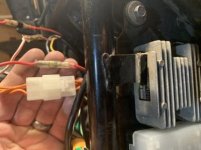
I appreciate your input. I was sure I had 12 volts on grounds, but double checked everything. Battery was hooked up correctly and 12.16volts on the grounds when the key is on. Since I discovered this issue, nothing happens when I hit start button. So I can?t test stator. My r/r has a white plug with I think 4 wires and a red wire with a bullet connection. When I disconnect the white plug or the red wire of the r/r, it kills the voltage to the grounds.
 

Attachments

  • 085E7776-6C1B-417D-A5A9-D54290ABD5E9.jpg
    085E7776-6C1B-417D-A5A9-D54290ABD5E9.jpg
    17.2 KB · Views: 0
I appreciate your input. I was sure I had 12 volts on grounds, but double checked everything. Battery was hooked up correctly and 12.16volts on the grounds when the key is on. Since I discovered this issue, nothing happens when I hit start button. So I can’t test stator. My r/r has a white plug with I think 4 wires and a red wire with a bullet connection. When I disconnect the white plug or the red wire of the r/r, it kills the voltage to the grounds.

I would strongly suspect your R/R. Remove or disconnect it completely. Try and start the bike. See why it will not crank over when you hit the starter.
 
I?ll have to investigate more tomorrow. I tried disconnecting it but it also killed the dash lights and nothing happened when I hit the starter
 
I’ll have to investigate more tomorrow. I tried disconnecting it but it also killed the dash lights and nothing happened when I hit the starter

Sounds like someone rewired the bike. Removing the R/R should not remove the battery from the circuit. The battery and R/R are in parallel to supply power to the electical system through the ignition switch.
 
Quick question, somewhat related. Is it normal for those r/r connectors to get hot whilst running? I attempted to do the quick test. Noticed the bolt on the battery negative terminal was a bit loose, which has happened before, probably due to vibration. I snugged it up and proceeded to take a few readings. Didn't get very far, as the battery is likely toast. After overnight charging on the tender, it showed 13.2v with key off, when I checked the terminals and noticed the loose negative bolt. Left it with the key on for about 40 secs (headlight on), then fired up the bike, fiddling with the idle speed for a few seconds to get it to idle. Whilst getting the meter probes into position on the battery, the r/r wire connectors happened to be in contact with my wrist, and I noticed them steadily getting hotter. I immediately shut off the bike....left it with the key and headlight on for about 20 more seconds while inspecting the wires. Bike won't crank now, shows 12.2 volt. Going to buy a new battery and then test. How warm do those bullet connectors normally get whilst running?:confused:

Edit: It is a later model r/r, fitted about 10 years ago. From a cbr, IIRC.
 
Last edited:
Quick question, somewhat related. Is it normal for those r/r connectors to get hot whilst running? I attempted to do the quick test. Noticed the bolt on the battery negative terminal was a bit loose, which has happened before, probably due to vibration. I snugged it up and proceeded to take a few readings. Didn't get very far, as the battery is likely toast. After overnight charging on the tender, it showed 13.2v with key off, when I checked the terminals and noticed the loose negative bolt. Left it with the key on for about 40 secs (headlight on), then fired up the bike, fiddling with the idle speed for a few seconds to get it to idle. Whilst getting the meter probes into position on the battery, the r/r wire connectors happened to be in contact with my wrist, and I noticed them steadily getting hotter. I immediately shut off the bike....left it with the key and headlight on for about 20 more seconds while inspecting the wires. Bike won't crank now, shows 12.2 volt. Going to buy a new battery and then test. How warm do those bullet connectors normally get whilst running?:confused:

Hot means poor connection. There is no exception, regardless if it is something loose, dirty, corroded, or otherwise compromised.

The simple reason is that a larger resistance will dissipate more heat. So unless you are talking about much larger wires or connections (that can dissipate much more heat without getting as hot).
 
Thanks for the quick reply. Are you saying they should ideally run cool to the touch, when properly connected? Would testing with a shot battery cause them to heat up more than usual? Sorry if these questions are stupid; I'm quite a duffer when it comes to electrical problems. :(
 
When you put a current path (e.g. a wire connecting a load) to the battery, current flows through that current path (cp). The current though the CP is the same no matter where you measure the current (think of water running through a hose where hose is cp and water is current). I'm describing a single current path with no splits or parallel paths.

Because the current actually goes in a full circuit (through battery, through cp and back through battery ...etc round and round), the amount of current flowing is determined by the total resistance in the battery plus cp. If that resistance is distributed evenly (ignoring battery connections) then the (cp) wire heats uniformly. However, if the resistance is concentrated at "connections", then those dissipate the heat in proportion to their total resistance.

If the bike's motor makes the wires warm, then the wires wont be cool. You just do not want a situation where the contacts are much (more than 10-20 degF) warmer than the rest of the wire.

If the battery is dead (low State of Charge), then there will be less current and correspondingly less heat all around independent of how the resistance is distributed, but still distributed in proportion to those resistances.
 
Last edited:
Thanks very much Posplayr, appreciate the simple explanation! I've never really had any electrical or even mechanical issues with this bike. Upgraded the stock r/r proactively, and have only replaced the battery every few years. It's very possible the connections now need attention. Thanks again!
 
Thanks very much Posplayr, appreciate the simple explanation! I've never really had any electrical or even mechanical issues with this bike. Upgraded the stock r/r proactively, and have only replaced the battery every few years. It's very possible the connections now need attention. Thanks again!

Ohms law is V=IR

Relating that to the pictured analogy, the voltage push (or pressure) required to overcome a given ohm resistance is in proportion to the amount of current in amp (flow) you want.

For a given R ohms, Current increases with voltage.

All of these forms are the same law; if you know the value any two, you can solve for the third.

V=I*R
I=V/R
R=V/I

attachment.php


In the case of your low battery

I=V/R (assume R is constant)
A lower V gives a lower I.

What does that have to do with heat? heat is the accumulation of energy converted to heat. Like if you burn a wooden stick, the energy in the stick turns to heat, current pushed through R gives off heat in a similar way. In fact this is considered an ideal conversion of energy to heat.

Electrical power is given by P = I*V (in words the voltage times the current is electrical power). Substitution for i or V we get two different forms

P = IV=I^2*R = V^2/R

In P=I^2*R we see power is proportional to resistance R for any given I^2.
 
Last edited:
Back
Top