• Required reading for all forum users!!!

    Welcome!
    Register to access the full functionality of the GSResources forum. Until you register and activate your account you will not have full forum access, nor will you be able to post or reply to messages.

    A note to new registrants...
    All new forum registrations must be activated via email before you have full access to the forum.

    A Special Note about Email accounts!
    DO NOT SIGN UP USING hotmail, outlook, gmx, sbcglobal, att, bellsouth or email.com. They delete our forum signup emails.

    A note to old forum members...
    I receive numerous requests from people who can no longer log in because their accounts were deleted. As mentioned in the forum FAQ, user accounts are deleted if you haven't logged in for the past 6 months. If you can't log in, then create a new forum account. If you don't get an error message, then check your email account for an activation message. If you get a message stating that the email address is already in use, then your account still exists so follow the instructions in the forum FAQ for resetting your password.

    Have you forgotten your password or have a new email address? Then read the forum FAQ for details on how to reset it.

    Any email requests for "can't log in anymore" problems or "lost my password" problems will be deleted. Read the forum FAQ and follow the instructions there - that's what we have one for...

  • Returning Visitors

    If you are a returning visitor who never received your confirmation email, then odds are your email provider is blockinig emails from our server. The only thing that can be done to get around this is you will have to try creating another forum account using an email address from another domain.

    If you are a returning visitor to the forum and can't log in using your old forum name and password but used to be able to then chances are your account is deleted. Purges of the databases are done regularly. You will have to create a new forum account and you should be all set.

Clear coat on wheels and engine cases?

1978GS750E

Forum Sage
Super Site Supporter
Past Site Supporter
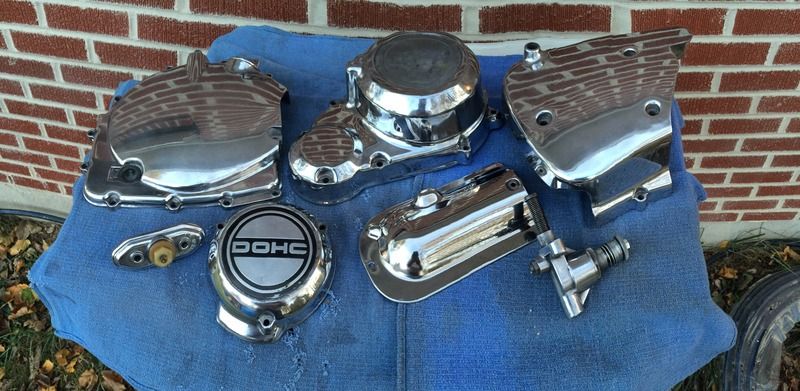
I'm restoring a 1978 GS750E and was wondering what most people do regarding clear coating polished parts. I am wondering about the wheels and engine cases. Any issues with then being coated? All of the parts will be polished to a mirror finish. If you have clear coated these parts, what brand of clear coat works best? Thanks in advance for the help!
 
Powder coat gets my vote. I used Por-15 Glisten clear before and it's okay. A little bit cloudy. They sell a special prep spray to etch the metal before application. I used it on engine covers but didn't ride the bike big miles to see how it held up to the heat long term.

BTW, a highly polished surface makes it more difficult for the paint to adhere too. Suzuki's engine covers were more of a very fine brushed finish, not polished, before clearing.
 
I used 220 grit to get a similar finish then degreased with denatured alcohol. I cleared with clear engine paint, 2 coats. It lasts a few years.
 
I used 220 grit to get a similar finish then degreased with denatured alcohol. I cleared with clear engine paint, 2 coats. It lasts a few years.
Is the 220 grit finish closer to mirror or brushed? I want to do my engine covers and would love the OEM brushed look, but I'm curious how it would come out by hand. I thought about maybe blasting it but that seems maybe a little aggressive for aluminum?
 
The key is to go in one direction. You can use steel wool but I don't recommend it because it can cause corrosion. I did my forks this way and got the satin look by going in one direction across the forks.
I redo mine every few years , I usually get about 5 years on the parts.
 
The stock finish is brushed but with something like 600 grit, not 220. You can do it by hand but it's a lot of work.
 
I recently got done polishing my cases. I went with a high polish with a buffing wheel on a bench grinder, but sanded for prep.

The prep work left a nice brushed look, I just chose to go further. As long as the parts aren't too bad you can start with 320 to remove small pits and dings, then jump right to 600 and be fine.

Go in one direction with the 320, then with the 600, sand perpendicular to the scratches you made with the 320.
 
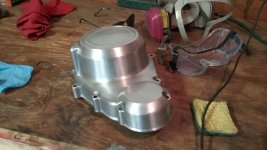
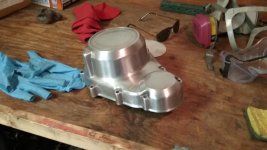
This is with 600

20170402_175941.jpg

You can see where i changed direction of sanding around the curves. I wasn't concerned because i knew i was going to be polishing. If you want to stop at a brushed finish, just make sure to go only in one direction for the final step.

Use a good wet/dry paper, and wet sand. 3M also make some good sanding sponges that are a bit easier to work with. You can get them at home depot, advance or auto zone...
 
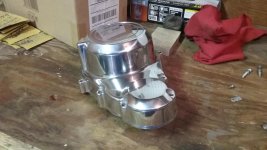
This was the finished product after black, brown, white, then red polishing compounds. I cleaned up with Dawn and a toothbrush. Then i gave it a good rub with Wizards Power Seal. Even if you're stopping at a brushed finish, i highly recomend Wizards to protect from oxidation.

20170402_222507.jpg
 
Remove old clear coat with paint stripper.

220 grit paper on a palm sized DA to get out the majority of the corrosion. A stainless steel wire wheel on a dremel for the nooks and cranies.

Sisal wheel w/ BLACK cutting compound to bring back the shine.

Done.


Remove old clear coat with paint stripper.

220 grit paper on a palm sized DA to get out the majority of the corrosion. A stainless steel wire wheel on a dremel for the nooks and cranies.

Sisal wheel w/ BLACK cutting compound to bring back the shine.

Done.


Looks like I still did way too much work. :confused:

I found the swirls from a dremel and the scratches from less than 320 took too long to work out. Also that black on a sisal looks good, but left noticeable scratches and swirls that were removed by the higher grit compounds.

I have a feeling you have a lot more practice with this than I do though... The method above is what I landed on after much trial and error, but can probably still be refined.

Do you have any pics of the pieces as a work in progress to show what it looked like after the 220 and dremel?
 
Remove old clear coat with paint stripper.

220 grit paper on a palm sized DA to get out the majority of the corrosion. A stainless steel wire wheel on a dremel for the nooks and cranies.

Sisal wheel w/ BLACK cutting compound to bring back the shine.

Done.
I use a similarly simple process, but just a little bit different. :-k
Aircraft stripper to remove the clear coat.

Harbor Freight FINE fiber sanding discs to remove any corrosion.

White compound on a sewn cotton wheel to polish.

I am pleased with the results. :-\\\

IMG_07691_zpsbamxc0nz.jpg


.
 
There are lots of different ways to achieve the results.

The reason I like the sisal wheel and black cutting compound is because it's the most aggressive polishing medium available. It will take the 220 grit scratches right out. I've tried that with a sewn wheel before and it doesn't get it. I'm lazy.
 
There are lots of different ways to achieve the results.

The reason I like the sisal wheel and black cutting compound is because it's the most aggressive polishing medium available. It will take the 220 grit scratches right out. I've tried that with a sewn wheel before and it doesn't get it. I'm lazy.

What sisal wheel are you using?...or, I should say who's? I've been using HF sewn and loose wheels...they go quickly but they're cheap enough for multiple grits. I need to invest in my own motor, wheels and a rake {?} for 1st trimming.
 
I tried the sanding discs, and a couple of other things to eliminate the manual sanding. When I went to the black compound with a sisal wheel (compound and wheels from Caswell), there were always scratches left behind. From the pics you guys posted though, it sounds like it was my polishing technique more than the polish/wheel. I got similar results, just with a lot more work. It was definitely an improvement, as I had previously polished completely by hand with progressively finer sandpaper up to 2000, and then Mothers and a rag...
 
Last edited:
Back
Top