• Required reading for all forum users!!!

    Welcome!
    Register to access the full functionality of the GSResources forum. Until you register and activate your account you will not have full forum access, nor will you be able to post or reply to messages.

    A note to new registrants...
    All new forum registrations must be activated via email before you have full access to the forum.

    A Special Note about Email accounts!
    DO NOT SIGN UP USING hotmail, outlook, gmx, sbcglobal, att, bellsouth or email.com. They delete our forum signup emails.

    A note to old forum members...
    I receive numerous requests from people who can no longer log in because their accounts were deleted. As mentioned in the forum FAQ, user accounts are deleted if you haven't logged in for the past 6 months. If you can't log in, then create a new forum account. If you don't get an error message, then check your email account for an activation message. If you get a message stating that the email address is already in use, then your account still exists so follow the instructions in the forum FAQ for resetting your password.

    Have you forgotten your password or have a new email address? Then read the forum FAQ for details on how to reset it.

    Any email requests for "can't log in anymore" problems or "lost my password" problems will be deleted. Read the forum FAQ and follow the instructions there - that's what we have one for...

  • Returning Visitors

    If you are a returning visitor who never received your confirmation email, then odds are your email provider is blockinig emails from our server. The only thing that can be done to get around this is you will have to try creating another forum account using an email address from another domain.

    If you are a returning visitor to the forum and can't log in using your old forum name and password but used to be able to then chances are your account is deleted. Purges of the databases are done regularly. You will have to create a new forum account and you should be all set.

CRAZY voltmeter to ground readings - whatthe?

  • Thread starter Thread starter Speedo
  • Start date Start date
Can a Stator that looks so good be so bad?

Can a Stator that looks so good be so bad?

POSPlayer - thank you for your thorough response. Unf, its a bit technical for an idiot like me:-s My counter-points:

1&2. I disagree that identifying is pointless. Something has to be wrong. Remember that both Shiraz and I got a lot of bounce - two sep multimeters -when just trying to measure charging voltage across battery with bike running (Stator Papers test#1 Overall Charging system health). Shiraz's 850 was rock steady with BOTH meters, my $25 cheapy and Shiraz's expensive Fluke. We also tested main ground and it was perfect.

3. Night test = no sparks/total darkness. This rules out coil & wires.

4. Same bounce with stator disconnected from RR. Which should be same as disconnecting RR since w/o stator connected to RR, RR has nothing to do/regulate. Not to mention we actually DID test w/o RR when old RR died before I put new one on.


Shiraz said it can't be a switched hot grounding to frame since that would have taken out a fuse, SOOOOO....what does that leave? Only the stator I think. I am going to redo the stator output tests from Stator papers and report results / also see if anyone has other ideas before pulling the stator cover.

Update on this saga:
Reperformed stator tests:
1. Resistance between legs was OK - all below 2ohms and about even at 1.5ish
2. Each stator leg to ground were all OK - no resistance (infinite reading as should be)
3. Output in AC volts between each pair of legs @ 4k rpm - what the hell? Readings would peak @ about 65-70 as should, but reading were jumping all over the place - JUST LIKE our weird "ghost ground pulse"!!
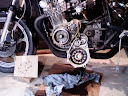
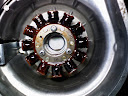
4. So I bit the bullet and took the cover off. Everything - wires as well as stator legs look perfect! But I still think it HAS to be a bad 30yr old stator, so I'm going to order a new one.
1109091648a.jpg


BTW, getting this hugely heavy thing up and leaning on the rear stand all by myself was a bit dicey and nerve-wracking, but I succeeded!!
1109091646.jpg

1109091647a.jpg
 
I am at wits end. Update, but first:
1. Someone with a late 70's GS (besides ShirazDrum who already did this) please take 1 minute, do the following, and report back:
***attach either lead of multimeter set to volts to any part of the frame, leave the other side unconnected to anything, and see reading=nothing (like Shiraz's bike) OR if the voltmeter goes crazy with readings jumping all over the place (like my bike). My thinking is, with all the discussion about a "sneak path" ground via frame and all, could this possibly be "normal" and I'm doing all this work/worrying for nothing??***


2. Took stator out (as in it's on my workbench), reattached cover, CRAZY voltage readings unchanged/still there. Cause = NOT stator.

3. RR totally disconnected to anything. CRAZY voltage readings unchanged/still there. Cause = NOT RR.

4. Night test of plugs wires = darkness. Impedance test of all plug wires =apx .2 (or .02 I forget) ohms, within specs from what I read.

5. Unbolted both coils from frame, CRAZY voltage readings still there BUT slower fluctuation and looked like lower voltage spikes, most notable when handling left (cyl 1-4) coil (other coil didn't make as much difference).

6. Wrapped both coils in rubber sheething and suspended out apx 4 inches away from bike: CRAZY voltage readings still there but slower fluctuation and same as test#5.

7. Performed primary coil resistance test per Dyna site. Both coils tested ok. Tried to perform secondary resistance test per Dyna site but I could not get any readings (I have a cheap $25 mm btw). No idea why or how important 2ary res is but, since it's supposed to test coil "output" (ie to plug wires) and since bike runs great, may I assume not important/relevant to my problem?


WHAT ELSE CAN THIS POSSIBLY BE? RUNNING OUT OF STUFF TO TEST (AS i SLOWLY GO INSANE)!!!

Last, before everyone/anyone reiterates that this crazy frame reading is not relevant or important, I want to reiterate that the whole reason I believe it IS important/a problem is because when I do the basic charging system voltage reading across the battery w/ bike running (aka Test#1 in Stator Papers), I got the SAME type of fluctuations, just a little slower so I can actually read the meter at times. Again, Shiraz's bike got rock solid NO fluctuations readings for Test#1 with BOTH my cheapo and his expensive voltmeters.
 
Don't know about anyone else, but I'm getting dizzy just following the updates and trying to figure out the shorthand. :oops:

"2ary res"?? Maybe "secondary resistance"?

"unf"??

and others, I'm sure. :o

.
 
I am at wits end. Update, but first:
1. Someone with a late 70's GS (besides ShirazDrum who already did this) please take 1 minute, do the following, and report back:
***attach either lead of multimeter set to volts to any part of the frame, leave the other side unconnected to anything, and see reading=nothing (like Shiraz's bike) OR if the voltmeter goes crazy with readings jumping all over the place (like my bike). My thinking is, with all the discussion about a "sneak path" ground via frame and all, could this possibly be "normal" and I'm doing all this work/worrying for nothing??***


2. Took stator out (as in it's on my workbench), reattached cover, CRAZY voltage readings unchanged/still there. Cause = NOT stator.

3. RR totally disconnected to anything. CRAZY voltage readings unchanged/still there. Cause = NOT RR.

4. Night test of plugs wires = darkness. Impedance test of all plug wires =apx .2 (or .02 I forget) ohms, within specs from what I read.

5. Unbolted both coils from frame, CRAZY voltage readings still there BUT slower fluctuation and looked like lower voltage spikes, most notable when handling left (cyl 1-4) coil (other coil didn't make as much difference).

6. Wrapped both coils in rubber sheething and suspended out apx 4 inches away from bike: CRAZY voltage readings still there but slower fluctuation and same as test#5.

7. Performed primary coil resistance test per Dyna site. Both coils tested ok. Tried to perform secondary resistance test per Dyna site but I could not get any readings (I have a cheap $25 mm btw). No idea why or how important 2ary res is but, since it's supposed to test coil "output" (ie to plug wires) and since bike runs great, may I assume not important/relevant to my problem?


WHAT ELSE CAN THIS POSSIBLY BE? RUNNING OUT OF STUFF TO TEST (AS i SLOWLY GO INSANE)!!!

Last, before everyone/anyone reiterates that this crazy frame reading is not relevant or important, I want to reiterate that the whole reason I believe it IS important/a problem is because when I do the basic charging system voltage reading across the battery w/ bike running (aka Test#1 in Stator Papers), I got the SAME type of fluctuations, just a little slower so I can actually read the meter at times. Again, Shiraz's bike got rock solid NO fluctuations readings for Test#1 with BOTH my cheapo and his expensive voltmeters.

Like one of the every experience engineers I used to work with.

"You are poised to learn something"

At the moment, I'm just not sure what :o
 
Like one of the every experience engineers I used to work with.

"You are poised to learn something"

At the moment, I'm just not sure what :o

LOL! That is funny right there, I don't care who you are! Thanks for the laugh and more helpful than you might think (ie whatever it is, it's not the end of the world....it'll all work out eventually). Thanks, I needed that!


Don't know about anyone else, but I'm getting dizzy just following the updates and trying to figure out the shorthand. :oops:

"2ary res"?? Maybe "secondary resistance"?

"unf"??

and others, I'm sure. :o

.

Steve - I apologize. Your input (and POS and a few others) are specifically the ones who's input/advice I look to, so critique noted. Language (unlike electronics) IS something I'm good at so I assume others can follow as easily as I would be able to. Mea culpa (my bad...there I go again).

First, I tried to include the whole problem in this last update so nobody should have to read any further back into the string to figure out what's going on and/or comment/help.

Shorthand translations(note to self: avoid in the future, some folks don't have kids that "text":D):
"2ary res" = "secondary resistance"
"unf" = "unfortunately"
"RR" = voltage regulator/rectifier (Honda 6 wire unit retrofit)
"apx" = approximately
"mm" = multimeter / multitester / voltmeter
"btw" = by the way

That's all that I see, rest seems clear (to me at least).

So what do you think? Did either of you guys run the 20second voltmeter to frame test (#1 BOLD in my post below) to see if you get any kind of readings?
Can you please try it for me?
 
You try a different battery?

Ohm out the ground lug of the battery to frame ground?
 
caveH - battery 100% good (took to 2 local bike shops) and me and ShirazDrum ohmed out the main ground and found it to be perfect - both way back in the thread - so sorry, apparently I didn't put the "whole" nightmare ordeal deal in my last post.
 
Love to but just can't. She ("Suzi"'s) family. Had her for 20 years. Bought her from one of my best buds who had her for 5 years before that and who still comes to visit me from OH to CA and rides her. BikeAnAsia is just not an option.
You (and everyone else including me) will have to do better. Think man, think!! Then help!
 
Love to but just can't. She ("Suzi"'s) family. Had her for 20 years. Bought her from one of my best buds who had her for 5 years before that and who still comes to visit me from OH to CA and rides her. BikeAnAsia is just not an option.
You (and everyone else including me) will have to do better. Think man, think!! Then help!

Maybe you could get a big glass display case to put it in.
 
Where were the bikes located when you took measurements on both bikes? I.E. one in the garage, one outside the garage.

was the bike in question located in the garage?

were the wild readings observed with the the bike running, or not?

florescent lighting?

what voltage scale was indicated on the DVM when the readings were observed? (?)Volts, mv?

speedo said:
7. Performed primary coil resistance test per Dyna site. Both coils tested ok. Tried to perform secondary resistance test per Dyna site but I could not get any readings (I have a cheap $25 mm btw). No idea why or how important 2ary res is but, since it's supposed to test coil "output" (ie to plug wires) and since bike runs great, may I assume not important/relevant to my problem?

you will have resistance readings on the coil secondarys. if the meter is not auto-ranging, did you have it on the proper scale setting(s)?

when your voltmeter negative lead is connected to the battery negative, you will have two leads that are antennas (a dipole). one is the positive lead you are holding in your hand, the other is the negative lead and the BA (big A..) bike frame that is connected to the negative battery post...

is there another source of EMI that may be the cause of your readings? can it be detected with an A.M. radio?

have you tried to take measurements with the garage power completely disconnected; if the bike was located in the garage?
 
Last edited:
Last, before everyone/anyone reiterates that this crazy frame reading is not relevant or important, I want to reiterate that the whole reason I believe it IS important/a problem is because when I do the basic charging system voltage reading across the battery w/ bike running (aka Test#1 in Stator Papers), I got the SAME type of fluctuations, just a little slower so I can actually read the meter at times. Again, Shiraz's bike got rock solid NO fluctuations readings for Test#1 with BOTH my cheapo and his expensive voltmeters.

So let me get this right. With both leads connected across the battery you get voltage bounce (how much 90% of min to max). How fast is the bounce (guestimate average time between reversals).

Is this with the motor running or not?

What types of meter are you using?

This same measurement on Shiraz's bike did not produce a bounce?

If your answer is that the needle bounces only when connected to your running bike battery only then here is what I would do:

1st SERIES of TESTS is to check for any sort of EMI going on.

Make sure the top of your battery is clean (take it out of the bike) clean with a mixture of baking soda and water. Make sure your meter leads are all clean and only do measuremnts when holding the plastic/rubber portions of the leads.

Lets see if the bounce exists when you have the meter across the battery, but the battery is only grounded to the frame with bike running. It is important to put the meter into the same condition by having it measure the nominal 12V of the battery. Also the battery provides plenty of damping for the meter and if you have bounce then there is some definite EMI going on as there should be no current flow between the battery and the bike.


a.) start the bike
b.) while the bike is running, remove the positive lead from the battery (nothing connected to the positive side, only the ground connected to the negative side)
c.) Put meter on 20V DC voltage range
d.) connect across the battery (+) to red and (-) to black
e.) Check for bounce. (record voltage deviations and period)
f.) reverse the leads to see if any difference

If the meter bounces still there is some EMI. I would get some aluminum foil and start wrapping the leads and the meter to see if you can effect a change in the bounce. If so then something is generating a lot of EMI.

If it doesn't then we need a different set of tests. Before I start down that path please report back on this simple test above.

Jim
report back
 
If the meter bounces still there is some EMI. I would get some aluminum foil and start wrapping the leads and the meter to see if you can effect a change in the bounce. If so then something is generating a lot of EMI.

If it doesn't then we need a different set of tests. Before I start down that path please report back on this simple test above.

Jim
report back

Technically, aluminum foil by itself would not block EMI, it would both need to be grounded, and covering the entire lead.

But beyond that, if the meter, both leads positively connected to the battery, bounces... well, I'd suspecting the meter. You are running the meter in the right range, right? (assuming not auto ranging). Have you tried a different meter? Does the bike run fine or does it have issues? Is the headlight on the bike flickering? If the meter, connected to the battery, which should damp the snot out of anything less than LARGE current spikes, is showing big bounces, but lights on the bike are nto surging, I would suspect the meter (of course, this partially depends on the time constant you would get with a light bulb, as it is a heated element and it will take some finite amount of time to heat/cool and make an output difference, but if the pulses are as random as you indicate, you should see the brightness change a lot)

Really man, try a different meter, it's sounding more and more like you are chasing your own tail here.
 
Really man, try a different meter, it's sounding more and more like you are chasing your own tail here.
Have you read this thread from the beginning? :-k

I seem to remember another thread before this one that covered more of the details.

Evidently Shirazdrum stopped by with his meter. Both meters acted funny on Speedo's bike, and both meters acted fine on Shiraz's bike. :confused:

I don't think it's the meter, based on those facts. :o

.
 
Have you read this thread from the beginning? :-k

I seem to remember another thread before this one that covered more of the details.

Evidently Shirazdrum stopped by with his meter. Both meters acted funny on Speedo's bike, and both meters acted fine on Shiraz's bike. :confused:

I don't think it's the meter, based on those facts. :o

.

Alright, you got me there, I forgot about that.

How about the other points I raise?
 
Speedo,

Just now saw this thread.

You say that measuring battery voltage without bike running and volt readings solid, not seeing the fluctuation. So that would seem to eliminate picking up anything from the surrounding building/wiring like floresnet lights or the mothership hovering overhead. Also does verify that have meter set up okay. And using other meter also has been a good check of things.

And you say that with the R/R disconnected and bike running that still see the fluctuations. If R/R disconnected, that would then also mean the stator is also disconnected....well...oh...wait... well, other than the one stator lead that is connected to the wht/grn wire that goes up thru the wiring harness to the handle bar connector and to the head light on-off switch on a 78 (a jumper on 80 and after) then to wht/red wire that comes back thru the wiring harness again to the R/R (if is still connected that way, many folks rewire that). Is that circuit up to the conenctor still connected (dont recall this being mentioned)? If so, then that leg of the stator wiring is going thru the wiring harness twice, maybe something strange there. Maybe try again with all wires from stator disconnected.
<<<<<<later note: Okay, now see your comment about stator wired directly to R/R. >>>>>>>>>
Maybe try with the stator completely removed from the cover.

(or did I missunderstand and you have replaced the stator?)

I am only thinking of the voltage flutcation with both meter leads connected to battery. Am not at all thinking of the situation with measuring fluctuations with only one meter lead connected, just a big shoulder shrug on that.

Yes, if one of any of the hot wires were to short to a ground (ground wire or bike frame), yes, that would drop the voltage, draw lots of current and blow fuse within a small fraction of a second, unless someone has rewired something and has somehow has bypassed fuse.

Being a 78, does it still have the breaker point ignition? If so, and If I to had to pick something to be my 2nd suspect, I might suspect some bad connection between coils and the points contact, only because that is something that opens and closes and has a inductive (big coil of wire) load.
Hum, thinking more of the breaker point ignition: You dont see sparking on the points (another dark room test proceedure) do you? The capacitor(s) is suppose to prevent that.

And if had to really think of wild things: How about if starter motor clutch isnt relasing and the starter motor is being driven by motor and is being a generator......? But you would probably hear that and know something is wrong.

Okay, back to the job search boards.

.
.

.
 
Last edited:
Last edited:
Recall from your second semester Physics class Faraday Sheilding ? There is no ground required for sheilding.

http://en.wikipedia.org/wiki/Faraday_cage

http://en.wikipedia.org/wiki/File:Faraday_cage.gif

It is however common practice to ground sheilds (at one end) in harness design.

True, not required, but it is good practice, so that any energy absorbed by the cage can be dissipated. Beyond that, to effectively use aluminum foil, you would need to cover the entire length of the wire, and not allow any pass throughs. EMI shielding is not as cut and dry as a tin foil hat.

Anyway, it would be nice if you guys had access to an oscilloscope. If the frequency of the pulses was running at the same frequency as the ignition system, you'd have a better idea of what was happening.

If this bike does have points instead of an electronic ignition, have you changed the points and condensor anytime recently?
 
True, not required, but it is good practice, so that any energy absorbed by the cage can be dissipated. Beyond that, to effectively use aluminum foil, you would need to cover the entire length of the wire, and not allow any pass throughs. EMI shielding is not as cut and dry as a tin foil hat.

Well maybe it is just me but I have used this exact technique to do hard wired radio receiver sensitivity tests at -115 dbm using a 1 watt transmitter. That is 145 db of isolation between transmitter and receiver in the same building.:eek:

Wrapping the wires and meter is aluminum foil will reduce any EMI by at least 40 db (educated guess) . Leave the face open enough to see the needle bounce and point it away from the bike.

What possible relevance do sheild currents or sheild grounds have? We are not doing a MIL-STD 461 design here. :confused:
 
Well maybe it is just me but I have used this exact technique to do hard wired radio receiver sensitivity tests at -115 dbm using a 1 watt transmitter. That is 145 db of isolation between transmitter and receiver in the same building.:eek:

Wrapping the wires and meter is aluminum foil will reduce any EMI by at least 40 db (educated guess) . Leave the face open enough to see the needle bounce and point it away from the bike.

What possible relevance do sheild currents or sheild grounds have? We are not doing a MIL-STD 461 design here. :confused:

I guess I didn't see you suggesting wrapping the meter too, I thought I read you meant just a dab of foil near the test point.

I hate Monday mornings.

The stuff I usually work on is more like 5kW at 80Mhz, and it's a pain in the ass to get any meaningful isolation with it, especially when you have an impedance mis-match and it's blowing RF all over the damn place.

But whatever, does the bike have points or not? Did the bike that worked find have points or not? What other indications of fail is he seeing on his bike?
 
Back
Top