• Required reading for all forum users!!!

    Welcome!
    Register to access the full functionality of the GSResources forum. Until you register and activate your account you will not have full forum access, nor will you be able to post or reply to messages.

    A note to new registrants...
    All new forum registrations must be activated via email before you have full access to the forum.

    A Special Note about Email accounts!
    DO NOT SIGN UP USING hotmail, outlook, gmx, sbcglobal, att, bellsouth or email.com. They delete our forum signup emails.

    A note to old forum members...
    I receive numerous requests from people who can no longer log in because their accounts were deleted. As mentioned in the forum FAQ, user accounts are deleted if you haven't logged in for the past 6 months. If you can't log in, then create a new forum account. If you don't get an error message, then check your email account for an activation message. If you get a message stating that the email address is already in use, then your account still exists so follow the instructions in the forum FAQ for resetting your password.

    Have you forgotten your password or have a new email address? Then read the forum FAQ for details on how to reset it.

    Any email requests for "can't log in anymore" problems or "lost my password" problems will be deleted. Read the forum FAQ and follow the instructions there - that's what we have one for...

  • Returning Visitors

    If you are a returning visitor who never received your confirmation email, then odds are your email provider is blockinig emails from our server. The only thing that can be done to get around this is you will have to try creating another forum account using an email address from another domain.

    If you are a returning visitor to the forum and can't log in using your old forum name and password but used to be able to then chances are your account is deleted. Purges of the databases are done regularly. You will have to create a new forum account and you should be all set.

Cu head gasket

So, are you Zed with me, in saying the VITON rings, in a full copper gasket might be redundant?
No rings below the Acorn nuts, clamping the outer top of the head either...

Bear in mind, all of you reading, that I've undertaken this job, after the 5th trouser sprayed with oil, dripping from the engine, circling the clutch case and ending on the lower left leg.

Folklore apart, an engine should not leak full stop
 
Last edited:
To avoid leaking, full stop, this is what you should do: 1) check the gasket surface for flatness and surface finish on both the cylinder and head and have them faced if not perfect, 2) buy fresh OEM gaskets and seals, from the base gasket on up, 3) assembly per the factory manual, 4) after each heat cycle of the engine after rebuild retorque the head nuts until you confirm the torque is not falling off from one check to the next, 5) check torque again at 500 miles. One option is to get some APE head studs and nuts, this will allow you to increase torque on the nuts up to 30 ft-lb. The extra clamp force may not be needed but it won't hurt.
 
So, are you Zed with me, in saying the VITON rings, in a full copper gasket might be redundant?
No rings below the Acorn nuts, clamping the outer top of the head also...

Bear in mind, all of you reading, that I've undertaken this job, after the 5th trouser sprayed with oil, dripping from the engine, circling the clutch case and ending on the lower left leg.

Folklore apart, an engine should not leak full stop

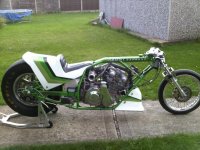
This is the Orient Express Turbo funny that i rebuilt.
It runs 30psi boost, produces 250hp and runs 8.1 quarters at 168mph average.
It runs a copper head gasket coated with Loctite 3020 sealer.
It's never leaked in the seven years since i built it.
If you prep the surfaces correctly this should answer your question.

Also if you want an alternative to the stock or copper gasket then Cometic produce MLS gaskets.
If they have your fitment they are capable of withstanding turbo boost pressures without piano wiring liners or using any sealer so would easily be good enough for a stock motor.
 

Attachments

  • 76722783_2196541633983129_6968067585690566656_o.jpg
    76722783_2196541633983129_6968067585690566656_o.jpg
    96.4 KB · Views: 0
Last edited:
The Mean Green is impressive!!

Yes the prepping takes a substantial part in the succesfulness of the work.
I indeed used the 3020 spry, but must confess I only let it cure for about 15 min out of anticipation...

Right what you say, about not having to anneal a copper gasket if employed in an hot environment, but if anyone does it , do it maybe holding it with tweezers or pliers, or laying it on a clean flat surface. Also, do not worry about the flatness (once annealed), cause when taken between the two opposing surfaces, it will happily rearrange it's molecular pattern towards a flat disposition .

The way I did it, as documented by the pic above, on a couple of refractory bricks, may potentially lead to particles of silica embedding on the copper surface, (guess how I know) which if going undetected, may be a cause for concern.

Nessism, I really do appreciate your approach, which cannot be faulted on the broad.

But after having gone to three gaskets (albeit pattern) + four cam covers and one cylinder one, how could I tell, the one who faulted me first, was not an original one...?

Making them out of copper, gives me a leaway, after being confortable with the planarity of the surfaces, as you said, for future lift-offs, without having to worry about (hopefully) getting a new one, each time I take a peek on it.

No problem living with an "el-cheapo" or "el-dumbo" fame, but I think the implement is gonna cost me way more than a factory standard one. :redface:
 
Last edited:
Yes the prepping takes a substantial part in the succesfulness of the work.
I indeed used the 3020 spry, but must confess I only let it cure for about 15 min out of anticipation...

Right what you say, about not having to anneal a copper gasket if employed in an hot environment, but if anyone does it , do it maybe holding it with tweezers or pliers, or laying it on a clean flat surface. Also, do not worry about the flatness (once annealed), cause when taken between the two opposing surfaces, it will happily rearrange it's molecular pattern towards a flat disposition .

First the annealing.
Hang the copper gasket with a steel wire (thin welding rod) and heat evenly to cherry red with a blow torch then immediately quench in cold water.
This will anneal the same as natural cooling but flashes off the oxides for a clean surface.

For the 3020 sealer, Once gasket is annealed and dry, hang the gasket and mist coat in several layers until you get a solid even pink colour.
Leave overnight to tack off then fit when needed.
 
Thanks for the valuable insight.

As far as following a direction towards the carrying out of this undertaking, I think I'm gonna start with a plain gasket, no o-rings; then run the engine in a controlled environment and, if it does seep, I'll open up the peripheral holes and drop some rubber in.
 
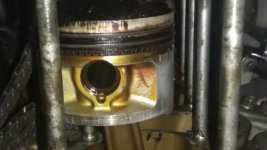
I'am putting new valve stem seals, lapping the valves, and I was wondering if this piston (the other three are more or less similar), warrants a rings job.

Thanks

IMG_20210707_213952.jpg
 
@gGegT

Look at me, as a modern day don Quixote, fighting his own ignorance and engineering dogmas.
Thanks

Did someone say Dogma? I'm pretty sure I saw that cutout on my head when it was off. It's just clearance for drilling one of the diagonal oil passages. Not functional in any other way.
 
Thanks for the clever insight, Dogma sir.

None of the sparks is wet;
cylinders bores, do not seem to be contaminated;
Crown has a light carbon buildup, easily removable, maybe from the late bogging on centrestand, trying to figure coils and stuff.
 
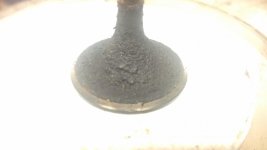
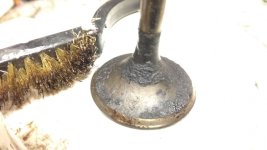
The exhaust valves have a moderate carbon buildup (c.b.) on the inner slope and on the lap, while intake do have a froty c.b. which goes away with a light brushup, and none on the lap:

intake

IMG_20210708_204010.jpg
 
intake valve and brass brush;

IMG_20210708_204255.jpg

this is how the valve lap looks:


Last edited:
...and a little surprise, proof that the head had been leaking in at least one place:

 
That valve need to be ground. You can see a ditch where it sits on the seat.
You need to accurately measure the piston and bore to decide if you can re-use them.
If you're holding a piston with 40 year old rings, you replace the rings, at least.
 
Thanks for the reply.

Allthough the valve might look scored, I can assure you that what you see is only a streak of carbon, after only a provisional cleansing;

viewed with a lens, they do not exhibit scores nor they are pitted.

About the rings, okay, should be standard procedure, to change them, after all those years, even on an hedge trimmer, but we don't know if they are that old, after all the engine has been opened before, and knowing how to judge them regardless of age, is not a bad thing.

All I wanted to know, if there has been some kind of blow-back or else;
they are going to be measured as a matter of course, together with the bore (a bore gauge is on its way) and the piston, along with a lap of the valve seat, as you mentioned, and a hone of the bore.
 
Last edited:
Pistons are in the 70.45mm (2.77in) range, against the limit of 71.880 mm (2.8299 in) so a rebore and new pistons is overidue I guess.
 
Last edited:
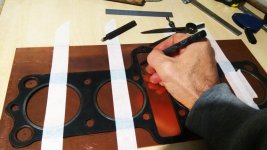
Marking and tracing the copper sheet.
It's gonna be head and base.


Attachments

  • IMG_20211216_194647.jpg
    IMG_20211216_194647.jpg
    90.8 KB · Views: 0
Last edited:
Back
Top