• Required reading for all forum users!!!

    Welcome!
    Register to access the full functionality of the GSResources forum. Until you register and activate your account you will not have full forum access, nor will you be able to post or reply to messages.

    A note to new registrants...
    All new forum registrations must be activated via email before you have full access to the forum.

    A Special Note about Email accounts!
    DO NOT SIGN UP USING hotmail, outlook, gmx, sbcglobal, att, bellsouth or email.com. They delete our forum signup emails.

    A note to old forum members...
    I receive numerous requests from people who can no longer log in because their accounts were deleted. As mentioned in the forum FAQ, user accounts are deleted if you haven't logged in for the past 6 months. If you can't log in, then create a new forum account. If you don't get an error message, then check your email account for an activation message. If you get a message stating that the email address is already in use, then your account still exists so follow the instructions in the forum FAQ for resetting your password.

    Have you forgotten your password or have a new email address? Then read the forum FAQ for details on how to reset it.

    Any email requests for "can't log in anymore" problems or "lost my password" problems will be deleted. Read the forum FAQ and follow the instructions there - that's what we have one for...

  • Returning Visitors

    If you are a returning visitor who never received your confirmation email, then odds are your email provider is blockinig emails from our server. The only thing that can be done to get around this is you will have to try creating another forum account using an email address from another domain.

    If you are a returning visitor to the forum and can't log in using your old forum name and password but used to be able to then chances are your account is deleted. Purges of the databases are done regularly. You will have to create a new forum account and you should be all set.

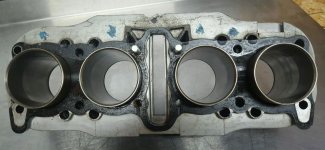
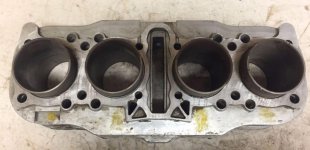
Cylinder bores dropped out while heat curing engine paint.

  • Thread starter Thread starter Kayak23
  • Start date Start date
Bob. When the aluminum cools and contracts that what hold the sleeves in. They put that oring at the bottom of the sleeves because when the bikes running and hot there is actually a few thousands of a gap between the block and the sleeves that oil would migrate up if not for the orings. its the head being bolted down that keeps th sleeves from literally coming out of th engine while running due to the expansion of the block away from the outside of the sleeves.

Just heat the block back up and seat the sleeves and then let it cool is all thats needed here.


When the engine is at operating temp there is no/zero clearance between the cylinder barrels and the cylinder cooling fins. They are an interference fit. You think the cooling fins get hotter than the barrels?

How would the cooling fins dissipate the heat out of the barrels if they are not touching the fins?
 
Bob. When the aluminum cools and contracts that what hold the sleeves in. They put that oring at the bottom of the sleeves because when the bikes running and hot there is actually a few thousands of a gap between the block and the sleeves that oil would migrate up if not for the orings. its the head being bolted down that keeps th sleeves from literally coming out of th engine while running due to the expansion of the block away from the outside of the sleeves.

Just heat the block back up and seat the sleeves and then let it cool is all thats needed here.
When the engine is at operating temp there is no/zero clearance between the cylinder barrels and the cylinder cooling fins. They are an interference fit. You think the cooling fins get hotter than the barrels?

How would the cooling fins dissipate the heat out of the barrels if they are not touching the fins?

Yep, what chuck said goes totally against my (albeit limited) understanding of our dry-sleeved, air-cooled GS engines. :confused:
 
Then explain why the engineers found it necessary for the oring around the bottom of the sleeves?? And explain why on really high millage engine withhold crusty old orings theres always a little oil and some crud between the block and sleeves. The aluminums like a heat magnet and it absorbs heat from everything including the oil itself. Heat from the liners is absolutely absorbed by the block.


The fins air for dissipation of heat from air moving across them. The block is solid around the bores for maybe an inch or so and sucks heat off the liners lie a sponge in water. And there are gaps between each bore that also help cooling....some. I always spray well with the power washer when cleaning to keep the gaps between the cylinders free of road grime and other debris.
 
Take some sleeves out oneday and youll find the grime around the outside surfaces.
had this argument on another forum. turns out the "grime" you call it is actually installation lubricant, used when installing the liners on the production line.
 
Think now. At the bottom of the cylinder it touches the case, convection works here. There maybe a little more expansion at this area of the cylinder. The engineers would add the o-ring here to ensure no oil leakage, all be it very very minor.

If the steel cylinders were not touching the cooling fins then heat dissipation would be greatly reduced. Pretty much non-exhistant.

Oil has more than one job, the second most important is cooling. It removes heat from the metal parts in the engine that don't have a direct cooling fin. It also absorbers heat from the gearbox. It then transfers this heat to the aluminum and then the airflow carries away the heat via the fins, whether they are on the cylinder, cylinder head or any of the case fins.

You said the cylinders do not touch the cooling fins, you are incorrect.

What do you think would happen to the cylinders if they had your stated "couple thou" clearance? I will tell you, they would flex like crazy. The amount of air flowing over the cylinders, when the bike is traveling, is capable of removing more heat than the cylinders produce. It has to be , otherwise the engine would overheat! That means the cylinders stay at a lower rate, smaller, expansion factor than the steel cylinders. Thereby maintaining the interference fit which gets rid of the heat. This is how an air cooled engine works. Just idle in traffic to long, see what happens to the engine.

Very little heat is absorbed by the block, sure there is some, but very little. Calculate the fin area on the block, properly called a case, vs the amount of fins on the cylinder and head.

Also, air cooling, when the engine is constantly having airflow over it is as efficient, and sometimes, more efficient than liquid cooling.
 
had this argument on another forum. turns out the "grime" you call it is actually installation lubricant, used when installing the liners on the production line.

True. While I don't use it when replacing sleeves, I've found similar paste in a Z1 barrel which had been resleeved in the US.

The O rings are there to prevent oil migration, yes. The liners are an interference fit in the block casting for about 2/3 of their length - the top portion. The lower third is a slip fit. This allows for differential expansion between the alloy block and the iron liner.
IMO it's not possible for oil to migrate as far as the head joint up the liners. But the barrel castings can be - and frequently are - porous. Suzuki would not have liked oil stains appearing on the finning hence the O rings.
 
Maybe properly called a case in Canada. Parts fish calls them cylinders and shows the two lower halves as the crankCASEs. Here in the US we refer to them mas the cylinder or the block. Differences of opinion here obviously.
 
That's what I said chuck, the lower engine is case, the cylinders are cylinders. You were the one that called the cylinders a block.

The rate of expansion of aluminum is greater at 300 than the steel barrels when there is no airflow. This is why in the oven the cylinders slide down the barrels when it is standing upright. My experience when I have removed barrels from cylinders anyways.

Certainly yes on porosity of aluminum, plus an old high mileage bike will have deteriorated seals thereby having oil in places a low mileage newer engine would not, leaks.
 
Last edited:
i never fit the o rings on the bottom of the sleeves, in fact i was told by a few performance engine builders to purposely leave them out. Never caused a problem so far.
 
Funny you mention that Agemax. I did the same thing on my 1085 rebuild 5 years ago. Virtually no oil leakage.

Only time I noticed any oil was when I got stuck in stop and go and traffic at 35 cel. Move 20 feet, stop for 30 seconds to a few minutes. All I can say was that was a very unhappy engine. I would have pulled over, but I was on a bridge that crosses Halifax harbour. Once I got over the crest, I shut her off and did the stop and go coasting.

I can only imagine how much unhappier the engine would have been if I did not have an oil cooler.

Some people on this forum say they are not required, I fit them to all air cooled engines for reasons like that.
 
Funny you mention that Agemax. I did the same thing on my 1085 rebuild 5 years ago. Virtually no oil leakage.

Only time I noticed any oil was when I got stuck in stop and go and traffic at 35 cel. Move 20 feet, stop for 30 seconds to a few minutes. All I can say was that was a very unhappy engine. I would have pulled over, but I was on a bridge that crosses Halifax harbour. Once I got over the crest, I shut her off and did the stop and go coasting.

I can only imagine how much unhappier the engine would have been if I did not have an oil cooler.

Some people on this forum say they are not required, I fit them to all air cooled engines for reasons like that.
well,here in the UK we got absolutely no chance of riding in 35*c heat lol.I think the hottest i have ridden is high 20's,and that was far to hot for me, haha
 
Block and cylinders are both used by many..its an apples and oranges issue really. Just as some call the inserts liners and some use the automotive term sleeves. But i guess technically sleeves is the correct term for any engine.

What are sleeves in an engine?


Sleeves are made out of iron alloys and are very reliable. A sleeve is installed by a machinist at a machine shop. The engine block is mounted on a precision boring machine, where the cylinder is then bored to a size much larger than normal and a new cast-iron sleeve can be inserted with an interference fit.


No, a block contains bores, some have sleeves that are changeable some are not changeable. The loose term cylinder refers to the bore plus it's stroke, it forms a cylinder. They are an integral part of an engine, the one used in your copy/paste. A cylinder, as in the air cooled engines we are talking about are technically called exactly that, cylinders, or cylinder assemblies where the head is part of the cylinder where there is a separate block/case engine with cylinders bolted to them.

And no, sleeve is not the correct term to use for "any engine", if the bores are a formed part of the block then they are not a sleeve. A sleeve is removable from the block or in our case the cylinder.

I have worked on all these types of engines I am talking about. These are the technical terms used in the appropriate manufacturers manuals.

There are many different designs of engines, your quoting of an obscure non-validated copy and paste is a demonstration of your lack of understanding of these technical terms.

I am finished with this conversation.

Have a nice night.
 
OPPS!!! I should have said GS engine..or motorcycle engine. Sorry for not being crystal clear...seeing its about a motorcycle and all.
 
I should say cylinders walls actually so others dont get mad for my not using the Kings English.
 
On at least the 1000 cylinders (most likely others as well) there is a colored paint dot on the bottom of the cylinder assembly for what I presume is a selective fitting methodology between the liner and the aluminum casting. I've seen maroon, yellow, and blue dots before. The liners are a press fit when cold but as chuck states, this greatly diminished when hot. Suzuki must control the press fit closely thus the selective fitting. As to how much of the press fit goes away when hot, I suspect most of it.

blue.jpg
 
Last edited:
Back
Top