• Required reading for all forum users!!!

    Welcome!
    Register to access the full functionality of the GSResources forum. Until you register and activate your account you will not have full forum access, nor will you be able to post or reply to messages.

    A note to new registrants...
    All new forum registrations must be activated via email before you have full access to the forum.

    A Special Note about Email accounts!
    DO NOT SIGN UP USING hotmail, outlook, gmx, sbcglobal, att, bellsouth or email.com. They delete our forum signup emails.

    A note to old forum members...
    I receive numerous requests from people who can no longer log in because their accounts were deleted. As mentioned in the forum FAQ, user accounts are deleted if you haven't logged in for the past 6 months. If you can't log in, then create a new forum account. If you don't get an error message, then check your email account for an activation message. If you get a message stating that the email address is already in use, then your account still exists so follow the instructions in the forum FAQ for resetting your password.

    Have you forgotten your password or have a new email address? Then read the forum FAQ for details on how to reset it.

    Any email requests for "can't log in anymore" problems or "lost my password" problems will be deleted. Read the forum FAQ and follow the instructions there - that's what we have one for...

  • Returning Visitors

    If you are a returning visitor who never received your confirmation email, then odds are your email provider is blockinig emails from our server. The only thing that can be done to get around this is you will have to try creating another forum account using an email address from another domain.

    If you are a returning visitor to the forum and can't log in using your old forum name and password but used to be able to then chances are your account is deleted. Purges of the databases are done regularly. You will have to create a new forum account and you should be all set.

Electricity not my strong point - '85 450L

  • Thread starter Thread starter trtsmb
  • Start date Start date
T

trtsmb

Guest
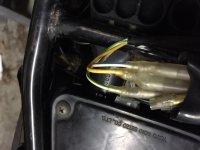
I did some troubleshooting and it seems like my r/r is leaking electricity. With the power off on the bike, the meter shows live wires in the three wires in the pic. These wires come off the r/r. If I unplug the fuse, the wires no longer show current. Is this a bad r/r or something else?

Thanks!

5815_75170_3_IMG_3232.jpg
 
Why is this a concern? Does your battery go dead when the bike sits? Just curious what symptoms would cause you to start troubleshooting.
 
Why is this a concern? Does your battery go dead when the bike sits? Just curious what symptoms would cause you to start troubleshooting.

Pretty much if I don't always leave the bike on the charger, it won't start. If the bike sits for more than a few hours off the charger, it won't start when I go to leave some place and the battery is only two months old.
 
What you are doing is not checking for a leakage current. For that you would put your amp meter in series with the negative battery connector. Make sure teh key is off when you do that and start with teh meter on a 10 amp scale. If it shows nothing move to teh 0.2 amp scale (these are typical ranges). I'm sure if you google you can find instructions for your meter and how to measure DC current with the meter.
 
You should remove the fuses one at a time to locate which circuit has the current draw. Once you locate the circuit with the current draw then test each component in the circuit to find the one causing the draw. It is helpful if you have a wiring diagram.
 
With the key off is you have current draw it will be the R/R leaking. Do not turn on the key while doing this current test unless you are on the 10 amp scale. Even then you can blow the fuse in the meter if you were to run the bike.


Better yet find someone to help.
 
You should remove the fuses one at a time to locate which circuit has the current draw. Once you locate the circuit with the current draw then test each component in the circuit to find the one causing the draw. It is helpful if you have a wiring diagram.

The 450 has exactly one fuse. I unplug the one fuse, the draw stops. The one fuse is between the battery and the rectifier. If I unplug the wire between the fuse and rectifier, the wires in the picture which go from the rectifier to the ignition stop drawing power.
 
With the key off is you have current draw it will be the R/R leaking. Do not turn on the key while doing this current test unless you are on the 10 amp scale. Even then you can blow the fuse in the meter if you were to run the bike.


Better yet find someone to help.

My more electrically inclined friend is coming over tomorrow to help.
 
With key off on all tests? Then unplug the R/R and put the fuse back and see if the draw stops; not sure how you are determining draw?
 
The one fuse is between the battery and the rectifier
... unless you changed the wiring, No, the fuse is between the battery and everything.

The output from charging merely connects to the main Positive (+) "bus" that supplies the bike.

But I think pos is saying that if the R/R is "blown" it could indeed be your problem, because it is not depending on the key . Disconnect the red wire from R/R where it plugs into another red wire and try the ammeter there, across the disconnection...the + probe goes on the "battery side" and the - (black) probe goes on the "R/R side"

If you don't want to fiddle with meters, just get a small 12v lightbulb and connect it across the disconnected...."in-line","in series" . If it lights, the R/R is blown.
("small" 12v bulb from say the gauge lamps...)
 
Last edited:
... unless you changed the wiring, No, the fuse is between the battery and everything.

The output from charging merely connects to the main Positive (+) "bus" that supplies the bike.

But I think pos is saying that if the R/R is "blown" it could indeed be your problem, because it is not depending on the key . Disconnect the red wire from R/R where it plugs into another red wire and try the ammeter there, across the disconnection...the + probe goes on the "battery side" and the - (black) probe goes on the "R/R side"

If you don't want to fiddle with meters, just get a small 12v lightbulb and connect it across the disconnected...."in-line","in series" . If it lights, the R/R is blown.
("small" 12v bulb from say the gauge lamps...)

Sorry, I'm not good at explaining. I haven't changed the wiring so you are correct about the location of the fuse. I did the test with the meter that you described and the needle on the meter showed juice going through.
 
The 450 has exactly one fuse. I unplug the one fuse, the draw stops.

My comments on troubleshooting were not specific to your bike but on how to go about finding parasitic draw. I have had to do this in a car where there were many circuits with multiple components in the circuit. The method is still the same. A bad relay or alternator diode can cause parasitic draw.
 
I understood you ok. It might be important to know is all.
It sounds very much as though your regulator is gone.
The electricity is supposed to come out of it in only one direction..towards the battery as" +" .

That's what "diodes" do here. Because the key switch is not involved, there needs to be a way to stop the battery from going dead. They are like a water pump's check valve...it only pumps-it does not drain!
You can hopefully confirm this with another test....there is one in most shop manuals for the older oem regulators. But the main gist of it is that electricity should not flow from the battery (+) through the regulator to (-) ground.
Leave the regulator disconnected tonight and see if your battery is ok tomorrow (has almost exactly the same voltage ) should be very simple confirmation.
Don't charge it up especially before doing this...you just want it to stay steady as a normal battery would in a working system so a 1/10 of a volt is no consequence.
 
Last edited:
I understood you ok. It might be important to know is all.
It sounds very much as though your regulator is gone.
The electricity is supposed to come out of it in only one direction..towards the battery as" +" .

That's what "diodes" do here. Because the key switch is not involved, there needs to be a way to stop the battery from going dead. They are like a water pump's check valve...it only pumps-it does not drain!
You can hopefully confirm this with another test....there is one in most shop manuals for the older oem regulators. But the main gist of it is that electricity should not flow from the battery (+) through the regulator to (-) ground.
Leave the regulator disconnected tonight and see if your battery is ok tomorrow (has almost exactly the same voltage ) should be very simple confirmation.
Don't charge it up especially before doing this...you just want it to stay steady as a normal battery would in a working system so a 1/10 of a volt is no consequence.

I did exactly what you said and the battery shows just about the same voltage as last night.
 
.Ok, so can I assume that this is an improvement for your problem. That is, if you hadn't done that, your battery would have weakened...leave it off until until you go for another ride. The bike should start if the battery hasn't already been ruined by long deep discharge...

Finding the problem is good news. Spending $ is bad news . You need a new regulator...tons of stuff here about that...

I shouldn't add this, and there is no guarantee, but it is "what I would do" because I have noticed that the old regulators can sometimes continue to function for awhile, even while they are not functioning properly.
so, while you shop, for a little while, PERHAPS you can just carry on with the suspect R/R but disconnect it when you get home. and,again this will confirm that the issue is indeed found .

....except that, it comes with a complicated caveat: that your battery is still being charged .

Test this after a ride, or with the bike warmed up a little.
-turn your meter toward the VDC range (not"VAC") and particularly something that says about 20VDC...we want to test the the charging of your battery so we want the multimeter to include a range 0f 10-20 volts direct current ("VDC").
-. Next put the red(+) probe on the +POS pole of the battery (or where it connects to your solenoid) and the black (-) probe on the - NEG pole of your battery (or a good contact to your engine or frame= metal,no paint,a minimum of rust) tuck these probes in so at least one will stay put while you....
turn up the idle or even Rev the bike a bit. You should see 13.5-14.8 v .Now , turn on a turn signal with brakelights and headlamp on. Meter should not drop below 12.5.
less or more are both bad.
So, you are maybe ok to ride short trips with the R/R and your battery won't go dead on you but I should say I have a voltmeter attached permanently on every motorcycle I own so "what I would do" is going to seem pretty convoluted versus 50$ for a new regulator....and pretty soon, "what -I -do" is get one anyways!
and, by-the-way-Check the fluid level in your battery if it has removeable caps on it. Top up with distilled water available at drug stores. If you find yourself adding a lot of water the battery has been
A) poorly maintained .
B) is being overcharged by the regulator per your readings (more than 14.8)
C) combination of the above
D) worn out,broken battery

Batteries wear out. But don't replace until the draining issue is completely solved.
 
Last edited:
The wires you showed in the pic initially are the three wires from the alternator I believe. These would have AC when the bike is running and nothing with the bike not running. There is another wire coming out of your reg/rec that tees with one leg going to your battery and the other leg going through that fuse then to your ignition switch. The fuse may be before the split and also serve to fuse the circuit before the wire goes to your battery. By going to your battery, it likely connects to the positive pole on your starter solenoid and then the main battery terminal connects to that pole as well.

I take it you feel as though the battery discharges while the bike is not running and you attribute this to a voltage leak? It would help to have an explanation as to how you came up with this conclusion if this is indeed the case. If it is the case, the issue can seem confusing but isn't all that hard to track as you have a finite number of output wires coming from your ignition switch and you could use a multimeter set in VDC at the lowest scale; unhook the connector out of your ignition switch and put the negative probe from your multimeter on a frame or engine ground and touch each out from the ignition switch and if you find DC voltage with the switch off, you have found your problem. If you can't find the problem with this method, then hook the connector back up and start touching hot wires in the headlight shell and elsewhere with the negative probe on a ground. It is time consuming but with the aid of a wiring diagram you should be able to trace each positive wire and find any leak. Just takes patience. You could also use a trouble test light and that might actually be easier for a tedious job that this may turn out to be.
 
.Ok, so can I assume that this is an improvement for your problem. That is, if you hadn't done that, your battery would have weakened...leave it off until until you go for another ride. The bike should start if the battery hasn't already been ruined by long deep discharge...

Finding the problem is good news. Spending $ is bad news . You need a new regulator...tons of stuff here about that...

I shouldn't add this, and there is no guarantee, but it is "what I would do" because I have noticed that the old regulators can sometimes continue to function for awhile, even while they are not functioning properly.
so, while you shop, for a little while, PERHAPS you can just carry on with the suspect R/R but disconnect it when you get home. and,again this will confirm that the issue is indeed found .

....except that, it comes with a complicated caveat: that your battery is still being charged .

Test this after a ride, or with the bike warmed up a little.
-turn your meter toward the VDC range (not"VAC") and particularly something that says about 20VDC...we want to test the the charging of your battery so we want the multimeter to include a range 0f 10-20 volts direct current ("VDC").
-. Next put the red(+) probe on the +POS pole of the battery (or where it connects to your solenoid) and the black (-) probe on the - NEG pole of your battery (or a good contact to your engine or frame= metal,no paint,a minimum of rust) tuck these probes in so at least one will stay put while you....
turn up the idle or even Rev the bike a bit. You should see 13.5-14.8 v .Now , turn on a turn signal with brakelights and headlamp on. Meter should not drop below 12.5.
less or more are both bad.
So, you are maybe ok to ride short trips with the R/R and your battery won't go dead on you but I should say I have a voltmeter attached permanently on every motorcycle I own so "what I would do" is going to seem pretty convoluted versus 50$ for a new regulator....and pretty soon, "what -I -do" is get one anyways!
and, by-the-way-Check the fluid level in your battery if it has removeable caps on it. Top up with distilled water available at drug stores. If you find yourself adding a lot of water the battery has been
A) poorly maintained .
B) is being overcharged by the regulator per your readings (more than 14.8)
C) combination of the above
D) worn out,broken battery

Batteries wear out. But don't replace until the draining issue is completely solved.

Thanks for all the pointers! I appreciate them more than you can know. I won't be able to ride again until late next week if I can get a shoe on (foot surgery yesterday) but I'm going to do your tests with the bike warmed up tomorrow. I checked the battery already and the levels are good so no distilled water needed :).
 
That is good news about your battery, bad news about your foot- get well soon..
all my so-called "pointers" are in posplayers' http://www.thegsresources.com/_forum/showthread.php?164993-Charging-System-QUICK-TEST and also in your shop manual somewhere.., but I'm glad it helps to hear them with a different syntax ..

...some form of analogy for electricity is often the best way to start if you find it daunting.....water-hoses and pumps and things that the water is running (a waterwheel grinding flour) is a good way "in" .
so Your original problem comes down to a leak in the dam and some beavers that are no longer maintaining it, if that makes it easier! :)
 
Back
Top