• Required reading for all forum users!!!

    Welcome!
    Register to access the full functionality of the GSResources forum. Until you register and activate your account you will not have full forum access, nor will you be able to post or reply to messages.

    A note to new registrants...
    All new forum registrations must be activated via email before you have full access to the forum.

    A Special Note about Email accounts!
    DO NOT SIGN UP USING hotmail, outlook, gmx, sbcglobal, att, bellsouth or email.com. They delete our forum signup emails.

    A note to old forum members...
    I receive numerous requests from people who can no longer log in because their accounts were deleted. As mentioned in the forum FAQ, user accounts are deleted if you haven't logged in for the past 6 months. If you can't log in, then create a new forum account. If you don't get an error message, then check your email account for an activation message. If you get a message stating that the email address is already in use, then your account still exists so follow the instructions in the forum FAQ for resetting your password.

    Have you forgotten your password or have a new email address? Then read the forum FAQ for details on how to reset it.

    Any email requests for "can't log in anymore" problems or "lost my password" problems will be deleted. Read the forum FAQ and follow the instructions there - that's what we have one for...

  • Returning Visitors

    If you are a returning visitor who never received your confirmation email, then odds are your email provider is blockinig emails from our server. The only thing that can be done to get around this is you will have to try creating another forum account using an email address from another domain.

    If you are a returning visitor to the forum and can't log in using your old forum name and password but used to be able to then chances are your account is deleted. Purges of the databases are done regularly. You will have to create a new forum account and you should be all set.

Front Brake Rebuild

Vmass

Forum Sage
Past Site Supporter
I have almost completed the front brake rebuild.

1) MC rebuilt
2) New brake lines and crush washers
3) Calipers rebuilt
4) New pad guides ( 3 out of 4 were missing tabs)
5) Scuffed pads ( existing were like new)
6) Painted calipers
7) Everything back in place


A couple of questions:

1) How many times should I expect to fill the reservoir, as I bleed the system?

2) Any difference if I start on the left or right caliper?

3) Any harm in keeping the system dry for the winter or would you recommend fluid/bleeding now?
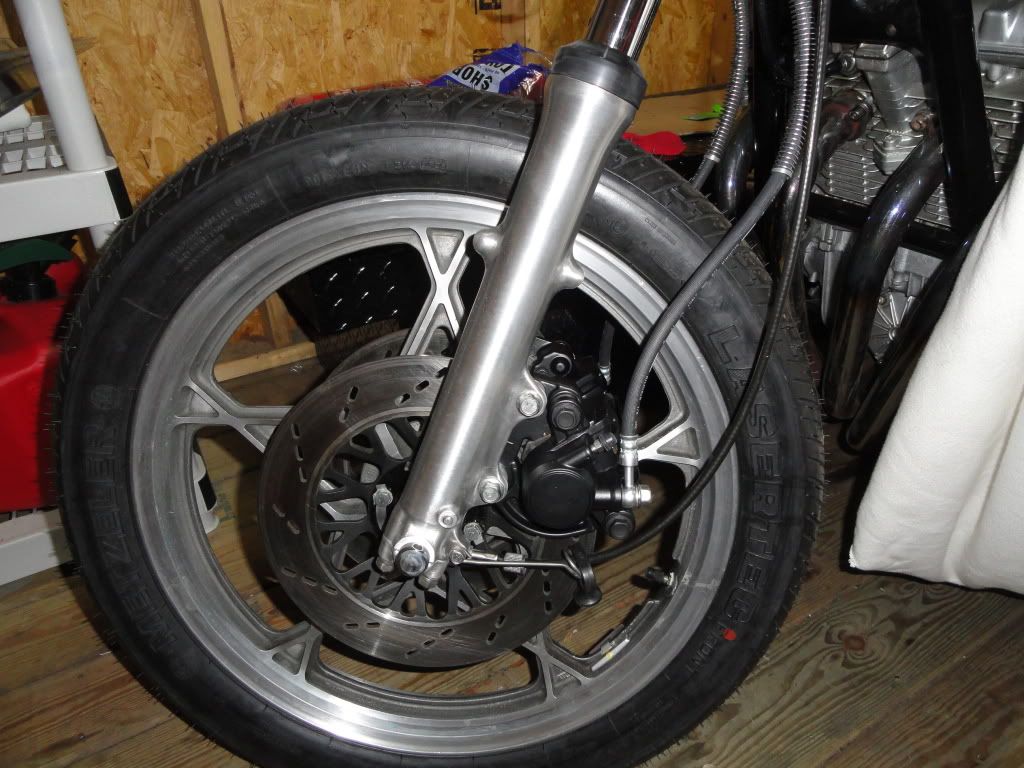
DSC01496.jpg
 
Looks awesome.:)

Bleed the system until all the air is out. Using a suction mechanism helps the process greatly. It doesn't matter which caliper you bleed first. And it shouldn't matter if you leave the system dry for the winter, but I'd go ahead and bleed them now just to be sure.

Sometimes these systems can be difficult to prime; they sort of vapor lock and the lever won't pump fluid. To prime the system you need to suck fluid out of the reservoir and into the pumping chamber. Again, vacuum on one of the caliper nipples really helps this process.

Another worthwhile thing to do after you bleed the system is to bungy the lever back as tightly as you can and leave it over night. This pressure forces the caliper pistons all the way out of their bores as far as possible and increases the lever firmness. It isn't always necessary but many times it really helps.

Good luck
 
A couple of questions:
And the same number of answers:

1) How many times should I expect to fill the reservoir, as I bleed the system?
That depends a LOT on how lucky you are. The entire system holds about twice the capacity of the reservoir, but you might go through that more than once, chasing that last elusive bubble. If possible, have someone watching the fluid level in the reservoir for you. If you don't trust them to pour in a bit of fluid while you are vacuuming it out at the caliper (as might be, in the case of a child), at least let them tell you the level is low.

2) Any difference if I start on the left or right caliper?
The principle is to start at the bleeder that is farthest from the source. You have a single line that goes to a splitter block, then separate lines to each caliper. In your case, it won't make any difference.

3) Any harm in keeping the system dry for the winter or would you recommend fluid/bleeding now?
If you could guarantee that the system is sealed from moisture, it would not make any difference. If it were my bike, I would probably fill and bleed the system now, just to minimize the possibility of moisture inside the lines.

.
 
Thanks Ed and Steve, I will give it a go as soon as I find a couple of hours.
 
Brake fluid absorbs moisture which has several effects:
1) Lowers the boiling point of the fluid which may have safety implications.

2) Raises the freezing/gel point of the fluid. This is of little import to motorcycles as they are seldom used in sub-freezing temperatures however the effect is to slow release of the brakes which can have some control issues. One of the most graphic effects is in an automobile or light truck having a hydraulic clutch release because contaminated fluid may be so viscous as to prevent the clutch pedal from returning until the system is warmed. It can be less than amusing at minus 40 to have the clutch pedal stay at the floor...

3) Water drops out of solution in low areas of the system with temperature change which, combined with copper crystals, accelerates corrosion.

Brake fluid should be changed yearly in motorcycle systems, IMO, for two reasons:
1) These systems are often not well sealed from water contamination out of the atmosphere.

2) The cost and trouble of changing fluid cannot be balanced against the cost of brake parts.

Don't use silicone brake fluid....
 
Norm, where do the copper crystals come from?

I've heard of this too. The dude at Firestone who tested the fluid against my wishes couldn't explain why it was bad or where it came from, just that they wanted over $100 to flush the system. Where does this copper come from in a system that has no copper other than maybe some alloying of aluminum castings? Is there copper in the fluid?
 
It comes from the atmosphere. As brake fluid is hydroscopic, it pulls the moisture from the air.
Your brake master cylinder has a breather. The minerals in the air get into the brake fluid.
Gravity eventually pulls all of these minerals down to your calipers.
Annual bleeding helps to flush these minerals out before they do too much harm.

Daniel
 
The copper comes from the line forming and plating process dissolves in microscopic amounts and is subsequently deposited as tiny surface crystals throughout braking system. It serves as a concentration point for galvanic corrosion which is why the amount of corrosion is out of all proportion to the amount of water present.

I can recall when this was discovered and it really rocked our thinking as no one had anticipated the cause. IMO, anyone who does not change the fluid in motorcycle clutch and brake hydraulics on a yearly basis is not operating with clarity. I suction the fluid from the brake master cylinder on our 4 wheel vehicles and replace at each oil change in order to cycle the fluid rather than bleeding the system on a yearly basis because I find this to be easier to accomplish. Crawling around on a creeper holds less and less attraction each year.;)

Likely the reason the shop tested the brake fluid were that they were looking for work which was required to be done. There are two main reasons for this: the obvious- they need the work to pay the bills and keep their doors open; and, there is an expectation that they will provide reasonable due diligence in determining whether the vehicle under their care is safe to return to the road. People often make the assumption that the shop is trying to "bait the hook" to bring them in but the work recommended has to be bona fide or the risk fraud. We always tried to do our best to recommend work needed be done but it is simply amazing how often people will try to take a dangerous vehicle onto the road because it does not seem convenient to undertake the repair, but that's another subject..


Not directly related to this subject of corrosion but a good primer as a general read on the subject of corrosion: http://7faq.com/owbase/ow.asp?GoodEngineeringPractice%2FCorrosion

When I was managing fleet service, we established a PM program in which brake fluid was changed yearly. After that time I don't recall replacing a brake cylinder.

Moisture will enter an even an apparently sealed brake system by absorbtion into the boundary layer of fluid coating the cylinder and piston. From there is moves through the fluid past the seals and into the system. The same effect allows micro-minute amounts of water to transfer across the reservoir sealing bellows. While the absorbtion and transfer are incredibly slow, it adds up to sufficient amounts over time to create problems. It has also be credibly suggested that water travels through the reservoir bellows by osmosis. I service motorcycle ABS modulators (so far as know am the only one in the world doing this work) which are sealed units but eventually many succumb to internal corrosion from moisture absorbtion through the above routes.
 
Last edited:
Interesting. I imagine that after a flush or two the copper would be removed. Of course the moisture problem remains...

Have you checked that replacing fluid at the reservoir prevents contamination of fluid at the caliper? I'm concerned that there isn't enough mixing of the fluid to prevent sludge formation in the calipers.

This particular Firestone was probably baiting the hook. They had asked me before doing the other work if I wanted this test done (they were going to charge for it). I said no, because I didn't know anything about moisture contamination at the time. They did it anyway. Later they quoted replacement of the calipers on my wife's car (I was out of town) for what turned out on just a cursory inspection when I returned to be an obvious pad and rotor problem. This particular Firestone is scum. I won't go back, not even for a tire sale.
 
Just to be edification brake fluid is not hydroscopic its hygroscopic
The similar-sounding but unrelated word hydroscopic is sometimes used in error for hygroscopic. A hydroscope is an optical device used for making observations deep under water.
 
So, with all of the copper brake lines on our bikes, and the copper found in the master cylinders/fittings, we need to flush them annually. Good to know.
I do all of them every year just to get the mineral deposits out anyway. Some of which probably is copper.
Cheap insurance. Less than $1.00 per bike. ;)

Daniel
 
Back
Top