• Required reading for all forum users!!!

    Welcome!
    Register to access the full functionality of the GSResources forum. Until you register and activate your account you will not have full forum access, nor will you be able to post or reply to messages.

    A note to new registrants...
    All new forum registrations must be activated via email before you have full access to the forum.

    A Special Note about Email accounts!
    DO NOT SIGN UP USING hotmail, outlook, gmx, sbcglobal, att, bellsouth or email.com. They delete our forum signup emails.

    A note to old forum members...
    I receive numerous requests from people who can no longer log in because their accounts were deleted. As mentioned in the forum FAQ, user accounts are deleted if you haven't logged in for the past 6 months. If you can't log in, then create a new forum account. If you don't get an error message, then check your email account for an activation message. If you get a message stating that the email address is already in use, then your account still exists so follow the instructions in the forum FAQ for resetting your password.

    Have you forgotten your password or have a new email address? Then read the forum FAQ for details on how to reset it.

    Any email requests for "can't log in anymore" problems or "lost my password" problems will be deleted. Read the forum FAQ and follow the instructions there - that's what we have one for...

  • Returning Visitors

    If you are a returning visitor who never received your confirmation email, then odds are your email provider is blockinig emails from our server. The only thing that can be done to get around this is you will have to try creating another forum account using an email address from another domain.

    If you are a returning visitor to the forum and can't log in using your old forum name and password but used to be able to then chances are your account is deleted. Purges of the databases are done regularly. You will have to create a new forum account and you should be all set.

GS Stator

The way I see it there is a battery, filaments and other things that require output voltage from the r/r be limited. A shunt r/r does this by providing a low impedance bypass of the load and then lets the phases deal with the diverted energy any way they can.
I look at it like a long wire with a varying magnetic field in the middle. If the ends are not joined no current flows. If I connect the ends to a light bulb I could get it to light up but if I short the bulb/load they way a shunt r/r does, I could end up melting the wire.
 
The way I see it there is a battery, filaments and other things that require output voltage from the r/r be limited. A shunt r/r does this by providing a low impedance bypass of the load and then lets the phases deal with the diverted energy any way they can.
I look at it like a long wire with a varying magnetic field in the middle. If the ends are not joined no current flows. If I connect the ends to a light bulb I could get it to light up but if I short the bulb/load they way a shunt r/r does, I could end up melting the wire.

The light bulb explanation is easy to understand. I like to describe dimming the lights in the method of a shunt R/R as using a pair of screwdrivers to short a wall outlet to dim the ceiling mounted lights. Of course the lights dim and the house wiring would also melt if it were not fused.

The Series R/R simply flips the light switch on and off fast enough and at the appropriate duty cycle to get the light level desired.

The analogy makes it clear that the SHUNT v.s. SERIES methods are as different as "light and dark"
 
not to worry, Pos. not on "ignore".
I just can't filter through all these factoids... what I said; to wit-"the stator is not grounded" reply?
A SHUNT regulator is the only type that "grounds" the stator. I put "grounds" in parenthesis as while the stator is grounded it is also shorted leg to leg so there is no actual current flow to chassis ground or anything but a back through the 3 phase stator circuit. It is also not a perfect ground as the shorts generally occur through an SCR. through
)
...I was responding to Nessisms post. It just seems to add to what is shunting hysteria -I call it that because it implies the misconception that when your shunt regulator is shunting, it is as though the stator is a big hot lightbulb made of tungsten. I suggest it is No more true than your housewiring is an element of your oven! how could you cook if your wiring all got as hot as the element? and what power are you using? It goes back to the power company through your meter-electricity doesn't "go","flow" or "move" anyways but that's a digression.

I am still looking for a representation that simply links a "series versus shunt" to stator burnouts. I am not saying it is not so, but unfortunately, it is apparently beyond my grasp here.

Maybe 3-5 years down the road when people stop chortling over their brand new stators and series regulators.....then I'll see how those stators are doing.

...but here and now, suggesting that there's 2 ohms through any two stator leads my coils is not helping. I have 3 stators. none show anywhere near 2 ohms and never did before rewinding. http://circuitcalculator.com/wordpress/2007/09/20/wire-parameter-calculator/
35' of 18ga is .0.223ohm @20C as an estimate...can't recall if I got it all on! Still, at 100C I see...0.294ohms. hmmm-I suppose you can consult your own sources but the suzuki wire leads attached to stator windings have PVC coating good to 100C , so I call it academic...


The proportion that is "shunted" or not may be big news at the regulator - though a decent shunt regulator in a cared-for system has no problem- but even if it is true, giving or taking 30 watts heat seems pretty small potatoes at the stator, compared to the 30-100 hp engine surrounding it.

http://www.thegsresources.com/_forum/showthread.php?191795-GS-Stator&p=2255184#post2255184
If I connect the ends to a light bulb I could get it to light up but if I short the bulb/load they way a shunt r/r does, I could end up melting the wire.
, well that would depend on several factors wire size, length...but where there's a mere 14vdc @15 amps available, it may not be the problem you suggest. and since a shunt is implied why not include it to make a better model...in which case, I am guessing the shunt will be the greatest resistor in this scenario and it will be the hottest thing with a high voltage drop. etcetcetc
 
Last edited:
not to worry, Pos. not on "ignore".
I just can't filter through all these factoids... what I said; to wit-"the stator is not grounded" reply?)
...I was responding to Nessisms post. It just seems to add to what is shunting hysteria -I call it that because it implies the misconception that when your shunt regulator is shunting, it is as though the stator is a big hot lightbulb made of tungsten. I suggest it is No more true than your housewiring is an element of your oven! how could you cook if your wiring all got as hot as the element? and what power are you using? It goes back to the power company through your meter-electricity doesn't "go","flow" or "move" anyways but that's a digression.

Your analogy does not treat the source and load in the same way as mine. Imagine source and load in series. When you short the source (the leads going to the load) the power delivered to the load goes to zero, the source current is only limited by the power available and the source resistance. Apply that to your analogy and you will see that your analogy is something else.

I am still looking for a representation that simply links a "series versus shunt" to stator burnouts. I am not saying it is not so, but unfortunately, it is apparently beyond my grasp here.

Maybe 3-5 years down the road when people stop chortling over their brand new stators and series regulators.....then I'll see how those stators are doing.

I assume you have just arrived and not had much time to look around; I'll help.

http://www.thegsresources.com/_foru...for-Compufire-R-R-Users&highlight=stator+poll
http://www.thegsresources.com/_forum/showthread.php?167974-Honda-R-R-Users-Poll
http://www.thegsresources.com/_forum/showthread.php?167978-Fried-Stator-Poll

There is an explanation of SHUNT v.s SERIES posted over 5 years ago. My keepandshare account went dormant 2 days ago.

...but here and now, suggesting that there's 2 ohms through any two stator leads my coils is not helping. I have 3 stators. none show anywhere near 2 ohms and never did before rewinding. http://circuitcalculator.com/wordpress/2007/09/20/wire-parameter-calculator/
35' of 18ga is .0.223ohm @20C as an estimate...can't recall if I got it all on! Still, at 100C I see...0.294ohms. hmmm-I suppose you can consult your own sources but the suzuki wire leads attached to stator windings have PVC coating good to 100C , so I call it academic...

You really love to waste my time right? I'm using lowest resistance for minimum room temperature and you go quoting 2 ohms? You obviously are backpedaling through a cloud of confusion.

The proportion that is "shunted" or not may be big news at the regulator - though a decent shunt regulator in a cared-for system has no problem- but even if it is true, giving or taking 30 watts heat seems pretty small potatoes at the stator, compared to the 30-100 hp engine surrounding it.

http://www.thegsresources.com/_forum/showthread.php?191795-GS-Stator&p=2255184#post2255184
, well that would depend on several factors wire size, length...but where there's a mere 14vdc @15 amps available, it may not be the problem you suggest. and since a shunt is implied why not include it to make a better model...in which case, I am guessing the shunt will be the greatest resistor in this scenario and it will be the hottest thing with a high voltage drop. etcetcetc

The data on stator current has been posted for well over 6 years. Google it

SHUNT_vs_SERIES_RR_Compare_Tutorial
 
@posplayr

Ok, I've read through this entire thread (and a handful of others), but being electrically ignorant, I wanted to make sure I've got the wiring correct from my SH-775 swap.

There are 3 wires from the Stator- two originally went to the R/R, but the third loops back into the harness and goes *somewhere*. I assumed this is fused? How/where do I use that third line with the third lead from the SH775?

There are the 2 positive wires, which I'll mate to the 2 positive leads on the SH775. This leaves 2 negative leads on the SH775- does one go to the battery, and one to a frame ground?

Sorry to be a pain, but I need my hand held with this stuff :) Cheers!
 
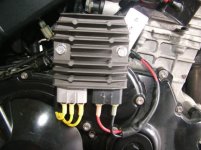
Look at the attached pic of a SH-775.....The three yellow wires connect directly to your stator: the red wire connects to same place that your original red wire from r/r connected to. The black wire connects to a good ground- hopefully this good ground has good contact with battery negative.
 

Attachments

  • image.jpg
    image.jpg
    46.7 KB · Views: 0
@posplayr

Ok, I've read through this entire thread (and a handful of others), but being electrically ignorant, I wanted to make sure I've got the wiring correct from my SH-775 swap.

There are 3 wires from the Stator- two originally went to the R/R, but the third loops back into the harness and goes *somewhere*. I assumed this is fused? How/where do I use that third line with the third lead from the SH775?

There are the 2 positive wires, which I'll mate to the 2 positive leads on the SH775. This leaves 2 negative leads on the SH775- does one go to the battery, and one to a frame ground?

Sorry to be a pain, but I need my hand held with this stuff :) Cheers!

The 3 stator wires go to the three input wires on the RR. IF there are two voltage wires then tie them together, and the same if there are two ground wires then tie them together. The 775 should have two receptacles, one with 3 contacts (for stator wires) and one with 2 contacts (Pos and Neg)

Make sure your have a fuse between the voltage and the battery positive.

Tie ground to the battery neg and tie also you the frame. Don't rely on just tying the RR neg to the frame.. You want to also connect to battery
 
Last edited:
As mentioned. It's a good technique to connect the RR neg directly to the Battery Neg terminal AND to the frame ground. If you rely on a second frame-battery neg connection and THAT second connection is not sound, the RR may not function to full output correctly.
 
As mentioned. It's a good technique to connect the RR neg directly to the Battery Neg terminal AND to the frame ground. If you rely on a second frame-battery neg connection and THAT second connection is not sound, the RR may not function to full output correctly.

This is described in various locations under Single Point Ground (SPG). The idea is that all ground currents are collected into a SPG as close to the R/R(-) as possible. That is why the R/R mounting bolt is convenient.

The three (16 AWG recommended) wires that need to come to this SPG are:


  • Factory Harness ring lug ground (B/W)
  • Battery (-)
  • Frame ground

The output of the SPG is the 14 awg wire to R/R(-). Keep this wire as short as possible (less than 1 ft)
 
Ok great I think I've got it now. All 3 stators to the R/R, 2x brown positives to red positives, one black R/R neg to battery, one to SPG on frame screw.

The un-used headlight lead- just leave it dangling/tape it?

My bike already had a ground lead from battery (-) to R/R frame screw, so I've got that covered. Probably something TKent did, since it doesn't look original.
 
This is the picture, so as long as you are following it.....................

picture.php
 
Back
Top