• Required reading for all forum users!!!

    Welcome!
    Register to access the full functionality of the GSResources forum. Until you register and activate your account you will not have full forum access, nor will you be able to post or reply to messages.

    A note to new registrants...
    All new forum registrations must be activated via email before you have full access to the forum.

    A Special Note about Email accounts!
    DO NOT SIGN UP USING hotmail, outlook, gmx, sbcglobal, att, bellsouth or email.com. They delete our forum signup emails.

    A note to old forum members...
    I receive numerous requests from people who can no longer log in because their accounts were deleted. As mentioned in the forum FAQ, user accounts are deleted if you haven't logged in for the past 6 months. If you can't log in, then create a new forum account. If you don't get an error message, then check your email account for an activation message. If you get a message stating that the email address is already in use, then your account still exists so follow the instructions in the forum FAQ for resetting your password.

    Have you forgotten your password or have a new email address? Then read the forum FAQ for details on how to reset it.

    Any email requests for "can't log in anymore" problems or "lost my password" problems will be deleted. Read the forum FAQ and follow the instructions there - that's what we have one for...

  • Returning Visitors

    If you are a returning visitor who never received your confirmation email, then odds are your email provider is blockinig emails from our server. The only thing that can be done to get around this is you will have to try creating another forum account using an email address from another domain.

    If you are a returning visitor to the forum and can't log in using your old forum name and password but used to be able to then chances are your account is deleted. Purges of the databases are done regularly. You will have to create a new forum account and you should be all set.

Hesitant acceleration after carb cleaning

  • Thread starter Thread starter ShirleySerious
  • Start date Start date
This sounds ghetto, but try it anyway. Take some duct tape and wrap about half of each pod so that only half of each one is exposed. Take it for a ride and see if it cures your problem. It will restrict some flow, and cause your lean problem to go more rich. Try it, what are you out if it does not work. I say you are flowing too much air.
 
I talked to Nerobro tonight and he thinks it's OK that my vent tubes are gone, as long as I'm running pods. Since the bike was running fine last summer and the problem I was having while the bike was in storage just needed the carbs to be cleaned, if the mechanic rejetted it, it was totally unnecessary.

Tomorrow I'll ask the mechanic about the specifics of the job and what he did with the jets. IYO, if he screwed it up, do you think I am entitled to at least a partial refund?

So yes, I did cave in and invested in a Clymer manual. For someone who's never worked on anything like this it is very intimidating. It's just tough to work on a bike in a cold, poorly lit garage with few tools.
 
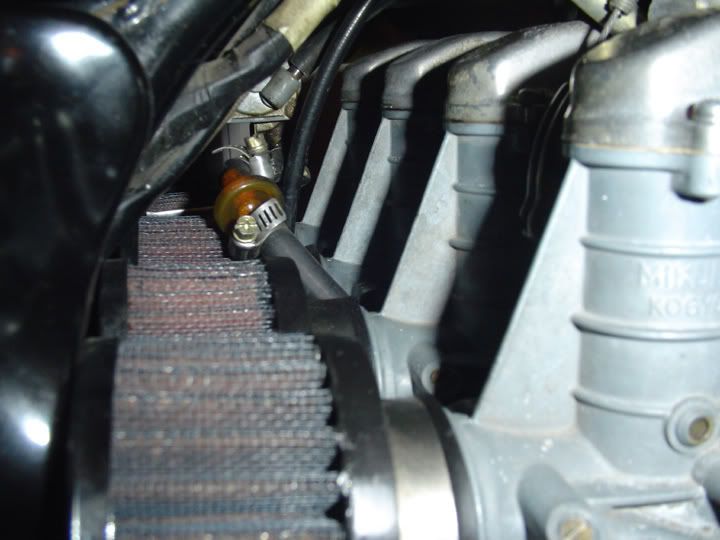
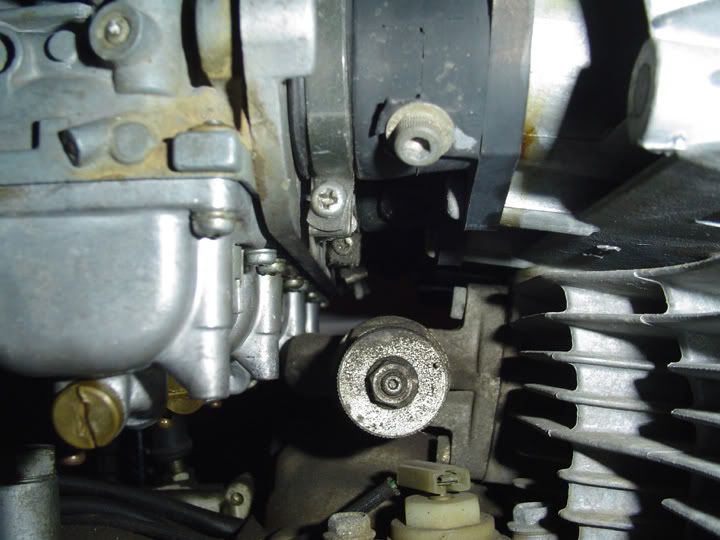
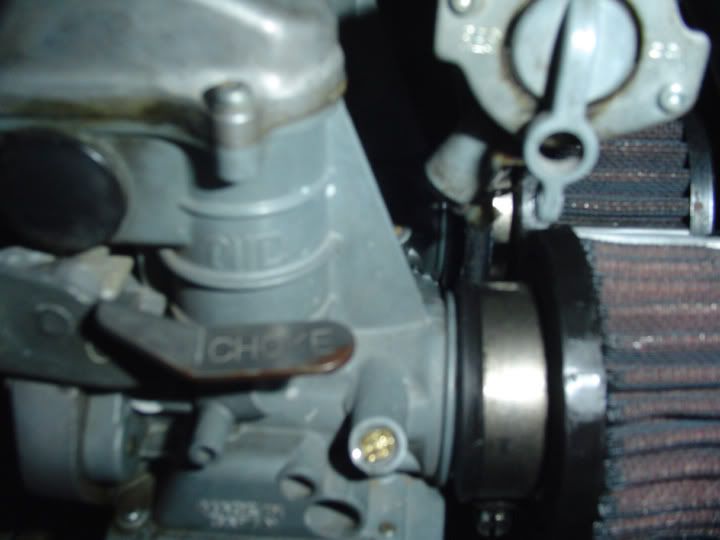
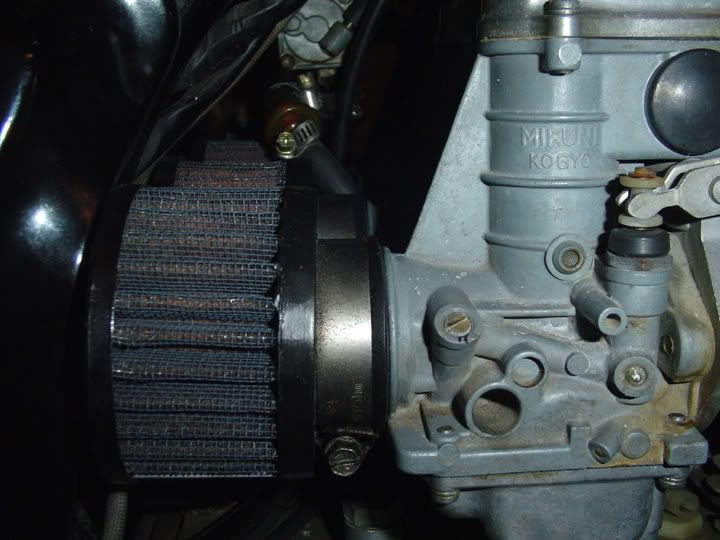
I managed to snap some pictures of my setup. Sorry if they look like crap:
bike001.jpg

bike002.jpg

bike003.jpg

bike004.jpg


Pic 1:Carbs on the right side
Pic 2:Looking left where the vacuum tubes used to be
Pic 3:Boots w/ carb sync screws looking left
Pic 4:Left side carbs, choke & petcock(Blurry, I know)

I know it's difficult to tell what's wrong by just looking at, but it might help. KSlawman, I tried the duct tape thing, but that didn't work.
 
So the thread title is accurate? After the carb cleaning the hesitation began? If so, you describe fuel starvation. Your engine needs less fuel to rev in neutral than under load. If I remember correctly, a plug read also looked lean?
The fuel starvation could be the carbs or flow related, possibly as simple as a kinked fuel line or cracking vacuum line.
When you run pods with your VM carbs, the two floatbowl vent lines must be removed to avoid fuel starvation. The mechanic at least did that right. I've made many posts about removing the vent lines when running pods if you want to search and read.
Hard to say what the mechanic did to result in this problem. If he did try a complete re-jet of all 3 circuits, we'd have to know what jetting he chose and if he used Mikuni jets and the correct style. Example: there are two lengths of Mikuni pilot jets for your carbs. Install the wrong/shorter one and it will run poorly. Generally, todays mechanics don't know how to jet our older bikes or service the carbs right.
I also don't like the sound of "filing down the points", though it can be beneficial if done right. It does sound like the carbs are adjusted wrong though.
If you don't feel comfortable doing the work and your mechanic isn't able to work on it, I don't know what you do. It's not that hard to work on the VM carbs but you do need to get a factory manual and basic tools to do it. Then ask us lots of questions.
I can give you some initial jetting suggestions that may be right the first time but jetting for pods and a stock exhaust can take some time. The pods will require at least one position richer on the jet needles and the jet needles are the most work on your carbs.
Just real hard to say what's needed until the carbs are inspected and all current jetting info is given.
Like I said, it's possible the carbs are jetted OK but it takes plug reads at different throttle positions and more performance/symptoms given to be sure. It could be as simple as adjusting the pilot fuel screws and side air screws correctly.
If you feel comfortable adjusting the screws, try it. Record/count their present settings and you can return them there if you don't like the results. Typical settings for your carbs would be 1 3/4 turns out for the side air screws and about 1 1/4 turns out for the pilot fuel screws underneath. Though fine tuning would be needed, these initial settings would be fairly close and if set that way, any problem as you describe wouldn't likely be from poor screw settings.
Just be careful if the screws are stiff to turn. Use a good fitting tool and a mirror to accurately record the settings. Always seat the screws LIGHTLY and then adjust out as I said. You may be lucky and it runs much better without any inside carb work. Set the idle to about 1,100 rpm's when warmed up. Tell us if the idle rises noticably from cold to hot.
I wonder too if the carbs were vacuum synched. That could contribute to poor performance.
 
I found a repair manual online, which isn't really convenient because I can't bring it in the garage, but it'll do for now. I checked the pilot air screws and they were all seated. I screwed them all out 1.5 turns, but I'm still having the same problem. I may be able to work on it tonight once I take a look at the manual, but probably won't be turning it on, as I've ****ed my neighbors off enough.

I'm not really that concerned about working on it myself, I'm just weirded out by all those fuel lines and taking off the gas tank because one wrong move and I've got gas all over.
 
I checked the pilot air screws and they were all seated. I screwed them all out 1.5 turns, but I'm still having the same problem.
If the side air screws were seated, then the mechanic truly doesn't know what he's doing.
Also, there's no way that your bike could hold anything close to a normal idle rpm if the side air screws are seated. Impossible. Without holding the throttle open, it would stall immediately. Starting would be very difficult too unless you throttled it. Even then, difficult.
Any chance you actually mean the pilot fuel screws underneath?? The bike would run if these were seated but you would be running lean unless the mechanic installed larger pilot jets and he found it necessary to close the pilot fuel screws. Again, that would be the work of a poor mechanic.
Please verify what screws you turned 1 1/2 out.
 
If the side air screws were seated, then the mechanic truly doesn't know what he's doing.
Also, there's no way that your bike could hold anything close to a normal idle rpm if the side air screws are seated. Impossible. Without holding the throttle open, it would stall immediately. Starting would be very difficult too unless you throttled it. Even then, difficult.
Any chance you actually mean the pilot fuel screws underneath?? The bike would run if these were seated but you would be running lean unless the mechanic installed larger pilot jets and he found it necessary to close the pilot fuel screws. Again, that would be the work of a poor mechanic.
Please verify what screws you turned 1 1/2 out.

My bad. I can't tell the difference, so here's the picture with the screw I adjusted circled. I'm not sure about the others, so I circled and numbered them (I know, I'm stupid). It's #1 in the pic:
bikecarbgb7.jpg

I have a feeling you are talking about the pilot screws because it doesn't stall after adjustment, but you can definitely tell it's doing something.
 
Shirley, make sure that you disconnect the earth/negative strap from the battery before removing the gas tank. If you should accidently short out on the positive with a spanner of screw driver, you could be meeting your maker earlier than you've planned.
Seriously though, you've done the right thing buying a manuel. Take your time and keep asking questions. We'll eventually get you hanging on for dear life, through all the gears.
 
Please, call me Josh (that's my real name).

Secondly, thanks for the advice. I'm not taking the tank off anytime soon, though. The aft part of the tank is loose, held down by its weight and the seat, but I can't figure out how to remove the fore part.

Anyway, the manual I downloaded wasn't all that great. It was kind of old and didn't really explain how to do things so well. I bought a Clymer manual. Is that a good one?
 
Okay Josh.
The aft of your tank should be secured by a bolt passing through a rubber doenut. This setup helps reduce foaming of the fuel, caused by vibration. It is dangerous to leave your tank floating around like yours is. The seat is the only thing preventing it from detaching from the bike.
When/if you do need to remove your tank, disconnect your petcock fuel line, vaccum hose and the fuel gauge electric leads. Now lift the aft end about 3 ins, slide the tank rearward for about another 3 ins and then lift the whole tank upwards. The front is held in position by two rubber bushes (another vibration reduction setup), which disengage with the tank when slid backwards.
 
Well, something isn't right with the pilot circuit. If you seat all those side air screws, it will stall. No air into the pilot circuit will create a stall. Something's wrong there.
If it will idle well enough to tune them, then tune them using the highest rpm method.
Highest rpm method: initially set the side air screws to 1 3/4 turns out, warm up bike completely, place on centerstand, set base idle at 1,000 rpm by using the idle adjuster knob, starting at any carb slowly turn in either direction until you hear the rpm's max, when the rpm's max...stop turning, fine tune it, re-set idle to 1,000 by using the idle adjuster knob, repeat until all 4 are set.
Also, you should remove that fuel filter. If the filter is there to remove rust particles from the tank, the tank should be repaired. Fuel filters cause more problems than they're worth.
 
Oh, I'm going a little off topic here, but when I disconnect the petcock tube (the transparent one I hope), will fuel fly all over uncontrollably, or should I empty the tube first? That's my one fear about removing the tank and other fuel carrying parts.
 
Oh, I'm going a little off topic here, but when I disconnect the petcock tube (the transparent one I hope), will fuel fly all over uncontrollably, or should I empty the tube first? That's my one fear about removing the tank and other fuel carrying parts.
If the petcock lever is in the on or reserve position, providing it's operating right, only fuel you might spill is what's in the line. Just use some towels/rags.
 
If the petcock lever is in the on or reserve position, providing it's operating right, only fuel you might spill is what's in the line. Just use some towels/rags.

Do I have to empty the tank completely, or can I keep it in there?
 
Hi all.
Im folllowing this thread with interest as I have similar problems as Josh.

I recently purchased a 1979 GS550E with pod filters, inline fuel filter.

The 2 vent tubes between the carbs have been blocked off is this correct?

Would I be better off replacing the original air box and resetting the carbs or can I stick with pods?

I planning to use the bike all year round so I guess rain and pods isnt a good idea.

Sorry to hijack your thread Josh.
 
Do I have to empty the tank completely, or can I keep it in there?
If you want to take off the tank, make it easier by draining some gas.
Get some extra fuel line or fuel proof hosing and attach it to the fuel outlet. Turn the lever to prime. It should drain out into your can.
Be careful of snagging any wiring/cables when you remove it. Don't pinch anything when you replace it.
 
Hi all.
Im folllowing this thread with interest as I have similar problems as Josh.

I recently purchased a 1979 GS550E with pod filters, inline fuel filter.

The 2 vent tubes between the carbs have been blocked off is this correct?

Would I be better off replacing the original air box and resetting the carbs or can I stick with pods?

I planning to use the bike all year round so I guess rain and pods isnt a good idea.

Sorry to hijack your thread Josh.
I'm out the door so just quick reply.
The floatbowls must breath. Remove any caps on the 2 and 4 vents. Pods require the vent lines be removed.
I'd lose that fuel filter too.
Up to you what's best about choosing pods or airbox. Lots to read around here if you want suggestions.
 
Hi all.
Im folllowing this thread with interest as I have similar problems as Josh.

I recently purchased a 1979 GS550E with pod filters, inline fuel filter.

The 2 vent tubes between the carbs have been blocked off is this correct?

Would I be better off replacing the original air box and resetting the carbs or can I stick with pods?

I planning to use the bike all year round so I guess rain and pods isnt a good idea.

Sorry to hijack your thread Josh.

In my opinion, unless you done exhaust mods (I'd like to see a port and polish when I say exhaust mods) such as a four into one system, what you gain by a rejet and pods is not worth the hastle...just my opinion. These bikes have a great air intake system from the factory...a bit on the finicky side but once there set, they work perfect! A big part of the longevity of any engine is the air it breathes...I'd go stock, great design!
 
I took the liberty of calling the guy at the dealer and making a recording of it. He does sound like he's talking a little nonsense. It's about 4 minutes long.
Download bikeconvo.mp3
 
Last edited:
I took the liberty of calling the guy at the dealer and making a recording of it. He does sound like he's talking a little nonsense. It's like 4 minutes long.
Download bikeconvo.mp3

I listened to the convo and it doesn't sound like the guy is trying to screw you over, he's just a guy behind the counter and may know little if anything about actually fixing bikes..."it's not his job", just the way he want's it, that's what the techs are for. I found it funny, when you mentioned that you were talking to "them/they", he was all over finding out what "they" say and who they are. He may have thought that you were with some sort of news show... :-D The part about blended fuels and added conditions, is bunk... if the bike is set up right, it will run right. The part about the baffles being drilled out is true. Both the lack of baffles and the addition of the pods, are going to lean out your bike. If the jets have not been changed and are indeed stock, that's where you're going to need to start.
 
Back
Top