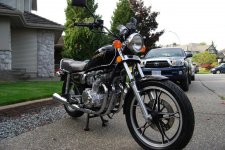
As far as the electrics go, one thing you should know that I haven't seen mentioned here yet in your thread is that the stock regulator rectifiers on all Suzuki GS models are absolute garbage. You need to Ohm out the stator leads to each other to check to see if they are still in spec, around 1.9 or 2.3 ohms if I recall(?), and test for any continuity to ground, just to make sure that the regulator rectifier did not fry the stator.
Then swap on a $45 used Polaris ATV Shindengen SH775 series style regulator, as this is a far more advanced design, as it does not run hot like a shunt style regulator rectifier which keeps the stator smokin' hot under low load demand conditions...
RM Stator and other sellers on eBay offer OEM Factory plug kits to wire in those regulator rectifiers to your bike.
For the actual regulator rectifier, search eBay for Polaris part number 4012941. You will find a bunch of used ones from crashed side by side ATVs, for about $45 shipped. What a killer deal. Poke around on here or ask about the wiring plug. Most on here at use a Triumph part number, but they are all over eBay for all kinds of different bikes that use shindengen regulator rectifiers, and very easy to identify visually. The kit comes with two water-tight wiring plugs and crimp in fittings. I solder the wires into them every time, and it works fantastic. I solder and thoroughly heat shrink every wiring connection that I make on these harnesses, FYI. Splices and crimp on connectors both get soldered in my garage...
Look up member posplayr (Jim) and click on that GS charging system health link in his signature file. Follow his minor modifications to the electrical system by doing his single point ground mod ( all grounds except for the starter motor go directly to a single point on the frame nearest the battery negative terminal, starter still goes to the battery directly). Then also look at his basic diagram for power distribution, I think it is titled "Popular rewiring for Suzuki GS." Open up the wiring harness and rewire yours this way. Also, the same as any vintage bike, you would be foolish to be doing wiring work and not separate the ignition power feed out of the harness, using the old feed to trigger a relay on which will channel direct power straight from the battery and charging system directly to the ignition and coils. This has been known to drastically improve the way many bikes of this age have ran!
One last thing about the wiring harness, follow the stator wires, if you see two extra confusing wires in the harness, early GS models, in an effort to have less excess voltage to regulate, ran one stator lead all the way up through the headlight switch and back down to the regulator rectifier. If the headlight was switched off, a spare set of contacts in the headlight switch also would just completely disconnect one of the stator outputs, in an effort to keep the voltage down and keep the engine heat down also by not having to shunt regulator output of that lead as well when there was already plenty of voltage present. Bypass this wiring Loop to the headlight switch and run your stator wires directly to the new regulator rectifier. This was a problematic design which was just a crutch for the original garbage regulator rectifier.
Make sure once you get your bike running, to test the stator output with a digital multimeter in AC, with the bike running exclusively off of a good battery, charging system on hooked. Look up the stator papers on here, a very very in-depth tutorial that members have compiled. It will tell you the ac voltage output depending on what RPM you are running. I think good range is somewhere between 30 and 80 volts AC depending on the RPM of the engine. this is the final test to make sure the stator does not have any shorts that only show up under high output levels.
oh, and look up cycleo-rings.com for the most complete carb o-ring kit you will find, and supplied to you by a member of this forum!
Then swap on a $45 used Polaris ATV Shindengen SH775 series style regulator, as this is a far more advanced design, as it does not run hot like a shunt style regulator rectifier which keeps the stator smokin' hot under low load demand conditions...
RM Stator and other sellers on eBay offer OEM Factory plug kits to wire in those regulator rectifiers to your bike.
For the actual regulator rectifier, search eBay for Polaris part number 4012941. You will find a bunch of used ones from crashed side by side ATVs, for about $45 shipped. What a killer deal. Poke around on here or ask about the wiring plug. Most on here at use a Triumph part number, but they are all over eBay for all kinds of different bikes that use shindengen regulator rectifiers, and very easy to identify visually. The kit comes with two water-tight wiring plugs and crimp in fittings. I solder the wires into them every time, and it works fantastic. I solder and thoroughly heat shrink every wiring connection that I make on these harnesses, FYI. Splices and crimp on connectors both get soldered in my garage...
Look up member posplayr (Jim) and click on that GS charging system health link in his signature file. Follow his minor modifications to the electrical system by doing his single point ground mod ( all grounds except for the starter motor go directly to a single point on the frame nearest the battery negative terminal, starter still goes to the battery directly). Then also look at his basic diagram for power distribution, I think it is titled "Popular rewiring for Suzuki GS." Open up the wiring harness and rewire yours this way. Also, the same as any vintage bike, you would be foolish to be doing wiring work and not separate the ignition power feed out of the harness, using the old feed to trigger a relay on which will channel direct power straight from the battery and charging system directly to the ignition and coils. This has been known to drastically improve the way many bikes of this age have ran!
One last thing about the wiring harness, follow the stator wires, if you see two extra confusing wires in the harness, early GS models, in an effort to have less excess voltage to regulate, ran one stator lead all the way up through the headlight switch and back down to the regulator rectifier. If the headlight was switched off, a spare set of contacts in the headlight switch also would just completely disconnect one of the stator outputs, in an effort to keep the voltage down and keep the engine heat down also by not having to shunt regulator output of that lead as well when there was already plenty of voltage present. Bypass this wiring Loop to the headlight switch and run your stator wires directly to the new regulator rectifier. This was a problematic design which was just a crutch for the original garbage regulator rectifier.
Make sure once you get your bike running, to test the stator output with a digital multimeter in AC, with the bike running exclusively off of a good battery, charging system on hooked. Look up the stator papers on here, a very very in-depth tutorial that members have compiled. It will tell you the ac voltage output depending on what RPM you are running. I think good range is somewhere between 30 and 80 volts AC depending on the RPM of the engine. this is the final test to make sure the stator does not have any shorts that only show up under high output levels.
oh, and look up cycleo-rings.com for the most complete carb o-ring kit you will find, and supplied to you by a member of this forum!