• Required reading for all forum users!!!

    Welcome!
    Register to access the full functionality of the GSResources forum. Until you register and activate your account you will not have full forum access, nor will you be able to post or reply to messages.

    A note to new registrants...
    All new forum registrations must be activated via email before you have full access to the forum.

    A Special Note about Email accounts!
    DO NOT SIGN UP USING hotmail, outlook, gmx, sbcglobal, att, bellsouth or email.com. They delete our forum signup emails.

    A note to old forum members...
    I receive numerous requests from people who can no longer log in because their accounts were deleted. As mentioned in the forum FAQ, user accounts are deleted if you haven't logged in for the past 6 months. If you can't log in, then create a new forum account. If you don't get an error message, then check your email account for an activation message. If you get a message stating that the email address is already in use, then your account still exists so follow the instructions in the forum FAQ for resetting your password.

    Have you forgotten your password or have a new email address? Then read the forum FAQ for details on how to reset it.

    Any email requests for "can't log in anymore" problems or "lost my password" problems will be deleted. Read the forum FAQ and follow the instructions there - that's what we have one for...

  • Returning Visitors

    If you are a returning visitor who never received your confirmation email, then odds are your email provider is blockinig emails from our server. The only thing that can be done to get around this is you will have to try creating another forum account using an email address from another domain.

    If you are a returning visitor to the forum and can't log in using your old forum name and password but used to be able to then chances are your account is deleted. Purges of the databases are done regularly. You will have to create a new forum account and you should be all set.

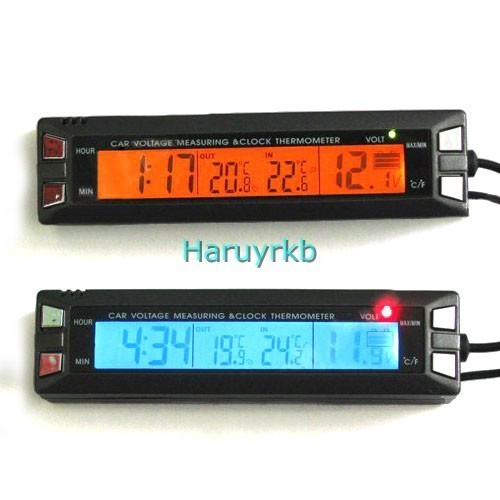
Installed a voltmeter

  • Thread starter Thread starter gearhead13
  • Start date Start date
I have installed this one on a couple of our bikes with good results.

It's not waterproof, but on a bike with a widndhield and other protection, it's not as big a problem.

It's also nice to have time displayed, but two temps are obviously designed for cages.

The display's backlight has two color options, the orange one matches the GS lighting quite nicely. :D

$(KGrHqJHJD!E-lNe4wtkBP0Q,Tn2gQ~~60_12.JPG

i looked at these meters but i could not decide what to do with the 2 temperature readings. i thought one could be used for normal air temperature and the other for engine temperature, or temperature of air flow into carbs but decided that it wouldnt work!
i agree, i would like to have a clock function as well
 
If you want a similar unit, but with a single temp readout, you can get the 5-in-1 unit from Big Bike Parts.

4-239.jpg


This is another one that is not waterproof, but a couple coats of clear polyurethane over the front work nicely.

My biggest complaint with that unit is the backlight. Rather than have a constant-voltage source, it gets brighter and dimmer right along with the voltage transitions. The clock and the other displays stay on when the key is off (they don't draw much at all), only the lights go on and off with the key.

.
 
Your diagram shows the positive being picked up from the coil relay. Would it matter where that positive feed comes from?


Attached is a simple device that will filter a lot of the noise. The biggest part of the noise is the negative going spikes when the R/R shuts off requiring the battery rush in to supply current.

The diode only lets current flow toward the meter. The capacitor is in parallel to the volt meter so it always has the same voltage as the meter.
When the input voltage drops below the voltage on the capacitor the capacitor supplies current to the meter minimizing the negative swings.

This will drop the measured voltage measured by the meter by about 0.7 volts so that might not be the best but better than a wacky display.

So using this to filter a (fuel or temp) meter reference voltage might be a better choice,
 
Yeah, some of these meters are crap out of box. But some meters don't have enough damping circuitry to show an "average" reading.Wiring to orange wire from key switch is a good spot- probably about 1/2 volt less than actual battery- good enough for me!

i am losing 0.3v from battery voltage when wired up this way. not too much to worry about i think. and the display is rock steady
 
I worked on the voltmeter wiring last week. I pulled my headlight thinking of using the 12v at the headlight. Tested it at 9.5v:eek: with the key on. Fully charged battery 12v+ . Maybe I need a relay for my headlight. Connected it direct to the + batt and ran it and the readout was steady. Ended up using the coil+ wire to sense from, shows 1.5-2.0v droop. Ran the wires on top of the top frame tube away from HT leads or coils as much as possible. The readout is better, more useful, just doesnt show full bat+ voltage, might change the + to the wire coming off the relay headed to the coil. Moving the wires around near the coils made the readout go major crazy, had to experiment with routing them with the least interference.
 
try connecting it to the orange wire coming out of the ignition switch in the headlight bucket. should get full battery voltage and no interference
 
Try this. Run a thick gauge wire from you batt + to the red wire on the switch and see what you get at the headlight. Then try connecting it to the output of the ignition switch and check again what you have at the headlight.

I'm guessing the voltage will go up the first time when you connect to the red and be slightly better the next time when you connect it to the orange.

I had a 2-3 volt drop in the line between the key switch and the battery before replacing the red line with a little bit larger gauge wire. After that there was very little drop between the orange wire and battery.
 
Just finished installing mine. Looks a little strange having that LED display on my 31 year old bike, but its good insurance. I followed the schematic Posplayer uploaded and it works like a champ. It reads.7-.9 volts below what I measure with a multimeter, but as long as I know what the normal operating voltage is then I will be able to see if something fails again. Took a few hours to make it happen: chopped up the stock gauge cluster bracket, but why should this modification be any different than all the others I have done to it! Ahhhh...peace of mind
 
Just finished installing mine. Looks a little strange having that LED display on my 31 year old bike, but its good insurance. I followed the schematic Posplayer uploaded and it works like a champ. It reads.7-.9 volts below what I measure with a multimeter, but as long as I know what the normal operating voltage is then I will be able to see if something fails again. Took a few hours to make it happen: chopped up the stock gauge cluster bracket, but why should this modification be any different than all the others I have done to it! Ahhhh...peace of mind

Thats true.

Hey what did you use over the top of your cables ? Looks nice!
 
Its a mylar tubing I bought from JC Whitney. I think its call show bike or something? For $25 it comes with different sizes and plenty of length to cover everything on a bike
 
wires seem way too thin...

wires seem way too thin...

Hi,

the 5-in-1 that Steve talked about, just arrived in a nice US postal package...but installing this is not going as planned...

the wires (black =GND; orange=key ON; red=POWER) are so incredibly thin,
that it has become impossible to strip these...even with my fingernails I can only break the wire and not strip the plastic...

is there a tip or trick that I'm overlooking ?
 
Just a thought, I'm mildly into Electronics and such, and one way of reducing Electromagnetic interference is to spin your wires together, the ground and positive become equally exposed but with the added benefit of the ground providing a shield, better even would be to ground your voltmeter as near to itself as possible and wire in another ground from that point that spins together with your input wire and grounds near the positive connection. (my thought would be that the output Direct from the R/R connection to the Ignition-On, would be the Ideal place to Wire in but if I'm going to put on a voltmeter I might just spin a shield wire onto the incoming feed line to the switch as well to cut interference beforehand.)

If I had my bike rewired and going already I'd test it myself, but I didn't see anyone else suggest it so I thought I'd chime in. I'd be interested in seeing what Kind of wire is being used as well, solder points, etc, if it's cheaply made enough, another thing to do would be to take the back off, line it with tin foil, and ground the tin foil as well. any kind of grounded shielding cuts interference tremendously and at least that way you don't have to cut your voltage readings with a Capacitor. i know the origional post is kind of old, but I thought I'd throw it out there, and if anyone gives it a shot for comparison sake it could prove to be useful information (or useless if it does nothing >.< haha, but I think it would)

and gert I would take the unit apart and solder in something thicker myself, wires that thin I wouldn't trust to carry propper voltages.
 
Last edited:
Just a thought, I'm mildly into Electronics and such, and one way of reducing Electromagnetic interference is to spin your wires together, the ground and positive become equally exposed but with the added benefit of the ground providing a shield, better even would be to ground your voltmeter as near to itself as possible and wire in another ground from that point that spins together with your input wire and grounds near the positive connection. (my thought would be that the output Direct from the R/R connection to the Ignition-On, would be the Ideal place to Wire in but if I'm going to put on a voltmeter I might just spin a shield wire onto the incoming feed line to the switch as well to cut interference beforehand.)

If I had my bike rewired and going already I'd test it myself, but I didn't see anyone else suggest it so I thought I'd chime in. I'd be interested in seeing what Kind of wire is being used as well, solder points, etc, if it's cheaply made enough, another thing to do would be to take the back off, line it with tin foil, and ground the tin foil as well. any kind of grounded shielding cuts interference tremendously and at least that way you don't have to cut your voltage readings with a Capacitor. i know the origional post is kind of old, but I thought I'd throw it out there, and if anyone gives it a shot for comparison sake it could prove to be useful information (or useless if it does nothing >.< haha, but I think it would)

and gert I would take the unit apart and solder in something thicker myself, wires that thin I wouldn't trust to carry propper voltages.

I'm still fighting gauge bounce. I understand why my fuel gauge bounces but now wondering why the volt meter is bouncing.

I even went to this trouble but it did not seem to help a lot.

http://www.thegsresources.com/_forum/showthread.php?t=161413&highlight=voltage+regulator

I think vibration is a big issue for mechanical gauges even when mounted on the handlebars. I have even had to rebuild my mechanical oil pressure gauge.

What you have described is called "twisted pair" and yes it is a standard technique to sheild wire pairs from radiated emissions. I think that any interference is more likely conducted as 250 mV noise from th R/R that I show and beyond that it is vibration. Electronic sensors with a stepper motor gauge would be best but pricey.
 
the wires (black =GND; orange=key ON; red=POWER) are so incredibly thin,
that it has become impossible to strip these...even with my fingernails I can only break the wire and not strip the plastic...

is there a tip or trick that I'm overlooking ?
Sharpen your fingernails. :D

.
 
Back
Top