• Required reading for all forum users!!!

    Welcome!
    Register to access the full functionality of the GSResources forum. Until you register and activate your account you will not have full forum access, nor will you be able to post or reply to messages.

    A note to new registrants...
    All new forum registrations must be activated via email before you have full access to the forum.

    A Special Note about Email accounts!
    DO NOT SIGN UP USING hotmail, outlook, gmx, sbcglobal, att, bellsouth or email.com. They delete our forum signup emails.

    A note to old forum members...
    I receive numerous requests from people who can no longer log in because their accounts were deleted. As mentioned in the forum FAQ, user accounts are deleted if you haven't logged in for the past 6 months. If you can't log in, then create a new forum account. If you don't get an error message, then check your email account for an activation message. If you get a message stating that the email address is already in use, then your account still exists so follow the instructions in the forum FAQ for resetting your password.

    Have you forgotten your password or have a new email address? Then read the forum FAQ for details on how to reset it.

    Any email requests for "can't log in anymore" problems or "lost my password" problems will be deleted. Read the forum FAQ and follow the instructions there - that's what we have one for...

  • Returning Visitors

    If you are a returning visitor who never received your confirmation email, then odds are your email provider is blockinig emails from our server. The only thing that can be done to get around this is you will have to try creating another forum account using an email address from another domain.

    If you are a returning visitor to the forum and can't log in using your old forum name and password but used to be able to then chances are your account is deleted. Purges of the databases are done regularly. You will have to create a new forum account and you should be all set.

Modern GSX throttle bodies

  • Thread starter Thread starter Joe Garfield
  • Start date Start date
J

Joe Garfield

Guest
Hi Guys,
I'm looking for some technical info and this place seems to have a technical knowledge far beyond most other forums, so I appreciate your input and hope you don't mind my asking a question about a new (non-GS?) bike.

I'm balancing my throttle bodies to smooth out some vibration. I did a first pass and it helped a lot, but then I started to think about what I actually did. "Internet Wisdom" says to do the synchronization at ~4,000 rpm, despite the manuals saying to go just above idle. The 'Wisdom' is that you should balance the throttle where you are more likely to be using it.

I haven't seen a schematic (parts diagram doesn't show details) but I have 2 thoughts about this:
1) It could be a system where the adjustment screw moves the position of the butterfly on the shaft. In that case, adjusting near idle gives you more 'resolution' where a small adjustment has a bigger effect, since the butterfly is mostly closed and the flow area is small. In this case, with part geometry within tolerance, all the butterflies would be set to the same angle/position on the main shaft so theoretically they should still be open the same amount at higher RPM.

2) Maybe there is some additional air circuit that is being adjusted. In this case, since its a very small screw in comparison to the overall butterfly, it would again have very low resolution unless measured when the butterfly is nearly closed. In this case, some fine adjustment of some small air circuit would probably be 'in the noise' at high rpm where butterfly position would be dominating.

Ok there's a 3) These new bikes have a secondary throttle valve and I bet "Internet Wisdom" doesn't really know specifically when they are actuated, and even if they did, doesn't have a good way of controlling RPM to just below that point.

Am I missing something? And how do these things work?

Here's a pic of the GSX-S1000 throttle bodies. You can see the screw used for synchronization on the bottom side - a brass screw inside a long port that leads to the side of each throttle body.

Here's a link to the parts diagram:throttle body.jpg
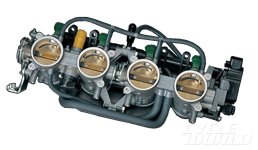
https://www.partsoutlaw.com/oemparts/a/suz/577fe1d687a86612d476e339/throttle-body-gsx-s1000fal6-e33
 
Yes, there are some here that advocate a sync at "operating speed", but looking at it realistically, "operating speed" with no load is still achieved at very low throttle openings. I don't see the advantage there.

The basic principle of doing the sync at (or near) idle speed merely ensures that all the throttles are open enough to contribute to the overall power output at idle. Since the linkage from one carb to the next is 1:1, whatever the relationship is at idle, it should remain the same all the way to wide open. The main advantage of having all the carbs open the same amount at idle also makes the bike much easier to ride. If it is idling on only three cylinders, it's possible that the fourth one will "wake up" and come online just off idle, when you are trying to leave a stop smoothly. If the carbs are all synchronized, there are no surprises as you turn the throttle.

.
 
Another reason to do it just above idle is that idle is where the differences will be easiest to identify. A 1mm^2 change in opening is a much bigger difference when the total opening is near to that size, instead of looking for a difference of 1mm^2 out of 200mm^2. And like Steve said, if you're balanced at idle, you're balanced everywhere (barring other problems).
 
Last edited:
Thanks, that's pretty much what I thought (although this is a fuel injected bike).

I went back and did it again, got all 4 synced really nicely but forgot to pay attention to RPM, and sure enough it won't run now with the sensors all plugged in. It seems like it's really rich (smelly). With sensors unplugged it idles a little high and seems like it takes time for the fuel to shut off when I get off the throttle.

The manual says I'm supposed to re-set the (intake air pressure?) sensor after a sync but I don't have the Suzuki SDS to do that. I'll try again today, syncing at idle at trying to keep it at 1,000 rpm. Then I'll bring to a stealership so they can plug in their stupid tool and charge me too much money.
 
I just realized another oxymoron: carburetor? Doesn't carburetor mean something that regulates air flow? Isn't my 'throttle body' technically a carburetor? And maybe a traditional carb is a 'fuel atomizing carburetor'?


Any good resources or links for learning about modern fuel injected bike throttles/carbs? I hate blind wrenching.
 
Thanks, that's pretty much what I thought (although this is a fuel injected bike).
Fuel injected or carbureted, you still have multiple throttle plates that are supposed to be operating together.


I just realized another oxymoron: carburetor? Doesn't carburetor mean something that regulates air flow? Isn't my 'throttle body' technically a carburetor? And maybe a traditional carb is a 'fuel atomizing carburetor'?
By definition, a carburetor is a device that blends fuel and air in the proper ratio for combustion. The part that "regulates air flow" would be the throttle plate or butterfly. In the case of your fuel injection, there is a computer that reads information from sensors relating to air temperature, air pressure, engine speed, throttle position, etc., to determine how much fuel to inject under pressure.

In the classic "carburetor", it all relies on simple physics to get the job done. A few variables have to be considered, like engine size, state of 'tune', air flow potential, etc., then jets are selected to allow the moving air to draw the approximately correct amount of fuel. As the throttle is opened, more air flow goes through the venturi, which pulls more fuel through the jets. More air, more fuel, simple.

In a fuel injected vehicle, instead of relying on moving air to suck fuel through jets, pressurized fuel is sprayed into the intake tract by an injector. The injector is basically just a solenoid that allows fuel movement when energized. Since the pressure of the fuel remains rather constant, the only variable is TIME. The computer reads all the sensors to determine how long to leave the injector open, based on information that has been programmed into it.

Your "throttle bodies" are just that, throttle assemblies that control the air flow. An engine tries to breathe as much air as it can, all the time, but it is usually restricted, or "throttled" to control it. In your bike, the injectors are quite likely near the throttle plates, maybe even part of the assembly, but all the throttle really does is control the air flow.

.
 
Thanks Steve!

The last thing I was trying to figure out is what the sync screw is actually adjusting. I couldn't find much online, but then I took a closer look at the diagram pic and noticed the screw has a needle point, and is sealed with a washer. So most likely it's a needle valve that's controlling an idle or bypass air circuit.
 
Got a link to that picture? :-k

I ask because on carbs, the cable pulls on one of the carbs, the others are piggy-backed from that one, with adjustments at each junction. It's a simple screw and locknut arrangement, no needle points, no washer, nothing to be "sealed".

I have seen on a few cars, there is no mechanical linkage for the throttle, hence no place that looks familiar to adjust idle speed. Found that there is a "bypass port" that allows air past the throttle butterfly to allow the engine to run. Adjusting that idle bypass simply allows more air into the engine, more air requires more fuel, the computer does the rest.

.
 
Sure:
(parts diagram)
https://www.partsoutlaw.com/oemparts/a/suz/577fe1d687a86612d476e339/throttle-body-gsx-s1000fal6-e33

(Suzuki pitch about engine)
http://www.globalsuzuki.com/motorcycle/moto/street/gsx-s1000/l6/

This is a screw (#3) that goes into a 'barrel' formed in the throttle body. There is one screw for each injector (obviously). I couldn't tell if the screw went in to act against the butterfly (or connected mechanism), but being that the screw is pointed and has an 0-ring I'm thinking it's an air bleed.

Note that there are 2 butterflies per TB - the lower (hidden) one is controlled by throttle cable, the upper one is electronically controlled.
 
Can't see if there are any adjustments possible in the linkage between carbs, so I would probably guess that the "air screws" are the "bypass port" that I mentioned in post #8. :-k

.
 
I agree, I don't think it's a mechanical thing. I can't find a cross section and can't see inside, but by the look and feel of it I think it's an air bypass valve.

One of the vacuum hoses came off which is why the bike wasn't running right. I just did a 3rd round sync and it's pretty perfect (trying to do it late at night rumbling in an apartment garage was nerve-racking, this time I did it outside). The bike runs like a raped effing ape! I thought I lost something special with the first bike since this one just never felt great. But now...Holy Moses!

I had vibes throughout the spectrum, to the point where I wasn't comfortable spending much time over 4500 rpm. It went all the way up to at least 9,000. Now there's hardly any vibration, the sound is better, the pull is stronger. It's hard to imagine such a small adjustment on such a small screw could make that big of a difference. It wasn't out more than maybe 2-3 cmHg.

Now I can get back to moving my crap out of storage, getting rid of my car, and FINALLY getting back to the 'real' GS :)
 
Back
Top