• Required reading for all forum users!!!

    Welcome!
    Register to access the full functionality of the GSResources forum. Until you register and activate your account you will not have full forum access, nor will you be able to post or reply to messages.

    A note to new registrants...
    All new forum registrations must be activated via email before you have full access to the forum.

    A Special Note about Email accounts!
    DO NOT SIGN UP USING hotmail, outlook, gmx, sbcglobal, att, bellsouth or email.com. They delete our forum signup emails.

    A note to old forum members...
    I receive numerous requests from people who can no longer log in because their accounts were deleted. As mentioned in the forum FAQ, user accounts are deleted if you haven't logged in for the past 6 months. If you can't log in, then create a new forum account. If you don't get an error message, then check your email account for an activation message. If you get a message stating that the email address is already in use, then your account still exists so follow the instructions in the forum FAQ for resetting your password.

    Have you forgotten your password or have a new email address? Then read the forum FAQ for details on how to reset it.

    Any email requests for "can't log in anymore" problems or "lost my password" problems will be deleted. Read the forum FAQ and follow the instructions there - that's what we have one for...

  • Returning Visitors

    If you are a returning visitor who never received your confirmation email, then odds are your email provider is blockinig emails from our server. The only thing that can be done to get around this is you will have to try creating another forum account using an email address from another domain.

    If you are a returning visitor to the forum and can't log in using your old forum name and password but used to be able to then chances are your account is deleted. Purges of the databases are done regularly. You will have to create a new forum account and you should be all set.

Mystery part!!! Could it cause charging system problem? Pic in post

  • Thread starter Thread starter bigs_gs
  • Start date Start date
B

bigs_gs

Guest
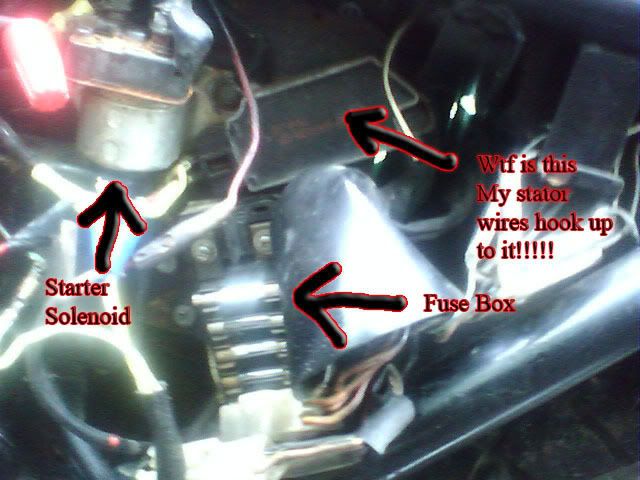
Ok GS'ers, heres the deal. My regulator/rectifier wasn't even hooked up!!! Instead my stator wires run to this.
\/ \/ \/ \/ \/ \/ \/ \/ \/ \/ \/ \/ \/ \/ \/
motor.jpg


Now my guess is that it is a voltage regulator off a car and that it is the root of my charging system problems. My stator throws out 76 volts at 5k rpms but it doesn't reach the battery. Your insight and expert advice will be much appreciated as I am soooooo itching to ride this bad boy.:)
 
I think you're right. Take the auto voltage regulator, search out the previous owner and install it in an appropriate place so he will understand your displeasure. LOL

The three stator yellow AC output wires MUST be connected to the rectifier three yellow AC input wires.
The black (neg) and red (pos) wires coming from the R/R are 12 v DC output and should be connected to battery.

E.
 
they run through the fuse box and are distributed from there actually if i'm correct
 
Yeah but the fuse keeps my electronics from doubling over to a toaster.
 
The electronics are draw and are already supplied from the fuse block.
The charging system is input. There are two common faults with the charging system. 1. the stator drops a leg and produces insufficient amperage. 2. The
R/R burns out the high limit side and charges at too high a voltage. Fuses protect against too high an amperage draw. Voltage doesnt blow them.
If your R/R goes belly up and starts shoving 18 volts into the battery/electrical system, the fuse is not going to blow, but the electronics will, the headlight bulb will burn out, the Ignition system will burn up, but not the fuse. You can run 1000 volts through that fuse and it wont do a thing to it. Its amperage/flow that will melt it.

E.

Yeah but the fuse keeps my electronics from doubling over to a toaster.
 
Last edited:
It is a regulator, it looks a lot like the one that was on my Yamaha. They don't handle a lot of power, like around 200-250watts. I would swap it for a more robust unit.
 
Thanks clone. And earlfor, heat blows fuses not amperage. If a high voltage heats up the wires it will burn the solder filament.
 
Seems to be a chicken or egg situation. It takes amperage to make heat. LOL
E.


Thanks clone. And earlfor, heat blows fuses not amperage. If a high voltage heats up the wires it will burn the solder filament.
 
fuses?

fuses?

Well then... why in the world do they rate the capacity of fuses in AMPS as opposed to volts?

You are partially correct. When an AMPERAGE higher than the rated value tried to go through the fuse, it overheats, as designed, and melts the "filament" electrode.
 
As voltage increases for a given load so does the amperage.

Current=Voltage/Resistance

If it was possible to have fuses that blow at a certain voltage then it would never blow unless you reg/rec fried out. Now in this situation if you had a short (ie. starter relay) somewhere on your bike you would melt the wires and not blow the fuse.
 
Last edited:
Ok, both of you, here's what get you confused:

Earlfor: Yr. assumption applies for power (Watt)
P = U x I (Power = Voltage x Current)
- Increase the voltage with same load (in Watt) and the current will decrease.

The loads on a bike is mainly resistive, making Ohms law apply:

U = R x I (Voltage = Resistanse x Current)

or:

I = U/R ( Current = Voltage / Resistanse in Ohm )

Assuming the load is a light bulb, the resistance is near to constant, and this is effectively the load.
Combining the two formulaes gives
P = U^2 / R( Power = Voltage squared over Resistance)

Which of course shows that power actualy increases with the square of a voltage increase. That is double the voltage and you quadrupple the power over the same load.

This discussion was about current draw, but as it has already been pointed out - current draw is just the function of voltage over the "almost" constant resistance.

-blo
 
Ok, both of you, here's what get you confused:

Earlfor: Yr. assumption applies for power (Watt)
P = U x I (Power = Voltage x Current)
- Increase the voltage with same load (in Watt) and the current will decrease.

The loads on a bike is mainly resistive, making Ohms law apply:

U = R x I (Voltage = Resistanse x Current)

or:

I = U/R ( Current = Voltage / Resistanse in Ohm )

Assuming the load is a light bulb, the resistance is near to constant, and this is effectively the load.
Combining the two formulaes gives
P = U^2 / R( Power = Voltage squared over Resistance)

Which of course shows that power actualy increases with the square of a voltage increase. That is double the voltage and you quadrupple the power over the same load.

This discussion was about current draw, but as it has already been pointed out - current draw is just the function of voltage over the "almost" constant resistance.

-blo

GREAT reading...I happen to like math! \\:D/ :-D It almost always settles the dispute.
 
Thank You. :-) Thats what I thought I said. Apparently, I was only clear in my own mind. hehehehe

E.


Ok, both of you, here's what get you confused:

Earlfor: Yr. assumption applies for power (Watt)
P = U x I (Power = Voltage x Current)
- Increase the voltage with same load (in Watt) and the current will decrease.
 
But what i was saying is that if there is something that heats the wires up enough to fry them the filament will be fried as well right?
 
Back
Top