• Required reading for all forum users!!!

    Welcome!
    Register to access the full functionality of the GSResources forum. Until you register and activate your account you will not have full forum access, nor will you be able to post or reply to messages.

    A note to new registrants...
    All new forum registrations must be activated via email before you have full access to the forum.

    A Special Note about Email accounts!
    DO NOT SIGN UP USING hotmail, outlook, gmx, sbcglobal, att, bellsouth or email.com. They delete our forum signup emails.

    A note to old forum members...
    I receive numerous requests from people who can no longer log in because their accounts were deleted. As mentioned in the forum FAQ, user accounts are deleted if you haven't logged in for the past 6 months. If you can't log in, then create a new forum account. If you don't get an error message, then check your email account for an activation message. If you get a message stating that the email address is already in use, then your account still exists so follow the instructions in the forum FAQ for resetting your password.

    Have you forgotten your password or have a new email address? Then read the forum FAQ for details on how to reset it.

    Any email requests for "can't log in anymore" problems or "lost my password" problems will be deleted. Read the forum FAQ and follow the instructions there - that's what we have one for...

  • Returning Visitors

    If you are a returning visitor who never received your confirmation email, then odds are your email provider is blockinig emails from our server. The only thing that can be done to get around this is you will have to try creating another forum account using an email address from another domain.

    If you are a returning visitor to the forum and can't log in using your old forum name and password but used to be able to then chances are your account is deleted. Purges of the databases are done regularly. You will have to create a new forum account and you should be all set.

No dip for you!

  • Thread starter Thread starter beetle
  • Start date Start date
Isnt that what makes us a great society.. we can all have our own viewpoints and all be right AND wrong at the same time.
 
Years ago I used to fly model airplanes.
A trick used for cleaning the engines was to put them in ethylene glycol antifreeze in a crock-pot, and simmer them overnight.

I did this for several engines that had all kind of crap, varnish, and gunk burnt onto them, and they came out looking brand new.

I think (but am not sure) that antifreeze is safe for all metals, all plastics and all o-ring materials.

When I finally do my carbs, I will try this method.


A couple warnings.

Cats, dogs, and other animals will try to drink the antifreeze if they can get to it; don't let them, it's poisonous

Also, the crock pot can NEVER be used for food again.

It's probably best to do this outside, cause it does smell like hot antifreeze.

I've tried the antifreeze method on gasser engines with little success..
It's really only effective for removing the castor glow fuel varnish.
 
I never dip carbs. never needed to dip them to make them run perfect. I just remove all removable parts(bowls, jets ,slides) and spray every passage way out thoroughly with spray b-12 chemtool untill everything looks spotless inside and out and then blow them out with compressed air. you can also put all brass parts(jets, seats, mixture screws, nozzles) in a baby food jar full of b-12 and soak them over night , shaking the jar every once in a while. Never soak any rubber parts(fuel needles, o rings, slide diaphragms, bowl gaskets) in carb cleaner or they will be ruined but it is ok to spray them of with it. before I reassemble I pull one bristle from a wire bush and spin each jet on it to make sure the entire inside of the jet is clear then blow everything out with compressed air and reassemble. I think dipping is more for those who want to try and make the outside of the carbs to look spotless. b-12 will do the same thing and much more quickly but it will cost a couple bucks more as 2 cans may be needed if you want to clean both the inside and outside. even on carbs with bowls full of rotten gas I never really find much buildup inside the bodies of carbs at least inside passage ways . well, nothing that spray carb cleaner wont remove in 1 squirt. I have also heard horror stories about chem dip eating the sealing material up on the throttle shafts of some cv carbs where the throttle shaft passes through the bodies of carbs causing bad vacuum leaks.
 
Use Lacquer Thinner, any paint store should have it.

No disrespect intended but this is a bad idea. The butterfly shaft of CV carbs has rubber seals on each end and lacquer thinner will aggressively attack rubber. I don’t recommend extended soaking in carb dip for the same reason, try to limit the soak dwell time to the minimum needed to get the grunge out and stay away from things like acetone and lacquer thinner.
 
Just a thought, Has anyone tried dippng there carbs in kerosene? I have an oil drain pan with about 2 gallons of kerosene in it. I usually take greasy and oily parts and drop them in there for a few minutes, scrub them with a brush and rinse. Today I took the oil pan off my Kat which had tons of sludge and oil on the inside and stuck on grease and tar on the outside. I put it in the kerosena and scrubbed it for a few minutes, It was like brand new when I took it out, absolutely spotless on the inside.

I usuall dip my carbs in berrymans overnight, which Im doing right now. But maybe Ill do a final rinse in the kerosene and see what it does. The suzuki manual recommends soaking the drive chain in kerosene to get all the oil and greae off, that works.
 
Is it me or do I get the sense that some of you tear into the carbs fairly often? I don't see any recomended lapse between carb cleannings published, but I would expect, with today's gasoline quality, not to have to do it more than once on a bike, or , say, every, say 30K miles? I just don't see the reason for it, yet it seems some of you do it at least once a season? Can someone explain, why its done, yearly or every coupleof years?
 
OK, so I'm in the process of dismantling and cleaning my carbs. Slight problem: there's no dip to be had. Ok, so you can't buy Berrymans or similar carb dip here in this Great Southern Land, but you can get Yamaha's Yamalube Carburetor Dip - except you can't. No Yamaha dealer within reasonable distance stocks ANY kind of Yamalube. Too expensive they says. They'll order it for me, provided I buy the minimum 12 bottles... :eek:

So, anybody here know a good alternative to brand name dip? My first thought was acetone. Any ideas?


Use charcoal lighter fluid.
Um, Im not kidding..
 
I dont think its that people tear into their carbs all the time. I think alot of these guys are just buying old stored away bikes and fixing them up and finding the carbs need going through.
 
Is it me or do I get the sense that some of you tear into the carbs fairly often? I don't see any recomended lapse between carb cleannings published, but I would expect, with today's gasoline quality, not to have to do it more than once on a bike, or , say, every, say 30K miles? I just don't see the reason for it, yet it seems some of you do it at least once a season? Can someone explain, why its done, yearly or every coupleof years?
Had to do the first set of carbs three times before I discovered that the "15 to 30 minutes" recommended dip time is not enough, but the carbs have not been off the bike in the five years since then. :dancing:

I have done multiple other sets of carbs, but only once per bike. :-\\\

I have never had the carbs off my Wing. I did see them this spring when I changed the timing belts and thermostat, though.
LOTS of fresh gas flows through them, too. 418.6 gallons in the last four months. :D

You do it right, you should not have to do it again. Of course, this depends on how often you run fresh gas through the carbs by riding, and whether you store it properly if you have to winterize it. :o

.
 
All this talk about how to clean old carbs has sprked a question in my mind.. I have a set of VM 26 off my 78 GS750. The bike was running when i took them off. I had a set rebuilt and decided to put the "FRESH" carbs on it. Anyways i just took the carbs off and shoved them up on the shelf. Question is this..should i take off the bowls and maybe blow them out with some compressed air or something to keep them from getting sticky inside? Maybe spay with carb cleaner and compressed air??? They have been off the bike now for maybe two months now.
 
All this talk about how to clean old carbs has sprked a question in my mind.. I have a set of VM 26 off my 78 GS750. The bike was running when i took them off. I had a set rebuilt and decided to put the "FRESH" carbs on it. Anyways i just took the carbs off and shoved them up on the shelf. Question is this..should i take off the bowls and maybe blow them out with some compressed air or something to keep them from getting sticky inside? Maybe spay with carb cleaner and compressed air??? They have been off the bike now for maybe two months now.

Two months, probably just pull the bowls and look. Dump the gas out, clean them out a little. If things look bad do the whole carb clean routine. They don't tend to get really nasty for a lot longer.
 
I never dip carbs. never needed to dip them to make them run perfect. I just remove all removable parts(bowls, jets ,slides) and spray every passage way out thoroughly with spray b-12 chemtool untill everything looks spotless inside and out and then blow them out with compressed air. you can also put all brass parts(jets, seats, mixture screws, nozzles) in a baby food jar full of b-12 and soak them over night , shaking the jar every once in a while. Never soak any rubber parts(fuel needles, o rings, slide diaphragms, bowl gaskets) in carb cleaner or they will be ruined but it is ok to spray them of with it. before I reassemble I pull one bristle from a wire bush and spin each jet on it to make sure the entire inside of the jet is clear then blow everything out with compressed air and reassemble. I think dipping is more for those who want to try and make the outside of the carbs to look spotless. b-12 will do the same thing and much more quickly but it will cost a couple bucks more as 2 cans may be needed if you want to clean both the inside and outside. even on carbs with bowls full of rotten gas I never really find much buildup inside the bodies of carbs at least inside passage ways . well, nothing that spray carb cleaner wont remove in 1 squirt. I have also heard horror stories about chem dip eating the sealing material up on the throttle shafts of some cv carbs where the throttle shaft passes through the bodies of carbs causing bad vacuum leaks.
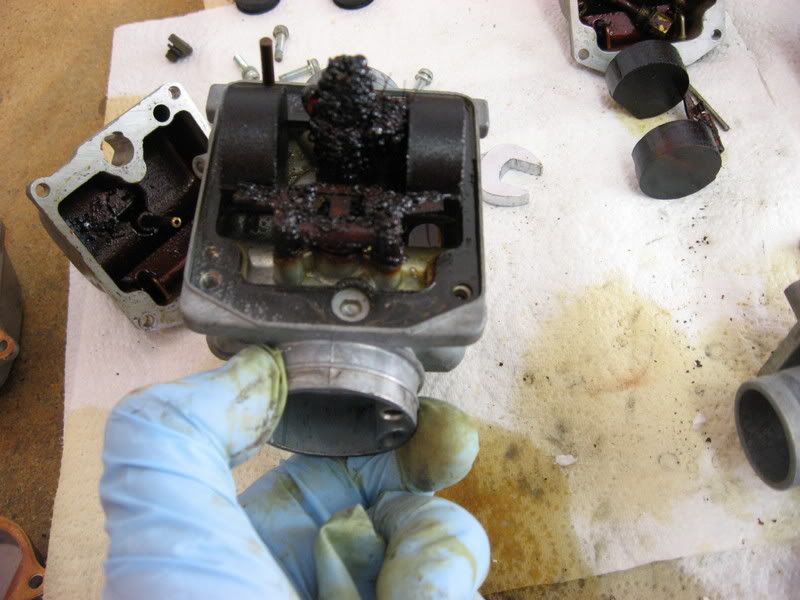
Spray cleaner don't get'er done when the carbs are really gunked up. These carbs came off a bike that had sat for about 25 years. You going to clean these things with spray cleaner?

IMG_0107.jpg
 
NESSISM...You got it wrong.. the carbs were running fine when i took them off.. I rode the bike aqt 80 miles an hr the day before i did the switch.. I wanna know how to presereve them so that over any extended period of time in storage that they DONT gte all gummed up and look like that..
 
These carbs have been sitting (on bike) since sometime in 1995, in various locations (outside, inside, under trees etc). They were frozen solid when I pulled them off - everything is filled or coated in black gunk that simply will not scrape off without some sort of chemical intervention. Spay can carb cleaner cleaned the sticky residue off the slides and throats easily, but won't budge the gunk. I need to soak them for a few hours in something that won't hurt the seals on the valve shafts, won't turn the bodies black and actually softens and removes the gunk.

I've canned the lemon juice idea based on above posts, so boiling them in water or maybe a dip in kerosene might be the answer, since both are readily available. Maybe a dip in kerosene or alcohol followed by boiling in water?
 
Spray cleaner don't get'er done when the carbs are really gunked up. These carbs came off a bike that had sat for about 25 years. You going to clean these things with spray cleaner?

LMAO!!
Sandblaster might do it?
 
Oh yeah, Nessism, that photo pretty much shows what I'm dealing with...
 
NESSISM...You got it wrong.. the carbs were running fine when i took them off.. I rode the bike aqt 80 miles an hr the day before i did the switch.. I wanna know how to presereve them so that over any extended period of time in storage that they DONT gte all gummed up and look like that..

Hey Chuck,

My message was not directed at you, it was for supersonic (notice the message quote in my response).

I agree with not dipping the carbs on a daily driver that is running well. I do feel the O-rings should be changed though on any bike with the original O-rings still installed, regardless of whether or not it is running well or not.
 
What would you suggest would be proper procedures for putting them into a long term storage senario?
 
Back
Top