• Required reading for all forum users!!!

    Welcome!
    Register to access the full functionality of the GSResources forum. Until you register and activate your account you will not have full forum access, nor will you be able to post or reply to messages.

    A note to new registrants...
    All new forum registrations must be activated via email before you have full access to the forum.

    A Special Note about Email accounts!
    DO NOT SIGN UP USING hotmail, outlook, gmx, sbcglobal, att, bellsouth or email.com. They delete our forum signup emails.

    A note to old forum members...
    I receive numerous requests from people who can no longer log in because their accounts were deleted. As mentioned in the forum FAQ, user accounts are deleted if you haven't logged in for the past 6 months. If you can't log in, then create a new forum account. If you don't get an error message, then check your email account for an activation message. If you get a message stating that the email address is already in use, then your account still exists so follow the instructions in the forum FAQ for resetting your password.

    Have you forgotten your password or have a new email address? Then read the forum FAQ for details on how to reset it.

    Any email requests for "can't log in anymore" problems or "lost my password" problems will be deleted. Read the forum FAQ and follow the instructions there - that's what we have one for...

  • Returning Visitors

    If you are a returning visitor who never received your confirmation email, then odds are your email provider is blockinig emails from our server. The only thing that can be done to get around this is you will have to try creating another forum account using an email address from another domain.

    If you are a returning visitor to the forum and can't log in using your old forum name and password but used to be able to then chances are your account is deleted. Purges of the databases are done regularly. You will have to create a new forum account and you should be all set.

Output flange rpm on gs1100g..???

  • Thread starter Thread starter Mark Harrop
  • Start date Start date
M

Mark Harrop

Guest
OK, why am I asking this?

I've got a project going that involves a gs1100G motor. I am building a transcontinental racebike that hopefully will be able to cruise comfortabley at 100mph.
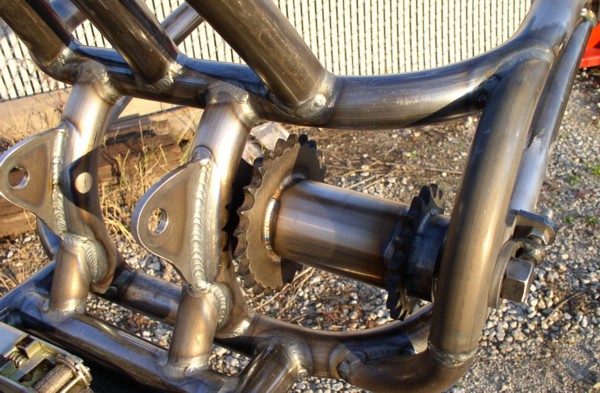
The motor is going to be spun 90 degrees counterclockwise (looking from above) and the output shaft that used to spin the driveshaft is going to power a jackshaft.
Picture an exposed primary drive on a Harley...except mine will be on the right side of the bike. I am doing this for a few reasons, common sense and practicality are not among them...;)

I am going to use the jackshaft to (hopefully) be able to change gear ratios easily so I can test the bike before the race. Taking off in first gear wont be a big deal...If I have to feather the clutch to get it moving, I dont care, I just want it to be at the optimal rpm when I hit cruising speed. I know the 5 speed tranny limits top end a bit...I will need to balance speed/fuel economy ( the bike will have a dummy oil tank filled with gas/elec fuel pump) with speed.

Anybody follow me here? I know it probably sounds stupid to some of you, but I really want to win this race and the chopper show that follows. Thats never been done before at the Smokeout.
Heres an example of a jackshaft...
360%20Radius%20Edit2.JPG


Yes, mine will be wider to align withthe output flange sticking off the right side of the bike...

I'm thinking a sprocket mounted directly to the output flange turning another on the jackshaft using 530 chain and a tensioner...simple and strong.

Any comments /suggestions? Anyone mess with jackshafts on racebikes/dragster type stuff where you changed sprockets alot?
 
Last edited:
Sounds like an interesting project. :-\\\

Without getting into just why you would want to do something like that, I have to wonder about the wisdom of turning the engine sideways. Your exhaust will be right up against your leg and three of the four cylinders won't be getting much cooling air. And, at 100 mph, I would think that they would need as much as they can get.

Would it not be a bit easier to have a different ratio made up for the final drive?
Yeah, it's not as different and flashy, but might be more practical, allowing your efforts to be directed elsewhere.

Any other engine mods in the planning stages?

What are you targeting as 'optimal' rpm for your 100 mph running?


Looking for flange rpm, you can go from two directions.
1. look at the transmission ratios and apply them to the engine speed.
2. look at the final drive ratio, figure in the diameter of the wheel to get driveshaft rpm / road speed

.
 
Last edited:
And don't forget the torque effect of an inline four...

When you twist the throttle the bike is going to want to lean over...

That's one of the problems they had back in the day of Hendersons and other like bikes....and they didn't have near the power you're going to have....
 
Mark, I am within a "Reasonable" driving distance of a Lot of the central U. S. and I have a Trailor. Here is an apprpximate one way mileage chart.

Nashville TN 2 Hours

Evansville IN 2 Hours

Memphis TN 3 1/2 Hours

Saint Louis MO 4.25 hours


Louisville KY 4 Hours

Cincinnati Ohio 5 Hours

Atlanta GA 6 Hours

Chicago or Detroit 8-9 Hours

I'm not rich but am more than willing to help a GSer in need.:)
 
Well Steve, I'm kinda going for this look...but a little more chopper/bobberish
Indian_4_1931.JPG


And this diagram shows exactly what I'll need to figure out...
#1 will be the output flange from the shafty motor...and I need to run 100 mph as economically as possible

The rest is math, my Achilles heel :oops: Do you think cooling airflow will be a problem at high speed? Maybe a cylinder head temp gauge on the rear cylinder may be in order during testing. The motor will be stock, or close to it. Its a used motor, and I know they are very reliable in stock trim, so no fancy race parts (like they make any for that motor...:rolleyes:)


drive_ratio.jpg
 
And don't forget the torque effect of an inline four...

When you twist the throttle the bike is going to want to lean over...

That's one of the problems they had back in the day of Hendersons and other like bikes....and they didn't have near the power you're going to have....
This bike will be built for 1 thing...going 100mph on I-40

Do you think it will be a problem? My other chopper is a plunger framed, undampened girder-forked 73 CB 750 that is scary as hell. I don't think it will be a problem, 'cuz I can ride anything.:D

I dont know though...:-k
 
Mark, I am within a "Reasonable" driving distance of a Lot of the central U. S. and I have a Trailor. Here is an apprpximate one way mileage chart.


I'm not rich but am more than willing to help a GSer in need.:)

Thanks Marv!

Do you know anything about electronic countermeasures to avoid laser and doppler radar?

...or helmet mounted commo systems that have CB and scanner capabilities?
;)
 
Thanks Marv!

Do you know anything about electronic countermeasures to avoid laser and doppler radar?

...or helmet mounted commo systems that have CB and scanner capabilities?
;)

No, but I do know that there are long stretches of I 40 not near Metropolitan areas (Knoxville, Nashville, Jackson, Memphis) where You would have to try to get the attention of Law Enforcement.;)
 
Do you think it will be a problem? My other chopper is a plunger framed, undampened girder-forked 73 CB 750 that is scary as hell. I don't think it will be a problem, 'cuz I can ride anything.:D

I dont know though...:-k

I really don't know either...I remember my Dad telling me it was a problem on the Hendersons....
At those speeds, in traffic, you may have to take some evasive action...
We all know how important lean angle is....an inline bike will lean over more or try to stand up when acellerated, depending on if you're going left or right...
Just something to think about...or check out in early testing...;)
 
I really don't know either...I remember my Dad telling me it was a problem on the Hendersons....
At those speeds, in traffic, you may have to take some evasive action...
We all know how important lean angle is....an inline bike will lean over more or try to stand up when acellerated, depending on if you're going left or right...
Just something to think about...or check out in early testing...;)

But at the 90 degree angle, it's not going to sit like an inline, almost more like a V twin. Sorta. The weight will be front to back, assuming that is the forcing mechanism behind the desire to lean. If it's just torque madness, the lean would probably be based more on how well balanced the rider stays and that the pants-crapping doesn't make the rider slide to the right or left, causing radical leaning one way or the other :eek: I've always felt like torque wants to stand the bike straight up, but that's me and I don't spend any time at 100mph. I'm only half as crazy as Mark. Maybe not even ;) Other than the rider, the weight is in the engine. An I-4 has it distributed more east west, while turning 90 degrees it brings it north-south in relation to the frame. Depending on what Mark does to avoid burned legs/reduced weight from exhaust, that is. My guess would be that it will make the bike feel lighter, and be more wheelie-inducing.
 
OK, anybody have a stock 1100g and can tell me what rpm the engine is turning at 100mph?

Maybe I should start there...

I'm googling for a dyno sheet on a stock 1100g too, so if anyone has one...
 
OK, I don't have an 1100G, and I haven't stayed at a Holiday Inn Express since October, but here's what I came up with.

Starting with a new 130/90-17 rear tire, it measures 80 inches in circumference.
There are 63,360 inches per mile (5280 feet x 12)
This will require 792 revolutions of the tire per mile.
The final drive ratio is 3.09
This will require the driveshaft to turn 2,448 times per mile.
At a speed of 60 mph, it will do those 2,448 revolutions in one minute.
At a speed of 100 mph, it will do 2448 / 60 x 100 or 4080 revolutions.
This will be different than engine speed because there is a difference in transmission ratios (which I don't have available), but you were asking about flange speed, weren't you?

.
 
OK, I don't have an 1100G, and I haven't stayed at a Holiday Inn Express since October, but here's what I came up with.

Starting with a new 130/90-17 rear tire, it measures 80 inches in circumference.
There are 63,360 inches per mile (5280 feet x 12)
This will require 792 revolutions of the tire per mile.
The final drive ratio is 3.09
This will require the driveshaft to turn 2,448 times per mile.
At a speed of 60 mph, it will do those 2,448 revolutions in one minute.
At a speed of 100 mph, it will do 2448 / 60 x 100 or 4080 revolutions.
This will be different than engine speed because there is a difference in transmission ratios (which I don't have available), but you were asking about flange speed, weren't you?

.
Your a damn genius...

Well, using my colored diagram, I was going to try and calculate what the flange rpm would be at 100 mph, or what it would need to be.
Honestly though, like I said, the math kills me. I have some kind of math dyslexia or something...:o

I'm not really concerned with the other gears, because I figure that if I can come up with a reasonable engine rpm at 100mph, the rest should fall into line. Since Its a going to spend 99% of its time from 70-100 mph, I dont care if its a little sluggish off the line.

If I bolt, say, a 16 tooth countershaft sprocket to the output flange, and use another 16 tooth on the other end of the jackshaft, what would my final drive sprocket need to be to achieve 5000 rpm at 100 mph...and is that even a reasonable goal?

See where I'm going?

I know this is a little out of the box, even for the GSR...;)
 
You looking for 5000 flange rpm or 5000 engine rpm?

Looking back at my figures, the shaft (flange) will be doing about 2448 rpm at 60 mph. My wife's 850's engine is turning about 4300 rpm. This would mean a ratio of about 1.75 from engine to output. (I just looked farther in the spec pages and found that it's actually 1.811 for the 850.) Using that ratio and the projected shaft speed of 4080, the engine would be turning about 7150. An 1100 might have a different ratio, so the engine speed would be less. If you are trying to get engine speed down to 5000 at 100 mph, you need to drop the ratio about 30%. You could do that by using a wheel sprocket with 30% fewer teeth than stock. Any idea what a stock sprocket is? If it's a 41 tooth sprocket, use one that is about 29.


Owww, stop it, my head is hurting.

.
 
Last edited:
[FONT=Verdana, Arial, Helvetica, sans-serif][SIZE=-3]Primary reduction:[/SIZE][/FONT]
[FONT=Verdana, Arial, Helvetica, sans-serif][SIZE=-3]1.775 (87/49)[/SIZE][/FONT]
[FONT=Verdana, Arial, Helvetica, sans-serif][SIZE=-3]Final reduction:[/SIZE][/FONT]
[FONT=Verdana, Arial, Helvetica, sans-serif][SIZE=-3]3.090 (34/11)[/SIZE][/FONT]
[FONT=Verdana, Arial, Helvetica, sans-serif][SIZE=-3]Gear ratios:[/SIZE][/FONT]

[FONT=Verdana, Arial, Helvetica, sans-serif][SIZE=-3] Low[/SIZE][/FONT]
[FONT=Verdana, Arial, Helvetica, sans-serif][SIZE=-3]2.500 (35/14)[/SIZE][/FONT]
[FONT=Verdana, Arial, Helvetica, sans-serif][SIZE=-3] 2nd[/SIZE][/FONT]
[FONT=Verdana, Arial, Helvetica, sans-serif][SIZE=-3]1.722 (31/18)[/SIZE][/FONT]
[FONT=Verdana, Arial, Helvetica, sans-serif][SIZE=-3] 3rd[/SIZE][/FONT]
[FONT=Verdana, Arial, Helvetica, sans-serif][SIZE=-3]1.380 (29/21 )[/SIZE][/FONT]
[FONT=Verdana, Arial, Helvetica, sans-serif][SIZE=-3] 4th[/SIZE][/FONT]
[FONT=Verdana, Arial, Helvetica, sans-serif][SIZE=-3]1.125 (27/24)[/SIZE][/FONT]
[FONT=Verdana, Arial, Helvetica, sans-serif][SIZE=-3] 5th[/SIZE][/FONT]
[FONT=Verdana, Arial, Helvetica, sans-serif][SIZE=-3]0.961 (25/26)[/SIZE][/FONT]
[FONT=Verdana, Arial, Helvetica, sans-serif][SIZE=-3]Final drive: [/SIZE][/FONT]
[FONT=Verdana, Arial, Helvetica, sans-serif][SIZE=-3]Shaft drive[/SIZE][/FONT]

The mighty 1100G power plant is not intimidated by the extra weight and wind resistance of the GK's equipment. The big GS engine zipped the GK through the quarter-mile in 12.69 seconds, with a terminal speed of 104.4 mph. The Honda GL1100 Aspencade, run on a better day, could only manage a best run of 12.999 seconds at 99.1 mph. The bare GS1100G rolled through in 11.88 seconds at 112.3 mph. There's also plenty of real-world power, so passes on the highway can be made quite rapidly in fifth gear.

moz-screenshot.jpg
1982_GS1100G_AUsales2c_1000.jpg
 
You looking for 5000 flange rpm or 5000 engine rpm?

Looking back at my figures, the shaft (flange) will be doing about 2448 rpm at 60 mph. My wife's 850's engine is turning about 4300 rpm. This would mean a ratio of about 1.75 from engine to output. (I just looked farther in the spec pages and found that it's actually 1.811 for the 850.) Using that ratio and the projected shaft speed of 4080, the engine would be turning about 7150. An 1100 might have a different ratio, so the engine speed would be less. If you are trying to get engine speed down to 5000 at 100 mph, you need to drop the ratio about 30%. You could do that by using a wheel sprocket with 30% fewer teeth than stock. Any idea what a stock sprocket is? If it's a 41 tooth sprocket, use one that is about 29.


Owww, stop it, my head is hurting.

.

You think your head hurts?

OK, I just posted more data, so it looks like final drive ratio is .961 (whatever that means)

Is that .961 of engine rpm? and what is the 25/26?, is that 25/26ths?
 
This would mean a ratio of about 1.75 from engine to output.

[FONT=Verdana, Arial, Helvetica, sans-serif][SIZE=-3]Primary reduction:[/SIZE][/FONT]
[FONT=Verdana, Arial, Helvetica, sans-serif][SIZE=-3]1.775 (87/49)[/SIZE][/FONT]
Pretty darn close, wasn't I? :-\\\

Now you just need to find the stock ratio of, say, an 1100, to see what the tooth counts were on the sprockets.

.
 
Pretty darn close, wasn't I? :-\\\

Now you just need to find the stock ratio of, say, an 1100, to see what the tooth counts were on the sprockets.

.

You'd already figured it out while I was posting...damn fine cyphering Steve, my hat is off to you.
 
Compression ratio..9.5:1
Transmission............5 speed constant mesh, 1-down 4-up
Primary reduction..1.775
Final reduction....2.800
Gear ratios, Low...2.500
Gear ratios, 2nd...1.777
Gear ratios, 3rd...1.380
Gear ratios, 4th...1.125
Gear ratios, Top...0.961

Thats from an 1100e, so it looks the same. Guess I just bolt up some sprockets that are geared a little higher and go for it.That wasn't as bad as I thought. Its almost like Suzuki knew I was going to bolt sprockets to the output shaft flange...and they made it easy for me.

Thanks again Steve for holding my hand through that brain teaser.

Now, about cooling issues...:-k

Or anything else that might come up running that motor sideways...
 
I would suspect you may have a problem with the drive flange breaking off due to the side loading with jackshaft. Who knows ? definate cooling problems
 
Back
Top