• Required reading for all forum users!!!

    Welcome!
    Register to access the full functionality of the GSResources forum. Until you register and activate your account you will not have full forum access, nor will you be able to post or reply to messages.

    A note to new registrants...
    All new forum registrations must be activated via email before you have full access to the forum.

    A Special Note about Email accounts!
    DO NOT SIGN UP USING hotmail, outlook, gmx, sbcglobal, att, bellsouth or email.com. They delete our forum signup emails.

    A note to old forum members...
    I receive numerous requests from people who can no longer log in because their accounts were deleted. As mentioned in the forum FAQ, user accounts are deleted if you haven't logged in for the past 6 months. If you can't log in, then create a new forum account. If you don't get an error message, then check your email account for an activation message. If you get a message stating that the email address is already in use, then your account still exists so follow the instructions in the forum FAQ for resetting your password.

    Have you forgotten your password or have a new email address? Then read the forum FAQ for details on how to reset it.

    Any email requests for "can't log in anymore" problems or "lost my password" problems will be deleted. Read the forum FAQ and follow the instructions there - that's what we have one for...

  • Returning Visitors

    If you are a returning visitor who never received your confirmation email, then odds are your email provider is blockinig emails from our server. The only thing that can be done to get around this is you will have to try creating another forum account using an email address from another domain.

    If you are a returning visitor to the forum and can't log in using your old forum name and password but used to be able to then chances are your account is deleted. Purges of the databases are done regularly. You will have to create a new forum account and you should be all set.

Potential Group Purchase - Wiseco GS650 741cc pistons

  • Thread starter Thread starter Ace07
  • Start date Start date
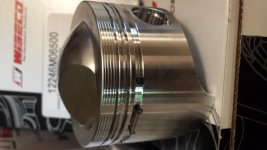
Here is the new piston,
IMG_9040.jpg
I was going to post more pictures but this restriction is stupid.
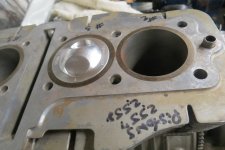
Anyway the factory piston sits down in the bore, I did not measure the amount.
These new pistons sit proud in the bore by about 0.013"
This is with a new base gasket and the cylinder block not bolted down so the piston might well be up a few more thou. I will try to get around to getting some studs or bolts in this tomorrow.
I am working with a factory fresh case and a used cylinder block. I also have a factory new 650 cylinder to run but might start out with a used head till the new one is ported and ready.

As for head gasket thickness, my measuring at this time is not accurate enough to go by, yet.
 
Dang that piston looks really good in there. How do you go about measuring the gasket thickness? I am still a long way from putting my Pistons in.
 
Dang that piston looks really good in there. How do you go about measuring the gasket thickness? I am still a long way from putting my Pistons in.

Most people chose to run a piston to head clearance around 0.030". To determine a gasket thickness one would take in this case the piston is 0.013" above the deck height, to this add the the desired clearance of 0.030 and you will come up with a gasket of 0.043" thick.

If the piston were below the deck such as the stock ones are the gasket will be thinner. Consider the piston is 0.010" below the deck. To get a desired 0.030" clearance the gasket would be 0.020"

Myself I choose to run less clearance than this. On most of the small motors I set up I run closer to 0.015" piston to head so in my case I would choose about a 0.030 gasket allowing me a more active squish area. In my case I need to get more accurate measurements to work with.

As for measuring the piston height, the proper method will be to use a depth micrometer the determine just where the piston is in relation to the cylinder deck. You also need to pay attention that the piston rocks in the bore especially when cold so multiple measurements need to be taken. Last night when i took my quick measurement I used a digital vernier which for this first setup is in the ballpark.
 
Oh ok. Well that seems like a pretty easy way of going about it. If you increase the squish band by just .013" will it increase your performance very much?
 
Oh ok. Well that seems like a pretty easy way of going about it. If you increase the squish band by just .013" will it increase your performance very much?

I think the thing about a tight squish band is that you can run much higher compression ratio and you can get away with more advanced timing without any detonation occuring. There's probably more to it but that's part of the reason for getting it tight.
 
I think the thing about a tight squish band is that you can run much higher compression ratio and you can get away with more advanced timing without any detonation occuring. There's probably more to it but that's part of the reason for getting it tight.

Correct, the way this operates is the tighter squish area forces droplets of fuel back into the center of the chamber providing a richer mixture near the plug and leaning out the outer areas that are prone to not burn fully. When this all works the engine can be run leaner therefore making more power on the fuel used as well as a cleaner burn. Simply put, a higher efficiency.
 
A dozen of these beauties have just arrived!!!!!!!!

attachment.php

(Sorry, I don't know why it turned the picture sideways, it is not that way on my phone, only after I uploaded it)
 

Attachments

  • 20160818_183706.jpg
    20160818_183706.jpg
    91.1 KB · Views: 0
Here ya go Charlie, full size version of yours:
attachment.php


Question for ya - I noticed a slight bit of flash rust in your cylinder bores. I would think that you would probably want to run the hone through that again, would you not? working on some two-stroke dirt bikes with nikasil plated cylinder walls, the plating is so hard that we didn't need to bore the cylinders out any when putting new rings and piston in. We do need to hone the cylinders for proper new ring break in, which is where I read up more on proper hones to use The really long 3 Stone flex hones apparently take a lot of material off, but the ball hones are more gentle and don't take much material off at all. I assume that with any flash rusting, the fine pointed "file-tooth tips" of the honing pattern that are responsible for the bulk of the proper break in within the first 15 miles would get rusted away very quickly and not be present to get a good break in performed. I assume that you would want to hone the cylinder again then if there is any flash rusting. Correct?


FYI everyone, it is really critical to do a proper ring break in after a good hone job. As soon as the bike is started up and up to operating temperature for the first time on the new engine, you need to go out and run it up through the RPM's without lugging the engine, say 3000 RPM to 5500 RPM acceleration, then immediately close the throttle and use the engine braking to decelerate, and repeat that acceleration then engine braking deceleration cycle about 10 times under a good load but not going 100% all out full throttl pulls. Each time, increase the RPM's slightly, I think you would probably want to end up on the 10th run about 6,700 RPM, but on the fresh engine, do not take it above 7000. Breaking it in with 30 weight oil, definitely never synthetic, is a better idea also. Then for at least the first 40 miles, do not ride the bike at any steady RPM, continue this ring break in process by constantly getting on the throttle and then closing it completely. Riding on the highway is not a good idea unless you are constantly altering your RPMs and closing the throttle then accelerating. The hone pattern on the cylinder walls is sharp and pointy and act like a file to custom fit the brand new piston rings perfectly to the surface of the cylinder. If you do not do this within the first 14 miles or so of riding, the hone pattern is worn smooth and only serves as holding oil on the cylinder wall for proper lubrication to prevent glazing ( if you don't break in your rings properly, it will likely glaze over the cylinder walls immediately due to the rings not sealing properly to their full potential).

The additional cylinder pressure caused by putting more of a load on the engine actually forces the piston rings outward and pushes them into the cylinder walls more, Expediting this break in process. The break in process actually removes any surface imperfections from the piston rings as well, as even though they are brand new, they may not have a perfect service, and they really need to match the cylinder walls.

Another thing I remember now from my last engine builds, the orientation of the gap in the piston rings is critical. Make sure to read up on that and have the gaps staggered properly and in the correct orientations


I like to change my oil after 40 miles or so, and then after 100 or so miles. After maybe two hundred miles, then I give it hell and run er hard!
 
Last edited:
Thank you Chuck,
Yes my cylinders need to be touched up, these were bored 10 years ago right about the time I had a debilitating injury so this and many projects went on hold. When bored the cylinders were coated with Quickseal. Unfortunately as good as Quickseal is for building engines it has no value as a protectant during storage hence the rust. Since I could not build the motor at that time I should have oiled the parts.
I have also found a crankshaft I bought on Ebay had been washed and not oiled, it is trash now.

As for ball hones, the only time I use them is the final scuff in two strokes just to reduce chances a port may not have been chamfered. That is just me though, they can be used for a quick deglaze.
 
So for cylinder honing, do you use the hones with the 3 long cutting stones on spring loaded arms then? On the 2 stroke / dirtrider / kdxrider.net forums, they were a saying to use the ball hones, & that the three legged stone hones were to aggressive for most cylinders. Your opinion is a little different than that concensus but excellent advice to hear.
 
Ball hones are the proper tool when you are doing a deglaze to prep used cylinders for new rings. When boring oversize a proper sizing hone is used to bring the holes to final size and a good crosshatch should be present when complete.
 
I only use a Sunnen hone, no spring loaded hones. The spring loaded hones are prone to chatter and do not take any taper out of a bore. There are many different grits available for hones and can provide anything from a gravel course to mirror finish depending on an engine and rings mission.

The spring or ball hones are used by some just for a deglaze of a mid life engine. If you buy a spring loaded hone break in the stones in a not to be used cylinder that is smaller bore than you are working with. Do not try to resize a bore with these. I do this with Sunnen hones as well, any square edge stone can do miserable damage in a bore.
 
Haven't had anything bored and honed in decades, except for using a ball hone myself to put new rings in a used cylinder. If I get a cylinder bored for these pistons will they hone it properly? Ready to throw it together as is or will it still require some honing? How can I find the best place in town to do it right? Same question with heads, how can I find the best shop to do it right? Nothing too fancy, just a nice tight valve job, maybe a little porting.
 
Find a good quality reputable machine shop, especially one that does hot rod engines or air-cooled old Volkswagens.

Give them your pistons. You may want to hang onto the clips pins and rings so they don't get lost. Have them measure each piston very precisely, as there is often a very slight variation in diameter on the pistons, & Wiseco is known for this... Then have them finish hone based on the piston to wall clearance spec that is printed on the Wiseco packaging. Make sure they measure all if the pistons precidely, and if any variation, adjust clearance specs for each cylinder for the final honed bore size. This will require marking the cylinders 1 through 4 and marking corresponding pistons appropriately for the hole that was sized precisely for that piston.

I have 12 of these babies, so if I can turn up a micrometer big enough to measure the pistons, I will compare them myself. I also need to get a small digital scale and adjust the weights of the pistons until they are all identical, & possibly remove a slight bit of material from strategic areas with a dremel type of cable driven grinder until they are closer to OEM piston weight. This will balance it out better and help it spin the engine up faster.
 
A machine shop with experience boring/honing motorcycle cylinders is ideal. The liners in air cooled cylinder blocks can spin if too much pressure is used either during honing or boring. Machine shop guys familiar with air cooled engines should know this sort of stuff (hopefully).
 
Haven't had anything bored and honed in decades, except for using a ball hone myself to put new rings in a used cylinder. If I get a cylinder bored for these pistons will they hone it properly?

Boring a cylinder is a two step operation in which the final part of the job is honing to final size. being you can not size a cylinder with any flex hone whoever does the job will have a proper hone and this day and age I would sure hope they have finer grit stones than were used way back in the days of leaded fuel and 2mm wide rings.
A race engine shop that can work down in our cylinders smaller bores of a bike shop that caters to engine work. Not necessarily a Harley shop since they are tooled differently than these engines need.
 
Ed, you seem to write faster than me, but then I have been working up on the roof.
 
Ok I bought my cylinders used from a guy on here that tried this build with some normal 750 pistons. He was having trouble with his engine over heating though. Should I do anything with my cylinder to help prep them? I have not done anything to them since I bought them.

Eventually I plan to sent my head off to a good machine shop about 45 mins from where I live and have them make sure the valves are in good shape.
 
I would first have the piston skirt clearance checked. If they were tight that could have been an issue and is real easy to remedy during your build. Eather way all of us need to confirm the piston clearance and ring end gaps.
It is hard to diagnose an overheating when you only have a small piece of the original but mixture and timing are the first two external items you will address.
 
Back
Top