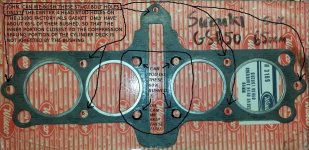
Chuck, reading your info again and if i have understood correctly, it seems as if i should go for one at 0.8mm and the other at 0.9mm, as then I can either run the block as it is, or run with a zero decked block.
Running the block almost zero decked (piston down in hole .003" with base gasket torqued) with a .8mm gasket would be the minimum clearance one would need. This gives you a .033" squish band (TDC piston to head clearance) as Old Colt the veteran race engine builder is shooting for.
In my hot rof car days, I was under the working impression from other veteran builders that you wanted to shoot for .039"-.045" squish band. This is on a water cooled V8 engine. I was going to shoot for that myself.
Another note - if you are planning to optimize your quench distance down to .030" or .040", you will be moving the cams closer to the crank, which is going to alter your cam timing quite a lot, and may require slotting the cam sprockets to dial them back in where you want it. This requires a runout type micrometer pointer gauge and magnetic base (I hit one at garbkr Freight tgat works well enough), a TDC piston stop device, & a cam degree wheel.
Running a very lightly skimmed / milled block and head and a 1.0mm or 1.1mm gasket will keep timing fairly close to where it was when the bike left the factory. This is another grey area, as factory timing tolerances varied quite a lot - 1 area where Suzuki skimp ed on assembly tolerances.
It is best to at least check the cam timing lobe centerlines regardless. 110 Int / 110 exhaust or so is better for lots of high end power. 104 intake / 106 exh builds lots of mud range street torque. Big lift cams can't advance the timing as much due to piston to valve clearance issues.
Any alteration of the cam timing requires checking piston to valve clearances, as the pistons and valves chase each other closely thoughout parts of the crankshaft rotation. You don't want them too close or else a missed shift at redline could start to float the valves and you might have some harsh contact there and bend a valve.
So what I am saying here is that if you zero deck and run a .9mm gasket, or run close to a zero deck and a .8mm gasket, you are definitely going to want to check the cam timing or at least piston to valve clearance (you can see thus through the spark plug hoke but pro builders do a clay mockup on the piston and assemble the engine and rotate, then pull back apart).
So if you are considering the thinner gasket and a zero deck, you definitely need to be aware that you should be checking your cam timing and piston to valve clearance.
If you run a lightly resurfaced head and block or stock, a 1mm gasket, your timing will be closer to factory soec, but again, the timing could be several degrees off at factory built conditions even, so it's best to get a degree wheel, runout gauge micrometer, & a TDC piston stop and read the Web Cams article on cam degreeing. Time consuming but not too difficult. A custom pointer on the runout gauge may need to be fabricated to clear the cam lobe to get on the bucket properly if you want to get the most accurate valve lift measurements.
Also just wanted to make sure you all realized the .8mm gasket may compress down to just a touch over .7mm, and about .76mm is around .030" which Old Colt was shooting for in total quench height, so he'd need to have his piston down in the hole at TDC about .04mm or approximately .003", which is just short of a zero deck.
Please make sure you are all aware of this info before we commit to ordering your thickness requested.
As to the bushed holes vs external riveted tabs, if there is any question of the 4 inner stud holes being able to be only half bushed (half of the circle riveted back on itself, not the half closest to the cylinder bores), then maybe we should lean towards the external rivet method and save $5/each