• Required reading for all forum users!!!

    Welcome!
    Register to access the full functionality of the GSResources forum. Until you register and activate your account you will not have full forum access, nor will you be able to post or reply to messages.

    A note to new registrants...
    All new forum registrations must be activated via email before you have full access to the forum.

    A Special Note about Email accounts!
    DO NOT SIGN UP USING hotmail, outlook, gmx, sbcglobal, att, bellsouth or email.com. They delete our forum signup emails.

    A note to old forum members...
    I receive numerous requests from people who can no longer log in because their accounts were deleted. As mentioned in the forum FAQ, user accounts are deleted if you haven't logged in for the past 6 months. If you can't log in, then create a new forum account. If you don't get an error message, then check your email account for an activation message. If you get a message stating that the email address is already in use, then your account still exists so follow the instructions in the forum FAQ for resetting your password.

    Have you forgotten your password or have a new email address? Then read the forum FAQ for details on how to reset it.

    Any email requests for "can't log in anymore" problems or "lost my password" problems will be deleted. Read the forum FAQ and follow the instructions there - that's what we have one for...

  • Returning Visitors

    If you are a returning visitor who never received your confirmation email, then odds are your email provider is blockinig emails from our server. The only thing that can be done to get around this is you will have to try creating another forum account using an email address from another domain.

    If you are a returning visitor to the forum and can't log in using your old forum name and password but used to be able to then chances are your account is deleted. Purges of the databases are done regularly. You will have to create a new forum account and you should be all set.

Relay burning out and fuse blowing

  • Thread starter Thread starter glenwill
  • Start date Start date
G

glenwill

Guest
I have developed an electrical problem. As background, I replaced my main fuse panel with an Eastern Beaver fuse box, and I did the ignition switch relay mod. I did this early last year, and it ran fine aside from a problem that developed with the signal generator, which I was able to resolve.

This season I took it out for a few rides, and had no issues. Then my son took it for a longer ride, and on the way home it died. I drove to meet him, and found that the main fuse had blown. I replaced it, and the bike was still dead. I traced and found that the ignition switch relay was fried. I had spare relays, so I replaced the relay, and the bike turned on and started up.

I followed him home, and it died within a few minutes. Again, both the fuse and relay were fried. He thought it happened on a turn both times, so we decided to drive home without using turn signals. That didn't help and it died a third time. This time I didn't have another relay on the road with me, so we pulled the wires from the relay and wired the ignition switch back to the fuse panel switched line, essentially undoing the relay mod.

We thought that maybe there was a short in the headlight line that was happening while driving, so he left the headlights home, with my car's headlights lighting the way. This time we made it home, although I am doubtful that was the problem. I suspect the failed relays was causing a short and blowing the fuse. My son said he noticed that before the bike died each time, the voltage steadily dropped to about 8 volts, then it dies. We have a digital volt gauge under the instrument cluster.

I cut open all three failed relays, and found that the coils had been fried. All were melted, and one was heavily blackened. The contact points looked clean, so I don't think there was an overdraw on the contact side I suspect that when they coils were melting, they gradually reduced resistance, lowering the voltage, until they heated enough to short out and take the fuse with it. This is just a guess.

I think the only thing that would fry the relay coils would be an overvoltage. Anyone who can confirm/refute that idea?

If that's true, then I thought I should look at the R/R. I measured the charging voltage, and it is a bit high. With the headlights off, it is just under 15 volts. With the headlight on, it is about 15.3 or higher. However, two factors I think affect that. My Honda R/R has a sensor wire, which I have connected to the rear brake light 12 volt input. With the ignition switch relay bypassed right now, the resistance in the switch is lowering the voltage to the sensor line, which I think would cause the R/R to compensate, causing overvoltage. If I temporarily reconnect the ignition switch relay, I measure a more reasonable voltage in the mid/high 14's.

I am unsure if right before it fails, there is some unexpected overvoltage from the R/R. My son didn't notice it, but that doesn't mean it isn't happening.

Any ideas where to go next?

Glen
 
If you could explain what is fried someone might be able to help. Ignition relay does not help much. What is the part and what part fried?
 
relay mods are a bandaid, if the electrical connections are cleaned up there is no need for a relay.
 
>>relays, and found that the coils had been fried. All were melted, and one was heavily blackened

The relay coils being melted and heavily blackened was the explanation, along with the fact that the relays had stopped working. Basically it's a failed relay that won't close contacts any more.

The ignition switch relay mod I found on this site, so I assumed others would understand what I meant. Basically, the ignition switch can be very hard to get cleaned sufficiently to avoid voltage loss. To bypass that, you put in a relay where the coil (that's the part that triggers the relay) is powered by the orange wire from the ignition switch. When the relay activates, it closes the normally open contacts connecting a 12v line from the battery to the switched part of the fuse box where the orange wire originally went. This results in full power to the electrical system without the voltage loss of the ignition switch.

It's the same approach mentioned in this post:
http://www.thegsresources.com/_forum/showthread.php?231276-Relay-mod-Main-or-coils-only&p=2173861#post2173861

This worked fine all of last year, so I'm trying to figure out why I now have had 3 relay coils burn out in a row. That would seem to suggest over voltage, but I don't know if that's the only possible cause. I also don't know if the RR can randomly jump up voltage. I had replaced the R/R with a
Shindengen SH232-12 from a Honda CB500.

Glen
 
>>relays, and found that the coils had been fried. All were melted, and one was heavily blackened

The relay coils being melted and heavily blackened was the explanation,
along with the fact that the relays had stopped working. Basically it's a failed relay that won't close contacts any more.

The ignition switch relay mod I found on this site, so I assumed others would understand what I meant. Basically, the ignition switch can be very hard to get cleaned sufficiently to avoid voltage loss. To bypass that, you put in a relay where the coil (that's the part that triggers the relay) is powered by the orange wire from the ignition switch. When the relay activates, it closes the normally open contacts connecting a 12v line from the battery to the switched part of the fuse box where the orange wire originally went. This results in full power to the electrical system without the voltage loss of the ignition switch.

It's the same approach mentioned in this post:
http://www.thegsresources.com/_forum/showthread.php?231276-Relay-mod-Main-or-coils-only&p=2173861#post2173861

This worked fine all of last year, so I'm trying to figure out why I now have had 3 relay coils burn out in a row. That would seem to suggest over voltage, but I don't know if that's the only possible cause. I also don't know if the RR can randomly jump up voltage. I had replaced the R/R with a
Shindengen SH232-12 from a Honda CB500.

Glen

The only way you can burn a relay coil is with too much voltage. It could be black because you are arcing contacts but that will not burn the coil. If the coil is open, then you have more than 12V on board. Is it open?

You said you monitored voltage and saw decreasing voltage so I don't know how you would over voltage the ignition relay coil.
 
Last edited:
I assume by open, you mean no conductivity. If so, then yes, all of the failed relays are open. I just checked a new one, and it's showing 80.8 ohms.

The decreasing voltage was what my son saw just before it died. I agree it's a contradictory symptom. But if overvoltage is a likely cause off the coil burning out, then there must be some explanation.

One thought is that as the relay is failing due to overvoltage, it may initially begin having higher and higher resistance as the wires start to melt together, lowering system voltage until it gets hot enough to open completely.

But I don't know if that makes any sense. And since voltage seems to measure fine while I am testing in my garage, I don't know if the R/R can spike randomly.

Glen
 
I assume by open, you mean no conductivity. If so, then yes, all of the failed relays are open. I just checked a new one, and it's showing 80.8 ohms.

The decreasing voltage was what my son saw just before it died. I agree it's a contradictory symptom. But if overvoltage is a likely cause off the coil burning out, then there must be some explanation.

One thought is that as the relay is failing due to overvoltage, it may initially begin having higher and higher resistance as the wires start to melt together, lowering system voltage until it gets hot enough to open completely.

But I don't know if that makes any sense. And since voltage seems to measure fine while I am testing in my garage, I don't know if the R/R can spike randomly.

Glen
 
I asked in post #2 for the relay part number or alternatively the voltage/ current rating of this relay.

81 ohm and 14V corresponds to 170 mAmps and is probably a 12V relay.
 
Last edited:
Sorry, I missed that. Of the 3 that failed, two were Bosch and one was GENSSI.

Bosch: 0332204150 - 12v 20/30 Amp. I believe the first number (20) is the NC contact, and the second number (30) is the NO contact. I was only using the NO contact.

GENSSI: MAH-S-112-C-3 - 12v 30/40 Amp


Thanks for your help.
 
Sorry, I missed that. Of the 3 that failed, two were Bosch and one was GENSSI.

Bosch: 0332204150 - 12v 20/30 Amp. I believe the first number (20) is the NC contact, and the second number (30) is the NO contact. I was only using the NO contact.

GENSSI: MAH-S-112-C-3 - 12v 30/40 Amp


Thanks for your help.

If the coil is open, there are basically two ways for it to fail: Over voltage or high vibration environment.
If you short the coil across the battery that is how it is designed to operate (continuous duty)
If you short a screwdriver across the top of the coil, that is doing nothing to the coil as the current goes through the screwdriver.

My guesses
a.) you have it mounted somewhere that is killing the relay.
b.) I just don't see how you could get 24V or more across it unless you have a stator wire activating the relay through a diode? With a Series R/R the voltages are much higher than with a shunt so while this trick works well with Shunt R/R with a simple diode, you need a voltage clamp with a Series R/R.

Again without a schematic of what you did, this is 29 questions. I'm just asking for the information that would be on any schematic.

I'm starting to feel a bit abused and therefore less tolerant about answering a litany of hypothetical questions based on the ambiguities in the information provided.
 
Last edited:
I'm sorry you feel that way. It's certainly not my intent. I just don't know what all information is helpful, and have been trying to give what I know. I completely misunderstood your first post, and thought you were asking me what "fried" meant. Sorry for that.

I don't think it's vibration, simply because after the first one failed, the 2nd and 3rd each failed within 5 minutes of riding.

I don't have a schematic, but I can see that would help to figure out if there is a wiring problem. I'll work on one and post it later this week.

Glen
 
...........
......................................................... However, two factors I think affect that. My Honda R/R has a sensor wire, which I have connected to the rear brake light 12 volt input. With the ignition switch relay bypassed right now, the resistance in the switch is lowering the voltage to the sensor line, which I think would cause the R/R to compensate, causing overvoltage. .............

Yes!
You understand properly.
If the voltage at the sence line is lower than battery voltage, the R/R will crank up its output (to the battery) trying to control the sense line voltage.
THis is why I have the sense line connected to the battery + (by a relay contact, similar to the ignition relay mod).

Yah, maybe the 15 volts is too much for the relay coil and it burns out after a time. Higher voltage is higher current is more heat. It is designed to tolerate the normal voltage/current/heat.

Good that you have a volt meter installed on the bike.

One time (in rain storm, 250 miles from home, when had sense line on brake circuit) I completely lost the sense line connection. My voltmeter went to high 18 volts, Yikes.

.
 
Last edited:
Thanks Redman. That voltage difference is why I put in the ignition switch relay in. When I was having the relays fail, the sense wire should have had a reasonable voltage since the relay was providing the power and not the ignition switch. The >15 volts measure was after the in-the-field disconnect of the relay, with power going through the ignition switch. When I temporarily hardwired the bike "on", the charging voltage dropped down to 14.8 or less.

I am researching single point ground, and wondering if a ground problem could cause an unexpected voltage through the relay. Hopefully that will be more clear when I post a schematic.
 
A bad ground either at the RR or the battery could certainly cause the voltage to increase, although maybe not enough to burn out a relay coil in 5 minutes. It would be interesting if you could jump the relay temporarily and measure the voltage across the coil at idle and 5000 RPM.
 
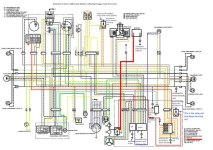
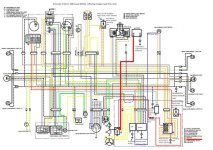
Ok, I've taken a schematic from this site and modified it to reflect my wiring. My modifications (done early last year) include a new fuse box, an ignition key-switch relay and a starter-cutoff-headlights relay. Making the schematic was a big help for thinking through my ground and power lines, although I haven't found anything that explains my issue.

The grounds are mostly as they were when I got the bike, and having read up on a single-point-ground, I definitely don't have that. I don't know if that could contribute to burning out the relay coil and fuse, but I suspect I should change it.

If anyone has any ideas, I would greatly appreciate it. Regardless, I will probably make several key changes to my wiring:

1) Consolidate the grounds into my new fuse box, which has a ground bar. Ground that to the engine case along with the battery negative.
2) Move the R/R sense wire to one of the switched fuses in my new fuse box. I have 3 spares.


Glen's 1980 Suzuki GS550L Wiring Diagram - Annotated.jpg
 
A few comments:

First congratulations for taking this big step to redraw a schematic. I suspect it was helpful to analyze your various modifications and get them clear in your mind. This is what real EE's actually do :).

As drawn, you have many if not too many connections between the R/R and the battery. I count 15+ contacts or crimps. You can certanly reduce that.
Use the Revised Phase A tests to measure the voltage drops.

You should read up more on the SPG. If your R/R is close to the new fuse box then you can make the bus bar yoru SPG but follow teh SPG recommendations which you have failed to reflect in your comment so far.

You seem to have missed GS Charging health as well and you did not eliminate the headlamp switch loop, but did eliminate one stator leg.

On teh surface I don't see anything wrong with where you put that relay (assuming you get rid of some of the contacts listed above), so it seems you probably have too much voltage somewhere. Have you measured the voltage across the relay coil when running? Measured the current through it? You know it should be about 150 mA and not more.

I asked you before if you might have been using a stator leg to power the relay; since that leg is missing what did you do with it?

The image is also hard to read and I'm guessing you used 300 DPI which in my experience will not pick up the fine print. Use 600 DPI if available.
 
Thanks posplayr. I apologize, I did eliminate the headlight switch loop, but did not update my diagram to reflect that. I saw that this morning and meant to edit it, but forgot when I got finished. I do have all three stator wires wired to the R/R. I've updated the diagram to reflect that, with 3 yellow wires from the stator to the R/R.


I did eliminate many of the connectors from the main power wiring, but I did not think to eliminate them from the diagram. I've cleaned those up as well. I'll inspect the wiring to see if there are any others.

I'll read more on SPG, but I do see where what I stated is not right. I think I would need to run the battery to the ground bar, the engine case to the ground bar, and every other ground to the ground bar. then I'd have a SPG, correct?

I don't have the relay connected currently, although I plan to wire it back up for further testing. I have currently reconnected the orange line directly through, which reintroduces some voltage drop through the keyswitch. That results in lower voltage at the lighting wire where I have my R/R sensor, resulting in a 15.5 volt charging level. If I move the R/R sensor to the fuse panel, I'll lower the charging voltage.

I see that the file posted is much lower resolution than the file on my laptop, so the site must be lowering the resolution. If there is a way to increase the upload resolution, I don't see it. I included a link to the full file below.

https://drive.google.com/open?id=0B7YtnGqYolOQQkdYNmdhREl0c1k

Glen's 1980 Suzuki GS550L Wiring Diagram.jpg
 
Thanks posplayr. I apologize, I did eliminate the headlight switch loop, but did not update my diagram to reflect that. I saw that this morning and meant to edit it, but forgot when I got finished. I do have all three stator wires wired to the R/R. I've updated the diagram to reflect that, with 3 yellow wires from the stator to the R/R.


I did eliminate many of the connectors from the main power wiring, but I did not think to eliminate them from the diagram. I've cleaned those up as well. I'll inspect the wiring to see if there are any others.

I'll read more on SPG, but I do see where what I stated is not right. I think I would need to run the battery to the ground bar, the engine case to the ground bar, and every other ground to the ground bar. then I'd have a SPG, correct?

I don't have the relay connected currently, although I plan to wire it back up for further testing. I have currently reconnected the orange line directly through, which reintroduces some voltage drop through the keyswitch. That results in lower voltage at the lighting wire where I have my R/R sensor, resulting in a 15.5 volt charging level. If I move the R/R sensor to the fuse panel, I'll lower the charging voltage.

I see that the file posted is much lower resolution than the file on my laptop, so the site must be lowering the resolution. If there is a way to increase the upload resolution, I don't see it. I included a link to the full file below.

https://drive.google.com/open?id=0B7YtnGqYolOQQkdYNmdhREl0c1k

View attachment 44704

Make the ground bar the SPG and follow the directions for SPG connections.


You know that is 1.0V too high

Perhaps you do not realize that the R/R output will adjust so that the voltage at the sense point is 14.5V(nominal). So if the sense point is below the battery the battery/charging voltage will rise to achieve the regulation level.
 
Last edited:
Thanks Posplayr. I do understand how the sense works and that my current voltage is high. The reason it is high right now is two-fold:

1) I haven't reinstalled the ignition key switch bypass relay. I originally installed that after running the modified charging tests, and finding that even after removing connectors from the path, I couldn't get rid of the voltage loss through the key switch. This week when I temporarily hooked up the relay, my charging voltage dropped to 14.7 or so. That is still slightly high probably, but is likely caused by...

2) My sense wire is on the rear brake pedal switch, which is affected by some of the connectors still in play for the lighting wiring, which I have not eliminated. My thought is to move the sense wire to the fuse panel (I have spare switched fuse slots) so it is picking up full voltage. Is this indeed better?

Since I don't have a solid explanation for the relays frying, I'm going to move the sense wire, clean up the grounds to follow SPG, and rewire the relay back in place. I'll make a jumper wire in case the relay fails on a test ride, and carry a bunch of fuses in case the problem is not resolved by the rewiring.

Glen
 
I see two possible solutions here, one should be considered "temporary" until you can implement the other:

1. Move your sense wire to the switched terminal in your Eastern Beaver fuse box. That will eliminate any voltage drops caused by dodgy connections because it is VERY close to the battery.

2. Get a SH775 R/R from a Polaris and eliminate the sense wire altogether. This has the added benefit of prolonging stator life on your smaller, higher-revving engine.
 
Back
Top