• Required reading for all forum users!!!

    Welcome!
    Register to access the full functionality of the GSResources forum. Until you register and activate your account you will not have full forum access, nor will you be able to post or reply to messages.

    A note to new registrants...
    All new forum registrations must be activated via email before you have full access to the forum.

    A Special Note about Email accounts!
    DO NOT SIGN UP USING hotmail, outlook, gmx, sbcglobal, att, bellsouth or email.com. They delete our forum signup emails.

    A note to old forum members...
    I receive numerous requests from people who can no longer log in because their accounts were deleted. As mentioned in the forum FAQ, user accounts are deleted if you haven't logged in for the past 6 months. If you can't log in, then create a new forum account. If you don't get an error message, then check your email account for an activation message. If you get a message stating that the email address is already in use, then your account still exists so follow the instructions in the forum FAQ for resetting your password.

    Have you forgotten your password or have a new email address? Then read the forum FAQ for details on how to reset it.

    Any email requests for "can't log in anymore" problems or "lost my password" problems will be deleted. Read the forum FAQ and follow the instructions there - that's what we have one for...

  • Returning Visitors

    If you are a returning visitor who never received your confirmation email, then odds are your email provider is blockinig emails from our server. The only thing that can be done to get around this is you will have to try creating another forum account using an email address from another domain.

    If you are a returning visitor to the forum and can't log in using your old forum name and password but used to be able to then chances are your account is deleted. Purges of the databases are done regularly. You will have to create a new forum account and you should be all set.

Repairing diaphragms ??

  • Thread starter Thread starter MatBirch
  • Start date Start date
M

MatBirch

Guest
Anybody successfully done it? Mine are cracked, but so far only in the rib that seats in the groove. There is one tiny pinhole in each also. Needed a bright flashlight to find it. I was thinking about a product like AquaSeal, used very, very sparingly, to fill the cracks and kinda "massage" into the pinholes. Obviously too much will create a stiff heavy spot that would flex funny and prevent proper operation.
At $144 a piece, I figure it can't hurt to at least try! Thankfully I only need 2! :(
 
Anybody successfully done it? Mine are cracked, but so far only in the rib that seats in the groove. There is one tiny pinhole in each also. Needed a bright flashlight to find it. I was thinking about a product like AquaSeal, used very, very sparingly, to fill the cracks and kinda "massage" into the pinholes. Obviously too much will create a stiff heavy spot that would flex funny and prevent proper operation.
At $144 a piece, I figure it can't hurt to at least try! Thankfully I only need 2! :(

You can try it and see, but I don't think it will help. Someone else may have tried it, and can give you better advice. Good luck!
 
Nothing to lose by trying. Some guys swear by rtv and say they have repaired lots that way.
 
I've used ThreeBond in the past and it's worked pretty well. Just need to make sure you use it sparingly.
 
Let me know if you need replacement diaphragms with slides. I have a few extra cleaned and ready for use.
 
That sounds fixable..I'd be trying the rtv silicone too. ..lots of washing the areas with water and dried first..goes without saying it'd be on the top side so it won't peel off and get sucked into the engine
 
Pinhole is one thing..a tear of any length is totally another. RTV will probably work temporarily but for an actual tear I would look for replacements. The more gunk you load up ( I would think anyway ) would have an adverse effect on the diaprams inverting as the throttle is applied.
 
That sounds fixable..I'd be trying the rtv silicone too. ..lots of washing the areas with water and dried first..goes without saying it'd be on the top side so it won't peel off and get sucked into the engine

Isn't it the other way round? The upper side is vented to the venturi and underside is atmospheric? That's why the vacuum raises the slide?.???

Actually, considering that the rtv would have to go through the little vent hole at the slide bottom, the size would have to be pretty small [unless it's been dynojetted ;-)] and I'm sure a mighty GS motor could eat that for breakfast without a hiccup.

I'd think coating both sides would be more durable. Then again, if it's cracking in one place the rest is inevitably on it's way. A hard spot just stresses the area next to it more. I've never had the problem but maybe it's just luck or the dry, ozone free desert air.
 
No...the air comes in under the diaprams and puffs them up to raise the slides. Theres a port to let air escape or be drawn in from above much like VM slides have the air hole to allow air to pass from one side to the other.
 
No...the air comes in under the diaprams and puffs them up to raise the slides. Theres a port to let air escape or be drawn in from above much like VM slides have the air hole to allow air to pass from one side to the other.

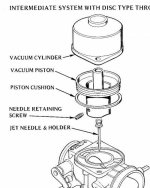
Technically the diaphragm is vacuum driven. Vacuum is produced in the venturi of the main body when the throttle plate is opened up. That vacuum is transmitted to the topside of the diaphragm through the small hole at the bottom of the slide(#7 below). The large opening at the top of the front inlet of the carb (#9 below) is vented to the underside of the diaphragm. Since the underside of the diaphragm is at atmospheric pressure (positive pressure) and the top of the diaphragm is under a vacuum (negative pressure) the diaphragm is actually sucked up against the spring pressure (#6 below) which then lifts the slide up along with the needle valve.

On a side note: If you drill the vacuum port at the bottom of the slide larger it makes the response of the slide quicker in both directions. It's one of the modifications in the stage III Dynojet kits. Here's a cutaway diagram that may help explain:

xCOaQk.jpg
 
As I recall, the action of the slide being somewhat behind the throttle give an accelerator pump effect; the momentary increase in 'suck' pulls more fuel from the jet than air through the venturi. In the original CV carb design by SU found on many British cars there was an oil damper fitted at the top of the slide housing that controlled the rate of movement as a shock damper would.

I think that drilling out the hole is fine as long as you're willing to make the midrange jetting somewhat rich[er]. For racing it's a good idea as you get faster midrange throttle response, but for emissions and economy, the factory had it right.

A bigger hole shouldn't make the slide run higher. Shortening the spring should; that ought to make the the slide hit wide open at a lower rpm, which could be a good or bad thing.

Some wag once said that the term carburetor comes from a French intransigent verb meaning 'to leave well enough alone'.
 
If it shouldn't make the slide run higher why would it make the midrange richer?
 
Just a whine per an otherwise fine drawing- the drawing doesn't show that the slides are a tight smooth fit in their bores- which is important, I think to stop air being drawn into the engine and to keep the venturi pressure away from the "atmospheric area" (though the effect of that would be small?)... anyways, I recall some CV carbs actually scribe rings into the slider. My guess is that they would do this to ensure a more airtight fit without increasing the friction.
A bigger hole shouldn't make the slide run higher.
oh no! the compressibility of air versus orifices! I was hoping it wouldn't come down to fart jokes. :)
 
Last edited:
If it shouldn't make the slide run higher why would it make the midrange richer?

It wouldn't. However, the reduction of the slide response delay would reduce the accelerator pump effect. To compensate you may have to have to raise the needle somewhat. This is the situation that CV carbs avoid - needing to run a bit richer than they would theoretically in order to not bog or surge when you open the throttle too much, too soon. They respond to engine demand rather than rider direct input.

This is why CV carbs general give better fuel economy. They can be set on the leaner side rather than the richer side in the cruising midrange. Once the throttle is wide open and the slides are up there's no difference. It's a bit hard to find perfect examples because in many cases when they went to CV carbs they changed a pile of other stuff, but I recall bikes getting 40-45 going to 45-50 when fitted with CVs.

Running the slide higher in relationship to the butterfly should actually make the mixture leaner; that's why non CV carbed engines can bog if you open the carb wide open at too low an rpm. The airflow velocity drops at the jet; you're flowing lots of air, but it isn't speeding up so much in the venturi. That's the whole plot of a CV carb; constant velocity at the jet mouth. It's all about midrange mixture control.
 
Just a whine per an otherwise fine drawing- the drawing doesn't show that the slides are a tight smooth fit in their bores- which is important, I think to stop air being drawn into the engine and to keep the venturi pressure away from the "atmospheric area" (though the effect of that would be small?)... anyways, I recall some CV carbs actually scribe rings into the slider. My guess is that they would do this to ensure a more airtight fit without increasing the friction.
oh no! the compressibility of air versus orifices! I was hoping it wouldn't come down to fart jokes. :)

I was going to point that out too, but as it shows the reference air coming in from the rear, I figured it didn't matter. But as drawn, you wouldn't get past idle.

I think the rings you mentioned were on the old SU [Skinner Union?] carbs that used to adorn British cars back when. I think a few bikes even had them, but they were pretty costly compared to a basic 'controlled leak' Amal.

The first SUs had a leather bellows, but the version I recall had just a big piston and no spring, plus an oil filled damper pot on top that served as a bearing and bounce restrictor. The can leaked, but the orifice was big enough to flow even faster, so the slide rose anyway. The jet block was adjustable up and down with a knob of the bottom, rather than having to raise or lower the needle. The biggest problem they had was a tendency to wear out at the butterfly shafts, which led to symptoms similar to bad intake boot o-rings. Someone in Design forgot to consider the return springs side loading the throttle shafts and/or that they didn't need to lift the driver's foot as well; that could be done otherwise.

Quite what the rings scribed into the piston did seemed a mystery to me as well. Maybe they just thought a piston would look silly without some sort of ring theme on it.
 
just a loose end per discussion...
I think the rings you mentioned were on the old SU [Skinner Union?] carbs that used to adorn British cars back when
-No, more modern. Here it is- a ringed piston in a cv carb from a Honda. and NO diaphragm -that's the raison d'etre maybe...

non-diaphragm-ringed piston.jpg <-click me larger
 
Just a quick update-
Thanks for the tip on JBM Industries! I picked up a pair of new diaphragms which fit perfectly. I love their no nonsense "if you can't follow directions, don't buy from us" attitude!

I highly recommend the company and the product!
 
Glad they worked as well for you as they did for me! I think the hardest part for me with the ones i bought was getting the plastic rings cut off of the old boots
 
just a loose end per discussion... -No, more modern. Here it is- a ringed piston in a cv carb from a Honda. and NO diaphragm -that's the raison d'etre maybe...

View attachment 43199 <-click me larger

Possibly the Hitachi copy of the SU, made under licence. They were factory fits on the Datsun 240Z also.
The rings were on the originals too, and did indeed provide controlled rates of air friction without requiring very close metal/metal tolerances, which would bring their own costs and problems in a cooking engine. Even so, it's easy to ruin an SU bell assembly by over cleaning it on the inside - once the diy bodger takes some grit paper to the piston or bell, it's toast.
 
Back
Top