• Required reading for all forum users!!!

    Welcome!
    Register to access the full functionality of the GSResources forum. Until you register and activate your account you will not have full forum access, nor will you be able to post or reply to messages.

    A note to new registrants...
    All new forum registrations must be activated via email before you have full access to the forum.

    A Special Note about Email accounts!
    DO NOT SIGN UP USING hotmail, outlook, gmx, sbcglobal, att, bellsouth or email.com. They delete our forum signup emails.

    A note to old forum members...
    I receive numerous requests from people who can no longer log in because their accounts were deleted. As mentioned in the forum FAQ, user accounts are deleted if you haven't logged in for the past 6 months. If you can't log in, then create a new forum account. If you don't get an error message, then check your email account for an activation message. If you get a message stating that the email address is already in use, then your account still exists so follow the instructions in the forum FAQ for resetting your password.

    Have you forgotten your password or have a new email address? Then read the forum FAQ for details on how to reset it.

    Any email requests for "can't log in anymore" problems or "lost my password" problems will be deleted. Read the forum FAQ and follow the instructions there - that's what we have one for...

  • Returning Visitors

    If you are a returning visitor who never received your confirmation email, then odds are your email provider is blockinig emails from our server. The only thing that can be done to get around this is you will have to try creating another forum account using an email address from another domain.

    If you are a returning visitor to the forum and can't log in using your old forum name and password but used to be able to then chances are your account is deleted. Purges of the databases are done regularly. You will have to create a new forum account and you should be all set.

SH 775 issue...again

The SH775 does not ground through the body. That bolt hole ground to frame ground is doing nothing.

You would be better off running the terminal ground over to the battery vs. the frame. If you want to ground to the frame regardless, that's not the worst thing possible, but adding a jumper from that frame ground point over to the battery won't hurt.
 
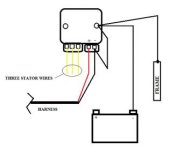
I guess the picture is not very clear. Where that line coming from the harness negative return crosses over the line between the battery and the mounting bolt, that is supposed to be a junction point or SPG where all grounding joins together. Your diagram is nice but does not show what is ground return and what is ground connected to mounting screw. And, why are there two red wires going to R/R? And what is the brown wire? The SH 775 I have only has 5 connection points: 3 stator, 1 positive, 1 negative. Forgive my ignorance, but I tend to think more pictorially than theoretically.


Well 1/2 the problem here is that you think that an explicit diagram according to engineering standards is confusing; the diagram is not an engineering drawing but it is pretty specific and for reference there is accompanying text. I will admit it is not a your drawing it is meant to be a guide to the R/R shown as well as 6 wire and 5 wire R/Rs as well. Again that is explained in the text.

I have to admit alos I did not see those nodes you are referring two, but without having you call out what is SPG I can't tell what is a solder ball or a SPG.
 
What is confusing about the diagram is that it shows more connections to the R/R than there physically are. As I said, there are only 5, unless you want to include the mounting screw, which makes 6. But I appreciate the help here. So, Nessism, you say it is pointless to connect ground from the mounting screw?
 
What is confusing about the diagram is that it shows more connections to the R/R than there physically are. As I said, there are only 5, unless you want to include the mounting screw, which makes 6. But I appreciate the help here. So, Nessism, you say it is pointless to connect ground from the mounting screw?

I'm almost certain the text accompanying the figure says if there two wires treat them as one (if they have common end points).
If there are two black wires treat them as one.
If there are two red wires treat them as the same.

The SPG is just a junction for current.

If you have a 5 wire R/R ignore the brown sense wire.

And yes you do not have to ground to the case of the R/R. It is just convenient/close place to gather the wires.
 
Apparently what is confusing you is the representation of the b/w backbone in the harness. B/w is distributed throughout the harness to serve as a return path for all components. There are then two b/w that extend from the harness with ring lugs. One of those is shown going to the SPG. The SPG is clearly labeled.
 
Ok, thank you. I could not sit still knowing there was work left to do, so I went home over lunch and redid the wiring. This picture shows what I did. Please tell me it's correct.
RR CONNECTIONS3.jpg
 
Ok, thank you. I could not sit still knowing there was work left to do, so I went home over lunch and redid the wiring. This picture shows what I did. Please tell me it's correct.
View attachment 45511

I know this maybe disappointing and it is almost there but here is the issue.

How big of a wire can you get into the terminal in the R/R(-) connector? Two small 18 awg wires? Now you have only a 18 awg wire carrying 4 amps of charging plus whatever else is coming from teh frame/engine grounds.

The prefered SPG configuration assume you only have one wire (as big as possible) coming off of the R/R(-).

If you can make the r/r(-) a giant solder ball (at the pin) that is just floating off of the connector then remove all the wires from the bolt. However the benefit of the bolt is that it keeps that stack of ringlugs cool and then cant get hot (or just elevated) because they are bolted to a big sheet of metal.


The idea of teh SPG is that you need to connect everything together, and then run one fat wire to R/R(-). If everything at teh SPG is soldered together then then it is even better.
 
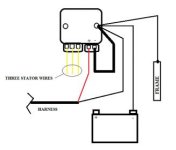
I'm trying to understand what you are saying but having difficulty. you assumed I used 18 awg wires, but I don't even know what they are. They are smaller than the wires you see coming from a lamp plug, but bigger than speaker wires. Anyway, does this picture reflect closer to what you are saying?

RR CONNECTIONS4.jpg
 
I'm trying to understand what you are saying but having difficulty. you assumed I used 18 awg wires, but I don't even know what they are. They are smaller than the wires you see coming from a lamp plug, but bigger than speaker wires. Anyway, does this picture reflect closer to what you are saying?

View attachment 45512

Yes that is it.

  1. The harness B/W is probably carrying about 10 amps with standard loads.
  2. The wire to the battery is carrying 4 amps at 3.5K RPM
  3. assume another amp through the engine/frame.
Generally you an figure 15 amps for standard loads.
In general your can not separate those currents any more without opening up the harness and splitting the B/W.
If you remove one of the wires then the current will have to move to one of the other wires.

The main thing you are doing is keeping the wire between the battery and SPG so that it is only carrying battery charging current. That keeps those two voltages closest together.
 
As posplayer has mentioned you can have as much as 4 or 5 amps of charging return from the battery, as much as 10 amps from the harness and maybe a couple from the frame. You are actually unlikely to have all of that at one time but it's a good worst case scenario.

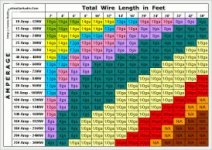
Here is a calculator you can use to determine the size wire you need. The harness determines the wire gauge and length for all the accessories, ignition, etc. Hooking the frame and harness directly to the battery minimizes this lengths but not much. best practice for charging is 2% drop or less. I'm running 12 gauge wire about one foot and see a calculated drop of around one half percent. (Only for the charging circuit.)

http://www.calculator.net/voltage-drop-calculator.html
 

Attachments

  • wire_chart.jpg
    wire_chart.jpg
    20.7 KB · Views: 0
As posplayer has mentioned you can have as much as 4 or 5 amps of charging return from the battery, as much as 10 amps from the harness and maybe a couple from the frame. You are actually unlikely to have all of that at one time but it's a good worst case scenario.

Here is a calculator you can use to determine the size wire you need. The harness determines the wire gauge and length for all the accessories, ignition, etc. Hooking the frame and harness directly to the battery minimizes this lengths but not much. best practice for charging is 2% drop or less. I'm running 12 gauge wire about one foot and see a calculated drop of around one half percent. (Only for the charging circuit.)

http://www.calculator.net/voltage-drop-calculator.html

most of the numbers I quote are nominal. Also this link provides a full set of nominal voltage calculations
thegsresources
http://www.thegsresources.com/_foru...x-STANDARD-INSTALLATION&p=1965992#post1965992
 
Last edited:
You guys are very helpful and thank you very much for walking me through all of this! I appreciate the wire gauge chart and everything else provided.
 
So where do you suggest connecting the r/r (-) wire?

To the SPG.
I should say the point of the SPG is to tie all the grounds TOGETHER, not tie them all to the frame. I guess you could tie all the grounds together, including the R/R -, and not bolt the SPG to the frame or R/R case.
 
To the SPG.
I should say the point of the SPG is to tie all the grounds TOGETHER, not tie them all to the frame. I guess you could tie all the grounds together, including the R/R -, and not bolt the SPG to the frame or R/R case.

The main problem with the GS charging system as it relates to grounding is because on various bikes Suzuki's grounds were through the rubber mounted battery box or electrical side panel. The grounds corrode after 30 years and the ground was weak to begin with. Clean the chassis grounds, use a little dielectric grease on the contacts, and make sure your R/R has a direct ground path to the battery and you are done. On my bikes I added one jumper wire to supplement the ground system for the R/R. You can gather all your grounds into a SPG methodology if you want, but it's not strictly necessary.
 
To the SPG.
I should say the point of the SPG is to tie all the grounds TOGETHER, not tie them all to the frame. I guess you could tie all the grounds together, including the R/R -, and not bolt the SPG to the frame or R/R case.


For the single point ground, you want all your grounds to tie together and bolt to the frame. You don't need to run a ground from the r/r to multiple points.

If you can ignore the colors in shadow's diagram, I'm pretty sure that's how mine's wired (don't remember what I did with the engine ground strap).

You current statement seems to be in line with my descriptions but seems to contradict your previous statement.
 
The main problem with the GS charging system as it relates to grounding is because on various bikes Suzuki's grounds were through the rubber mounted battery box or electrical side panel. The grounds corrode after 30 years and the ground was weak to begin with. Clean the chassis grounds, use a little dielectric grease on the contacts, and make sure your R/R has a direct ground path to the battery and you are done. On my bikes I added one jumper wire to supplement the ground system for the R/R. You can gather all your grounds into a SPG methodology if you want, but it's not strictly necessary.


You are correct ED but not using a SPG or tieing the R/R(-) direct to the battery(-) is a distinct disadvantage.
 
You are correct ED but not using a SPG or tieing the R/R(-) direct to the battery(-) is a distinct disadvantage.

Jim, you are living your life in a theoretical fantasy world. SPG is the answer to the question only you asked. I will say though, you helped turn the forum on to the SERIES R/R devices, and for that I'm grateful. SPG, no thanks. Especially when people are adding splices and crimps in their wiring harness to do so.

BTW, charging system problems on Kawasaki KZ's are about 1/3 that of our GS's. Why? For one, the stators are less powerful so less current gets shunted back to the stator. For another, the R/R ground has a direct path to the battery and so does the power out. In fact, the + runs from the R/R and direct to the battery without any fuse. In my time hanging out on KZRider i've never once heard about anyone's charging system melting down. On the GS site we get bikes where the stator loop melts quite regularly. At any rate, the proof of the pudding is in the eating as they say.
 
Last edited:
Ed I have to say you have no idea what is theory and practical knowledge. You should at least follow your own advice about measuring things but I suspect for charging systems you would be at a loss for that as well.

when I get around to it I will post a step by step analysis that shows how current flow varies with each configuration change from stock to an ultimate SPG configuration. If you want to call that theory then to you ohms law is theory which you probsbly discount as well.

i understand you are just unfamiliar with even the basics of electrical current flow( you have demonstrated it enough times) but continuing to bad mouth SPG when it is no different to what you recommend except for the SPG is specific as opposed to your recommendation that is non specific.

i will admit that I have been suprised at how confusing the SPG seems to be to people . Generally it seems to be because most people want to believe that current disappears toto the frame or needs to return to the battery. It seems that the inability to grasp the simple notion that the r/r is the source of power when running down the road cases so much consternation that that the simpelidt of instruction just flies over people's heads.

so I'm coming around to your way of thinking despite the technical superiority and relative ease and simple directions it is probably beat to just say clean connection snd just hope for the best. After all a dead battery or burnt stator is not the snd of the world.

after all there are a number of people here who think that 13.25 volts is going to charge thier battery; they have been riding that way for years and they there for assume that every battery in the world would be fine charging at that level.
 
Last edited:
Back
Top