• Required reading for all forum users!!!

    Welcome!
    Register to access the full functionality of the GSResources forum. Until you register and activate your account you will not have full forum access, nor will you be able to post or reply to messages.

    A note to new registrants...
    All new forum registrations must be activated via email before you have full access to the forum.

    A Special Note about Email accounts!
    DO NOT SIGN UP USING hotmail, outlook, gmx, sbcglobal, att, bellsouth or email.com. They delete our forum signup emails.

    A note to old forum members...
    I receive numerous requests from people who can no longer log in because their accounts were deleted. As mentioned in the forum FAQ, user accounts are deleted if you haven't logged in for the past 6 months. If you can't log in, then create a new forum account. If you don't get an error message, then check your email account for an activation message. If you get a message stating that the email address is already in use, then your account still exists so follow the instructions in the forum FAQ for resetting your password.

    Have you forgotten your password or have a new email address? Then read the forum FAQ for details on how to reset it.

    Any email requests for "can't log in anymore" problems or "lost my password" problems will be deleted. Read the forum FAQ and follow the instructions there - that's what we have one for...

  • Returning Visitors

    If you are a returning visitor who never received your confirmation email, then odds are your email provider is blockinig emails from our server. The only thing that can be done to get around this is you will have to try creating another forum account using an email address from another domain.

    If you are a returning visitor to the forum and can't log in using your old forum name and password but used to be able to then chances are your account is deleted. Purges of the databases are done regularly. You will have to create a new forum account and you should be all set.

SH-775 wiring and battery drain

  • Thread starter Thread starter Guest
  • Start date Start date
Wow! I look at the sprocket and missed it.:o

When I saw it, my jaw dropped. Probably been that way for years. That explains why the masterlink would lightly touch the chain guard when I reverse spun the wheel while lubing the chain. There is no damage to the splines or anything else. Someone up there likes me.
 
When I saw it, my jaw dropped. Probably been that way for years. That explains why the masterlink would lightly touch the chain guard when I reverse spun the wheel while lubing the chain. There is no damage to the splines or anything else. Someone up there likes me.


You're like the "unbreakable"...........
 
I saw it and it didn't even register since everything else was taken apart. You do indeed live a charmed life it seems.
 
If the main fuse blows or breaks a fire will not nessesarily ensue. At elevated rpm you will overcharge but that is the worst of it. That a lot safer than having the bike quit in traffic. If you have a volt meter you should see it immediately upon glancing at that indicator.

I don't think that is however the driver for me, it is that in a direct battery connection you have to increase the fuse size well above the actual load requirement. That is just not good. There are other more subtle reasons as well. This a clear example of Suzuki having done the design correct and the popular naive way is just asking for trouble.
And the KAW method ed keeps coming up with where there is no fuse between the battery and r/r is just idiotic. If the r/r shorts the battery will fry anything between it and that ground.

After following this thread with interest, I can see where people get misled when upgrading/retrofitting. Even Jim at Eastern Beaver, with his very nice fuse block, doesn't show where to tie in the R/R. Look at his diagram at the bottom of this page.

http://www.easternbeaver.com/Main/Wiring_Kits/Fuseboxes/PC-8/Installation/installation.html

So I went back and checked my wiring - sure enough, when I replaced the stator, changed to the SH775 R/R, and added the EB fuse block, I ended up with the R/R output connected to the battery instead of the "tee".

FIXED NOW.

Thanks for continuing to flog us until we get it right!
 
After following this thread with interest, I can see where people get misled when upgrading/retrofitting. Even Jim at Eastern Beaver, with his very nice fuse block, doesn't show where to tie in the R/R. Look at his diagram at the bottom of this page.

http://www.easternbeaver.com/Main/Wiring_Kits/Fuseboxes/PC-8/Installation/installation.html

So I went back and checked my wiring - sure enough, when I replaced the stator, changed to the SH775 R/R, and added the EB fuse block, I ended up with the R/R output connected to the battery instead of the "tee".

FIXED NOW.

Thanks for continuing to flog us until we get it right!

You can check this and compare as well.

http://www.thegsresources.com/_forum/showpost.php?p=1637803&postcount=9

http://www.thegsresources.com/_forum/showpost.php?p=1636554&postcount=4
 
Last edited:
I changed mine back to the Suzuki standard. I will probably be looking for a SSPB soon.
 
If the main fuse blows or breaks a fire will not nessesarily ensue. At elevated rpm you will overcharge but that is the worst of it. That a lot safer than having the bike quit in traffic. If you have a volt meter you should see it immediately upon glancing at that indicator.

I don't think that is however the driver for me, it is that in a direct battery connection you have to increase the fuse size well above the actual load requirement. That is just not good. There are other more subtle reasons as well. This a clear example of Suzuki having done the design correct and the popular naive way is just asking for trouble.
And the KAW method ed keeps coming up with where there is no fuse between the battery and r/r is just idiotic. If the r/r shorts the battery will fry anything between it and that ground.

Purely for the sake of argument which may inform me....because I'm not going to go out and short out a stator in good condition to see for myself.
I had a bike come to me with the wires to the brakelight and turn signals a melted mass. I don't believe the bike " kept running" for very long, with most of the "charging" going there and not to coils,lights whatever ,but I believe it "kept running" long enough to wreck the wiring.
How else could it have set fire to itself? One has to assume that the single suzuki fuse blew or even taht it did not, because the stator was the main contributer to the circuit....?

Next question...a bit more argumentative but you are welcome to pick holes in it
The assumption here somewhere seems to be that a 20 amp fuse to the stator only would blow. Duly noted that needing a higher fuse value reduces it's usefulness... because how much protection can you give a stator connected through a solidstate R/R when you must allow minimal 15 amps at the fuse ? or 20 which is shown? Assume the battery is in good shape=12ah ...on a really bad day, and assuming the Blown R/R has 0 resistance to reverse polarity (which I think is unlikely) this would pass Parallel through 3 legs of a stator each having ?...more than a 1/2 ohm resistance? is that less than 288 watts a leg? They are rated for short term 180 watt output.I wonder if a third more will hurt them versus what a 20 amp fuse is supposed to help with..and exactly how long will the battery "heat" the stator? with a 144 watt/hr output.... 10 minutes? It might be enough .But that's a stopped bike. The effect of a spinning motor may bring other questions.... I would assume a higher voltage than what the battery can do "against" it.
And then too there's ac on the other side of the Rectifier which complicates it more than I can guess.
 
Last edited:
Purely for the sake of argument which may inform me....because I'm not going to go out and short out a stator in good condition to see for myself.
I had a bike come to me with the wires to the brakelight and turn signals a melted mass. I don't believe the bike " kept running" for very long, with most of the "charging" going there and not to coils,lights whatever ,but I believe it "kept running" long enough to wreck the wiring.
How else could it have set fire to itself? One has to assume that the single suzuki fuse blew or even taht it did not, because the stator was the main contributer to the circuit....?

Next question...a bit more argumentative but you are welcome to pick holes in it
The assumption here somewhere seems to be that a 20 amp fuse to the stator only would blow. Duly noted that needing a higher fuse value reduces it's usefulness... because how much protection can you give a stator connected through a solidstate R/R when you must allow minimal 15 amps at the fuse ? or 20 which is shown? Assume the battery is in good shape=12ah ...on a really bad day, and assuming the Blown R/R has 0 resistance to reverse polarity (which I think is unlikely) this would pass Parallel through 3 legs of a stator each having ?...more than a 1/2 ohm resistance? is that less than 288 watts a leg? They are rated for short term 180 watt output.I wonder if a third more will hurt them versus what a 20 amp fuse is supposed to help with..and exactly how long will the battery "heat" the stator? with a 144 watt/hr output.... 10 minutes? It might be enough .But that's a stopped bike. The effect of a spinning motor may bring other questions.... I would assume a higher voltage than what the battery can do "against" it.
And then too there's ac on the other side of the Rectifier which complicates it more than I can guess.

First off I don't see anything argumentative and don't take any offense. You have apparently been look at what happens when an R/R shorts and looking at what will happen and how to protect against that.

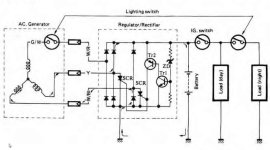
Look at the picture from the GS1100E factory manual. The R/R is shown with both a full wave diode bridge rectifier and a two shorting SCR's. Some of the newer ones including Electrosport have a shorting SCR on all three legs. This is typical of a SCR based SHUNT R/R. There are also MOSFET based SHUNT R/R's and SERIES type R/R's which can be built with either SCR's or MOSFETS. In all cases and for each stator leg, there are at least two semiconductor devices connected between the leg with one going to +BAT and the other going to -BAT (i.e. GROUND).

Normally when there is a full wave rectifier the battery just can not push current backward through the R/R because of the upper blocking diodes. So in theory unless one of those shorts, a battery short through the R/R cannot happen.

Now if one of the upper diodes were to short, then one of the other lower blocking diodes would also have to be go (i.e. short). If it was a diode on the same, leg then the short would be directly through the battery ground. If the short was on another stator leg then it would have to short through the stator.

At 12V and 0.5 ohms you are still at 24 amps more current than most of the wire would want to tolerate

If there were shorts in the semiconductor devices on the same leg, who knows how low that would be maybe 0.1 ohms and the current would just be much higher.

If you look at the MOSFET Shunt R/R's you will see that they could have used MOSFETS to replace all of the diodes, but they chose not to. They left the upper block diodes in place. Probably for a safety concern in case of a short.

Another tidbit, MOSFETS tend to fail 9 of 10 times as a short. SCR's tend to fail 9 out of 10 times as a OPEN. So in theory a MOSFET based device needs to be much more concerned about shorts but that doesn't means the SCR type devices are immune.

The biggest danger is providing such a low impedance path to the battery. It can provide a lot more current. That current is not based directly on amp hours., It is based on effective internal resistance. Yes a bigger battery has lower internal resistance and can provide more peak current, but the little ones can create plenty as well.


One last thing, a melted connector is not necessarily due to a short. It mostly would start out with corrosion in the contacts, causing a resistance that creates a heat build up under normal operation (all currents normal/no shorts). As the heat increases with no place to go, the plastic melts causing goo and then maybe a short.
 

Attachments

  • GS_CHARGING.jpg
    GS_CHARGING.jpg
    61.5 KB · Views: 0
Last edited:
I read this and then the thought of my first beer interfered with my reply- fortunately posplayr will straighten this out.
 
You have apparently been look at what happens when an R/R shorts and looking at what will happen and how to protect against that.
My apology for not being clear. The example above is an attempt to figure out how useful the stock fuse setup really is....for the moment then, let's assume the R/R is fine, whichever type it is. The first question though is how the stock setup is a good hookup on a smaller bike without a fuse panel. Perhaps it's irrelevant to those with fuse panels. But the long and short of it might be that smaller bikes should build fuse panels and NOT rely on the Suzuki wiring.

That single main fuse....We can agree it is protection against the battery's greater potential for mischief ,because it's instantaneous output is only limited by it's internal resistance. For a bike sitting still, a single fuse as they have it is good enough.
However...
I will try a different illustration.

Given that we have the stock setup, where the Charging system is connected "past" that fuse, here's how I imagine it .
The bike is humming along down the road at Regulated Voltage...14.8 or so.
A wire chafes and a short causes a voltage drop .
A fuse is supposed to protect against such mishaps.
Let me guess how the single fuse stock setup will or will not.
The R/R "opens" wide to counter the Voltage drop.
....the battery will only share the load of this voltage drop Through it's fuse) when and IF the stator can't keep up. And even when it does, it's merely a portion of the load as long as the bike is running. That fuse is only going to blow when the Battery's portion of the Voltage drop overmasters it....and leaves just the stator and Regulator still running, to supply it.
How well is the Bike going to be running while the above is happening? Not well, is my surmise, because what's left for the coils and headlight? But with a fully charged battery combined with the Stator's output, I would expect (and I think I have SEEN)a nasty fire in the wiring that could have been prevented by a fuse.
Without building a full fledged fuse panel "after" the Charging systems output, what is the easiest way?
I do not think it is the Suzuki way and I do not think they got it right
 
Close. I had to remove the case savers to get the cover off. It is the missing countershaft sprocket nut. I don't even know how long it's been like this.

:eek:

I noticed what appears to be busted gear position sensor, but didn't notice the missing C/S nut. Wow.
 
My apology for not being clear. The example above is an attempt to figure out how useful the stock fuse setup really is....for the moment then, let's assume the R/R is fine, whichever type it is. The first question though is how the stock setup is a good hookup on a smaller bike without a fuse panel. Perhaps it's irrelevant to those with fuse panels. But the long and short of it might be that smaller bikes should build fuse panels and NOT rely on the Suzuki wiring.

That single main fuse....We can agree it is protection against the battery's greater potential for mischief ,because it's instantaneous output is only limited by it's internal resistance. For a bike sitting still, a single fuse as they have it is good enough.
However...
I will try a different illustration.

Given that we have the stock setup, where the Charging system is connected "past" that fuse, here's how I imagine it .
The bike is humming along down the road at Regulated Voltage...14.8 or so.
A wire chafes and a short causes a voltage drop .
A fuse is supposed to protect against such mishaps.
Let me guess how the single fuse stock setup will or will not.
The R/R "opens" wide to counter the Voltage drop.
....the battery will only share the load of this voltage drop Through it's fuse) when and IF the stator can't keep up. And even when it does, it's merely a portion of the load as long as the bike is running. That fuse is only going to blow when the Battery's portion of the Voltage drop overmasters it....and leaves just the stator and Regulator still running, to supply it.
How well is the Bike going to be running while the above is happening? Not well, is my surmise, because what's left for the coils and headlight? But with a fully charged battery combined with the Stator's output, I would expect (and I think I have SEEN)a nasty fire in the wiring that could have been prevented by a fuse.
Without building a full fledged fuse panel "after" the Charging systems output, what is the easiest way?
I do not think it is the Suzuki way and I do not think they got it right

I agree with everything you say. If you only have one fuse between your battery and R/R, then you should also have a second down stream because 15 amps of R/R current and 15 amps of main battery current will still burn up a lot of wire.

If you think about it a little the reasons for having a multi position fuse box are more than just fault isolation. It also allows you to use smaller wires because you will never need to pull more than the 10 amps of the fuse box fro that circuit. With a single 20 amp fuse you would have to support 20 amps anywhere.

So yes a fuse box is best, an SSPB is better ;)

One fine point, my reference to Suzuki "doing it right" was in reference to 5 position fuse box with the power "T", not a single fuse configuration. As your experience and analysis point out a single fuse isolating the battery alone is a bad things. It is "necessary but not sufficient"
 
Last edited:
Ah. That is the same general area where my gear position switch is mounted, so that was my immediate thought.
 
Back
Top