• Required reading for all forum users!!!

    Welcome!
    Register to access the full functionality of the GSResources forum. Until you register and activate your account you will not have full forum access, nor will you be able to post or reply to messages.

    A note to new registrants...
    All new forum registrations must be activated via email before you have full access to the forum.

    A Special Note about Email accounts!
    DO NOT SIGN UP USING hotmail, outlook, gmx, sbcglobal, att, bellsouth or email.com. They delete our forum signup emails.

    A note to old forum members...
    I receive numerous requests from people who can no longer log in because their accounts were deleted. As mentioned in the forum FAQ, user accounts are deleted if you haven't logged in for the past 6 months. If you can't log in, then create a new forum account. If you don't get an error message, then check your email account for an activation message. If you get a message stating that the email address is already in use, then your account still exists so follow the instructions in the forum FAQ for resetting your password.

    Have you forgotten your password or have a new email address? Then read the forum FAQ for details on how to reset it.

    Any email requests for "can't log in anymore" problems or "lost my password" problems will be deleted. Read the forum FAQ and follow the instructions there - that's what we have one for...

  • Returning Visitors

    If you are a returning visitor who never received your confirmation email, then odds are your email provider is blockinig emails from our server. The only thing that can be done to get around this is you will have to try creating another forum account using an email address from another domain.

    If you are a returning visitor to the forum and can't log in using your old forum name and password but used to be able to then chances are your account is deleted. Purges of the databases are done regularly. You will have to create a new forum account and you should be all set.

Stator diagnosis confirmation

  • Thread starter Thread starter Guest
  • Start date Start date
G

Guest

Guest
Hi all as a novice at these things I would like to check to see if I have come to the fight conclusion before getting the spanners and wallet out.

Battery initial voltage, 12.8v
Battery and lights 12.5v
idle 12.8v
2500 rpm 12.8v
5000 rpm 2.7v (I assume this will be due to poor connections)

So the battery is good as I have been trickle charging however there is no charging from the bike.

So on to the stator test. One pair of stator leads gave a reading of 0.7 ohms while the other pair gave nothing. Now I see from the wiring diagram that two of the stator wires also go elsewhere, is it worth cross checking with them or do I have a dead stator!

Also a quick noob question. Is there oil behind the generator cover therefore requiring an oil drain?

As it looks like I will need to replace the stator I was also going to upgrade the r/r at the same time so have not investigated the original. Is there anything else I should do?

Thanks for all opinions in advance.

Greg

Just found Basecliff's how to, so that answers the oil question. Typical, dropped the sump two weeks ago.
 
Last edited:
There are three wires from the stator. A B C Resistance checking is between pairs AB BC CA and between phase and case/ground AG BG CG. That's six readings in all.
With the meter on ac check the readings between phases at 5000 rpm. You should be getting 80 Volts.
The two wires doing a solo run to the headlamp bucket is an old idea of Suzukis to dump excess energy from the charging system. Mostly people wire three phases direct to the rectifier input and leave that loop disconnected.
The generator space is common with the sump. Oil cools the stator or stator heats the oil depending on your regulator and point of view.
 
Brendan is describing the revised phase b of stator tests. The resistance tests using ohm meter are basically worthless. What gives me pause is that measurement of 2.7v at 5000 rpm . That is not possible! Is it a typeo?
 
Brendan is describing the revised phase b of stator tests. The resistance tests using ohm meter are basically worthless. What gives me pause is that measurement of 2.7v at 5000 rpm . That is not possible! Is it a typeo?

I wouldn't say it's completely worthless. I valid test failure would indicate a bad component. One such case would be if you have a short between any leg and the case ground. Barring any other cause, such as a pinched wire, it would be a true indicator of a failed stator. Another case would be a shorted or open reading between any two poles.

Now, with that said, the resistance measurements alone could not tell you if the stator is in good working order. That would require more dynamic testing as you've indicated.
 
I wouldn't say it's completely worthless. I valid test failure would indicate a bad component. One such case would be if you have a short between any leg and the case ground. Barring any other cause, such as a pinched wire, it would be a true indicator of a failed stator. Another case would be a shorted or open reading between any two poles.

Now, with that said, the resistance measurements alone could not tell you if the stator is in good working order. That would require more dynamic testing as you've indicated.

http://www.thegsresources.com/_foru...W-of-Stator-testing&highlight=phase+B+testing
 

Yep, that basically confirms my statement. A verified failure point is conclusive but a passing test does not conclusively indicate a working stator. I would still advocate doing a quick resistance test and then an AC output measurement to rule out obvious failures. If the stator passes those tests but still outputs no charge voltage from the R/R then there's a higher probability of a failed R/R over the stator but, again, not conclusive. Even if replacing the R/R repairs the charging issue is still doesn't rule out early stator failure in the future due to failing insulator material withing the stator.
 
Yep, that basically confirms my statement. A verified failure point is conclusive but a passing test does not conclusively indicate a working stator. I would still advocate doing a quick resistance test and then an AC output measurement to rule out obvious failures. If the stator passes those tests but still outputs no charge voltage from the R/R then there's a higher probability of a failed R/R over the stator but, again, not conclusive. Even if replacing the R/R repairs the charging issue is still doesn't rule out early stator failure in the future due to failing insulator material withing the stator.
My comment is in the context of having a defined checkout procedure that in the aggregate works best for all assuming very little knowledge. If you know what you are doing and are even a bit lucky you can in a particular instance diagnose a specific failure faster than a optimal solution that works best for all failures.

when you mathematically formalize the problem of optimal diagnostics procedures (ie minimum time to repair) each diagnostic step is a test with an ambiguity group for the result; a set of possible conditions related to the measurement. According to the First law the ohmmeter has the largest ambiguity group. Now that in and of itself doesn't disqualify the relevance of the test. It is the broad range of possible failures many of which are temperature dependent.

I dont have have any specific statistics, but I would guess that only about 10% of initial stator faults are detectable using an ohmmeter whereas the leg to groung tests are well over 90% in identifying failed/failing stators.

Now in order to avoid a discussion of time optimal decision theoretical, and a priori knowledge of population failure rates a simple rule is preferred. It is clear that the ohm meter tests are inferior, especially considering the manual recommendation to do ac leg to leg tests. Now when you add the leg to ground to the mix, the ohm meter stuff is more confusion than anything else.
 
I dont have have any specific statistics, but I would guess that only about 10% of initial stator faults are detectable using an ohmmeter whereas the leg to groung tests are well over 90% in identifying failed/failing stators.

Now in order to avoid a discussion of time optimal decision theoretical, and a priori knowledge of population failure rates a simple rule is preferred. It is clear that the ohm meter tests are inferior, especially considering the manual recommendation to do ac leg to leg tests. Now when you add the leg to ground to the mix, the ohm meter stuff is more confusion than anything else.

First off, I want to clarify that, when speaking of diagnosing failures, I'm speaking specifically to catastrophic failure modes exhibited by little to no output from the stator. Under those conditions, I would argue that the resistance and AC output measurements would have a much higher detection percentage than your stated 10%. I would also add that the instruments required to do those measurements are readily available and understood by most. I see no confusion of the stator leg to ground resistance measurement. If you have continuity between any leg to case ground then you have a failure. Now trying to predict partial or borderline failure modes is a completely different situation. Under those circumstances, it would require a more extensive diagnostics and even then there is some margin for error. The original poster's example clearly indicates little to no output from the R/R which could be stator or R/R related.

My goal is to guide a member seeking a solution to their problem with an initial "quick verification" of a catastrophic failure mode. If the failure of those "simple tests" is verified, then no more diagnostics would be required. If those results are inconclusive then further diagnostics is needed. It's just simpler and quicker to do the easy tests first when things are very bad.
 
Also a quick noob question. Is there oil behind the generator cover therefore requiring an oil drain?

Just found Basecliff's how to, so that answers the oil question. Typical, dropped the sump two weeks ago.
There is no need to dump the oil.

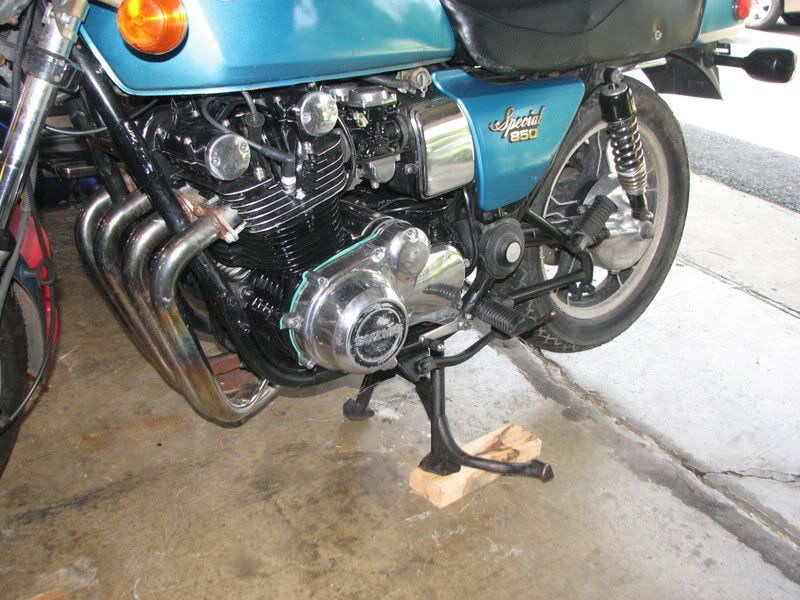
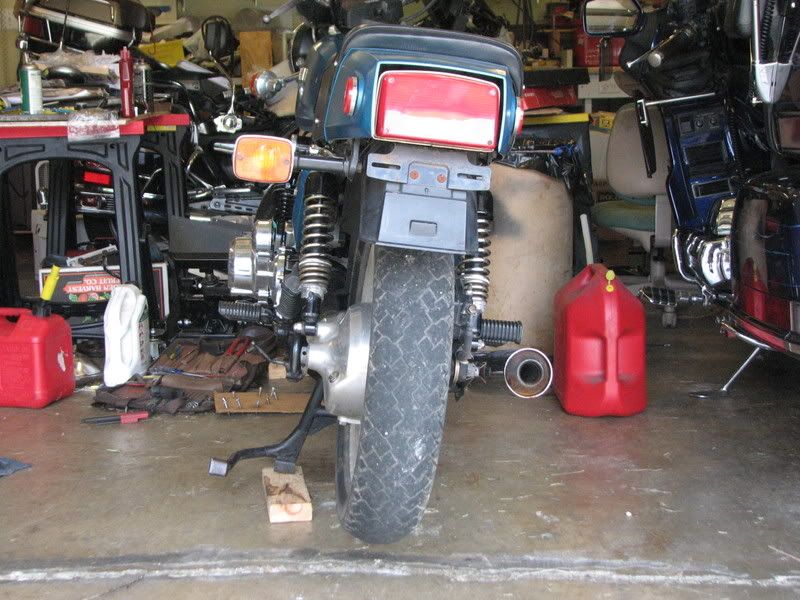
Put the bike on the center stand. Tip it to the right, put a 2x4 under the left foot of the stand. Yes, the bike is still plenty stable.

IMG_7677.jpg


IMG_7679.jpg


.
 
First off, I want to clarify that, when speaking of diagnosing failures, I'm speaking specifically to catastrophic failure modes exhibited by little to no output from the stator. Under those conditions, I would argue that the resistance and AC output measurements would have a much higher detection percentage than your stated 10%. I would also add that the instruments required to do those measurements are readily available and understood by most. I see no confusion of the stator leg to ground resistance measurement. If you have continuity between any leg to case ground then you have a failure. Now trying to predict partial or borderline failure modes is a completely different situation. Under those circumstances, it would require a more extensive diagnostics and even then there is some margin for error. The original poster's example clearly indicates little to no output from the R/R which could be stator or R/R related.

My goal is to guide a member seeking a solution to their problem with an initial "quick verification" of a catastrophic failure mode. If the failure of those "simple tests" is verified, then no more diagnostics would be required. If those results are inconclusive then further diagnostics is needed. It's just simpler and quicker to do the easy tests first when things are very bad.
Catastrophic are the easy ones. Of all the electrical problems it has been the stator tests that have been the most problematic.
 
My general approach to diagnostics is to rule out the fast and easy things first.

That certainly falls out of any objective analysis.

The problem is in deciding to pull a stator based on a ohmmeter test alone. With your typical user there is that the finite probability that someone doesn't know how to read an ohms meter, or zero calibrate an ohmmeter of otherwise consider a measurement that is supposed to be be somewhere between 1-2 ohms. If they read it wrong they pull a stator that may be not broken. So a back up confirmation is advisable to avoid this and since the only backup is a real test, then the answer in a broad sense is to skip the ohmmeter.

It is easier to tell if someone got the measurement correct if they do the back to back AC tests.Ohmmeter not so much.
 
Hi guys,

Steve thanks for the top tip.

I have redone some tests, so here goes-

A-B Out of limits on resistance
A-C OL
B-C 0.5 ohms

A-Ground OL
B-Ground 0.85
C-Ground 0.85

Engine 4000 rpm

A-B Wild voltage
A-C Wild voltage
B-C 80v

I think the stator is unserviceable!
 
Yup, that's gotta go. Cooked rather well done.

It's likely that the R/R is on it's way out as well. At the very minimum, test it before you put in a new stator, lest you run the risk of frying your brand-new stator.
 
I'm going to put a SH775 in anyway and upgrade the whole system.

Thanks for all the advice.

Greg
 
Good luck. Don't forget the connections are as much a part of the system as anything else and the battery.
 
Thanks Brendan, not forgotten, deep in Basscliffs web site at the moment, so standby for more question!
 
Hi guys,

Steve thanks for the top tip.

I have redone some tests, so here goes-

A-B Out of limits on resistance
A-C OL
B-C 0.5 ohms

A-Ground OL
B-Ground 0.85
C-Ground 0.85

Engine 4000 rpm

A-B Wild voltage
A-C Wild voltage
B-C 80v

I think the stator is unserviceable!

That would be my definition of catastrophic failure.;)

Agreed that replacement of the R/R would probably be in good order. The SH775 is your best option.
 
I have the same problem going on. phase to phase at 5000 rpm a-b 6volts a-c 4volts and b-c 0 volts. but it oh med out good at 0.6 on all 3 phases.
 
Back
Top