• Required reading for all forum users!!!

    Welcome!
    Register to access the full functionality of the GSResources forum. Until you register and activate your account you will not have full forum access, nor will you be able to post or reply to messages.

    A note to new registrants...
    All new forum registrations must be activated via email before you have full access to the forum.

    A Special Note about Email accounts!
    DO NOT SIGN UP USING hotmail, outlook, gmx, sbcglobal, att, bellsouth or email.com. They delete our forum signup emails.

    A note to old forum members...
    I receive numerous requests from people who can no longer log in because their accounts were deleted. As mentioned in the forum FAQ, user accounts are deleted if you haven't logged in for the past 6 months. If you can't log in, then create a new forum account. If you don't get an error message, then check your email account for an activation message. If you get a message stating that the email address is already in use, then your account still exists so follow the instructions in the forum FAQ for resetting your password.

    Have you forgotten your password or have a new email address? Then read the forum FAQ for details on how to reset it.

    Any email requests for "can't log in anymore" problems or "lost my password" problems will be deleted. Read the forum FAQ and follow the instructions there - that's what we have one for...

  • Returning Visitors

    If you are a returning visitor who never received your confirmation email, then odds are your email provider is blockinig emails from our server. The only thing that can be done to get around this is you will have to try creating another forum account using an email address from another domain.

    If you are a returning visitor to the forum and can't log in using your old forum name and password but used to be able to then chances are your account is deleted. Purges of the databases are done regularly. You will have to create a new forum account and you should be all set.

Stator Papers AC on phase and minus battery. 3 times GS 750 '79

  • Thread starter Thread starter Guest
  • Start date Start date
G

Guest

Guest
We have an issue with the stator papers, Phase B , the last Test, measuring the ac voltage between one of the three phases and battery (-).
We have now the third on generator and the first , the second and the third one has about 35 Volt AC on the wires at 5000 rpm.
Is this meaning we have 3 broken generators or is this test not right?
I've used the stator papers because the loading Voltage isn't higher then 12,8 (@ Battery)
When I measure the voltage drop between + Battery and + Rectfier , it results in a 350 mVolts , and the max is 250 mV by the stator papers.
The cause is the bad connection by the main fuse ( I have used sandpaper but that didn't get a better result.)
When a short circuit this item the loading voltage is max 13,4 Volt, and that's to low.

Sorry for the bad language , I'm Dutch and mu English is rusty.
 
"measuring the ac voltage between one of the three phases and battery (-)."

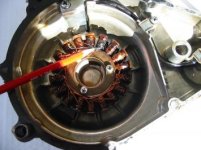
What is being done here is a check to determine if any voltage during this test is leaking to ground....battery negative. The three phases are wound tightly on the stator core...any winding error or ,more likely fried insulation, lets some voltage "escape" to ground, thereby causing reduced voltage output for charging system. The attached pic shows a stator that I replaced 9 years ago...the pencil points to a burned section. This stator struggled to get a charging voltage of 13 volts @ 4000rpm

image.jpg
 
Thank you for the reply, what I now understood is that all the 3 Alternators thus are broken.
That's bad luck , and cost me another 7 euro for a gasket.
I hope that my second hand shop have some good ones.
 
We have an issue with the stator papers, Phase B , the last Test, measuring the ac voltage between one of the three phases and battery (-).
We have now the third on generator and the first , the second and the third one has about 35 Volt AC on the wires at 5000 rpm.
Is this meaning we have 3 broken generators or is this test not right?

As Tom said, we are looking for leakage of the stator at 5K RPM which should be isolated from the chassis,frame, battery ground. Want close to zero volts (no more than 1-2 VAC)

I've used the stator papers because the loading Voltage isn't higher then 12,8 (@ Battery)

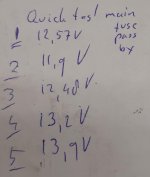
In the Quick Test (see link in signature) I recommend providing 6 voltages so we can diagnose what is going on.

When I measure the voltage drop between + Battery and + Rectfier , it results in a 350 mVolts , and the max is 250 mV by the stator papers.
The cause is the bad connection by the main fuse ( I have used sandpaper but that didn't get a better result.)

Voltage drops are mainly due to Corrosion and the biggest problem is in the crimps which can not be helped with sand paper. You need a chemical clean like Vinegar of Naval Jelly. DeOxit or similar is god to finish, but it does not cut the green stuff. You don't have to worry about all connections, but those between battery/R/R and fuse box are most important.

Any voltage drop will reduce your charging by an equivalent amount. So 350mVolts will reduce charging from 14.5V down to 14.15V

When a short circuit this item the loading voltage is max 13,4 Volt, and that's to low.

Not sure what this means, but it is probably not one of the prescribed tests as there are no short circuit tests. Do teh Quick Test and report the three numbers. I woudl do this after chemically cleaning corrosion and treating with something becuase the brass will re corrode fast.


Sorry for the bad language , I'm Dutch and mu English is rusty.[/QUOTE]
 
First of all, thanks for the response. Since the bike is with my son-in-law, I will come with the quick test values ​​tonight.
When a short circuit this item the loading voltage (Battery) is max 13,4 Volt, and that's to low.
By that I mean I made a connection from + Rectifier to + Battery, so parallel over the main fuse.
 
First of all, thanks for the response. Since the bike is with my son-in-law, I will come with the quick test values ​​tonight.

By that I mean I made a connection from + Rectifier to + Battery, so parallel over the main fuse.

OK, and I understand why you might want to do that test but the result doesn't point to anything specific (i.e. actionable).

If you want to measure voltage drops measure them directly without a short circuit trying to raise the voltage.

If you had a bad stator, the voltage might not rise with RPM because the stator is at max output, but you still have voltage drops (dirty contacts). So shorting will not be able to determine anything.

The Quick Test is to test and divine what is going on in order to direct follow-on testing.

As a general rule, I would clean up connections and grounds early on because this is equivalent to driving a car without checking the air in the tires. The car might drive, but is something you are going to want to remedy at first opportunity.

Given you have only 13.4V (assuming that was at 5K RPM), my guess is the stator is low, but not really knowing how you shorted the lines it could still just be connections.
 
20200707_170744.jpg
I'll clean the contacts. Wanted to see if shorting the main fuse gave better results.
 
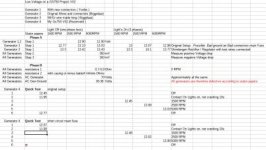
Thanks for putting the extra effort into organizing your measurements. Without going through every measurement I will highlight a few things.

I assume you mean stator leg (or Phase) when you label something as Generator. Common terminology is to describe the stator as 3-Phase and each wire coming from the stator is informally called "leg".
If you want to call the stator a generator, I would not chide you, but it is technically an PM alternator.

Your note says you are using a Shindengen R/R but there is no model number? Is it a 5 wire or 6 wire? Is it Shunt or Series?

You should assume that anytime the key is on the headlamps should be on. The rest of the headlamp off measurements are redundant at best and can be misleading becuase they are at reduced load.

ANALYSIS:


  1. When you see voltages drop from 2500 RPM to 5000 RPM this indicates that the extra current load is dropping a higher voltage between R/R and Battery. Plain and simple have dirty connections.
  2. Your "Voltage Drop" measurements also indicate 0.5V drop, but I don't know what RPM this was at. I suspect 1500 or 2500 RPM and they get bigger at 5000 RPM (my guess). Your "Short circuit main fuse" tests indicate a 0.87V improvement at 5000 RPM.
  3. The battery portion test comparing Step #1 and Step #2 should have been with lights on. If it was not, then with teh additional load the battery woudl probably drop another 0.5V. This indicates the State Of Charge(SOC) of the battery is low.
  4. Finally, you have concerns about the Leg-Ground tests at 5K RPM. This is not the first time that we have had similar results reported (leg-ground 30 VAC present but the bike seems to charge). If we use your ohm meter tests, you show an open with the VOM (probably 9VDC) potential. This is insufficient to break down the insulation. At 5K RPM your generator is producing 70 VAC (which is a little low) but is apparently enough to break down the insulation. When the stator is connected to an R/R which is connected to a battery, the voltage across the stator does not exceed about 20VAC zero to peak (you can only raise teh battery voltage so much). So it can be that the stator is simply not operating in the voltage regime being tested. I should clarify that a stator in good condition will still be isolated at 5K RPM, so the fact that there is voltage can still be taken as a forewarning of accumulation insulation breakdown (the stator is breaking down although still functioning).

RECOMMENDATION:
  • Chemically clean all connections and fuse box between R/R and battery. (vinegar or Naval jelly cuts the green gook). Surface preparation after with DeOxit or similar protects the stripped bare surfaces.
  • Remeasure the voltage drops (without doing the shorting test).
  • Recharge the battery so it drops less than 1.0 volt with key on (set #2).
  • Redo the Quick Test till you get at least 14.25V at 5K RPM.

Final note:

The typical current running out of the R/R and returning through the grounds is 10-13 amps DC (depending on RPM)
A 0.1 ohm resistance will drop 1V at 10 amps. To get the total voltage drops down to 100 mV your woudl need to lower the total resistance down to 0.01 ohms and each individual connector/crimp some fraction of that.
This not any contact but rather those between R/R and Battery.

This is why chemical cleaning and proper preparation to forestall the inevitable corrosion buildup is essential for peak charging.
 
Thank you for the extensive review, I am very grateful to you.

No, I thought Generator was also used in English. We say for an alternator (with a motorcycle or car) a dynamo.
In a powerplant we say a generator (mostly 3 phases and 100 to 600 Megawatts)

The shindengen wich I temporary used tot test if de rectifier or regulator wasn't broke down is a 5 wire one. SH593

You should assume that anytime the key is on the headlamps should be on. The rest of the headlamp off measurements are redundant at best and can be misleading becuase they are at reduced load.
In Europe , we have a lightswitch on our Bikes. Only Sweden has always lights on. But every motorcyclist drives with Lights on.

ANALYSIS:
1 I found it quite strange indeed that you have a voltage drop at higher speed
2 Voltage drop @ 5000 RPM
3 I did it with Lights on, It's a brand new MBTX14AU MotoBatt but I had to start a lot because the machine has been rebuilt.
4 I understand your story, but if your four alternators give the same result you start to doubt.
I should test the used (second hand) alternator , we call that meggeren, reading Ohm by high voltage (1000-2000 Volts) to see if the insulation is all right.
But such devices are very expensive ( the good ones)

RECOMMENDATION
I will certainly do that, but we don't have the stuff (except vinegar) you describe.

Final note:
Thanks for the advise.
A lot of work, partly due to translation

https://commons.wikimedia.org/wiki/File:GSrecources_Elektra_02.png
 
Last edited:
Thank you for the extensive review, I am very grateful to you.

No, I thought Generator was also used in English. We say for an alternator (with a motorcycle or car) a dynamo.
In a powerplant we say a generator (mostly 3 phases and 100 to 600 Megawatts)

The shindengen wich I temporary used tot test if de rectifier or regulator wasn't broke down is a 5 wire one. SH593


In Europe , we have a lightswitch on our Bikes. Only Sweden has always lights on. But every motorcyclist drives with Lights on.

ANALYSIS:
1 I found it quite strange indeed that you have a voltage drop at higher speed
2 Voltage drop @ 5000 RPM
3 I did it with Lights on, It's a brand new MBTX14AU MotoBatt but I had to start a lot because the machine has been rebuilt.
4 I understand your story, but if your four alternators give the same result you start to doubt.
I should test the used (second hand) alternator , we call that meggeren, reading Ohm by high voltage (1000-2000 Volts) to see if the insulation is all right.
But such devices are very expensive ( the good ones)

RECOMMENDATION
I will certainly do that, but we don't have the stuff (except vinegar) you describe.

Final note:
Thanks for the advise.
A lot of work, partly due to translation

https://commons.wikimedia.org/wiki/File:GSrecources_Elektra_02.png

I don't want to be overly pedantic about the use of "generator" other than to insure were are talking about a leg on the stator.

Glad to see you are aware of meggers; the 5K RPM test is to approximate a megger with the internal EMF of the open loop stator (at 5K RPM). As per spec it is in excess of 65 VAC, but would drop substantially when you put a load across it.

I don't see any reason to suspect that a typical stator would pass even a 250 VAC test much less 1-2KVAC. Your is failing at 70 VAC.
If you lower your RPM to 1/2 you should be at 35VAC and you can see if you pass leg to ground there.

In view of your understanding of insulation breakdown, you can probably appreciate this post.

FIRST LAW OF STATOR TESTS:
ANY POSITIVE RESULT of a STATOR TEST HAS AN AMBIGUITY PROPORTIONAL TO THE UNTESTED OPERATIONAL STRESS.

SECOND LAW OF STATOR TESTS:
ANY NEGATIVE RESULT of a STATOR TEST IS A NECESSARY AND SUFFICIENT CONDITION TO DECLARE A STATOR BAD.

.

https://www.thegsresources.com/_for...AW-of-Stator-testing&highlight=stator+testing


Note: I see there is a contradiction in the corollary if you exceed the operational range in the test (which I think is happening in your failed test). I need to rethink the wording of the corollary.
 
Last edited:
I don't want to be overly pedantic about the use of "generator" other than to insure were are talking about a leg on the stator.

I think you misunderstand me, I used 4 alternators.
I changed that in the picture of calc.

I understand that by "leg" you mean a pool of the stator, because I can not find it on the internet.

If you lower your RPM to 1/2 you should be at 35VAC and you can see if you pass leg to ground there.
I don't understand this last sentence.

This one can't measure @100 Volts:
https://www.reichelt.nl/uni-t-isolatie-tester-ut-511-p97159.html?&trstct=pol_4&nbc=1

Peter
 
Last edited:
I think you misunderstand me, I used 4 alternators.
I changed that in the picture of calc.

I understand that by "leg" you mean a pool of the stator, because I can not find it on the internet.


I don't understand this last sentence.

Peter

OK, the problem is that conventional motorcycle terminology is that the wound three phase device is called a stator. Each of the 3 wires of the stator is called a leg whether it is Wye or Delta wound.

you are equating generator=alternator=stator. I understand now but generator or alternator would correspond to the whole unit of PM rotor and stator.

You are saying you had 4 different stators. Did you get the same leg-to-grd measurements on all 4?

>>>>If you lower your RPM to 1/2 you should be at 35VAC and you can see if you pass leg to ground there.

The open loop voltage (leg-to-leg) is nominally 80 VAC/5K RPM or 16 VAC/ 1KRPM.

If 70 VAC is causing a failure of the insulation, you can lower the RPM by 1/2 and that lowers the voltage by 1/2 so that 2.5K RPM now corresponds to only 35 VAC.

You stator insulation may be able to withstand that voltage if it can not do it at 70 VAC.
 
I did an insulation test, all 4 alternators are ok. If normally 80 Volt open loop is achieved, I can only think that the magnets have gone bad
 
Back
Top