• Required reading for all forum users!!!

    Welcome!
    Register to access the full functionality of the GSResources forum. Until you register and activate your account you will not have full forum access, nor will you be able to post or reply to messages.

    A note to new registrants...
    All new forum registrations must be activated via email before you have full access to the forum.

    A Special Note about Email accounts!
    DO NOT SIGN UP USING hotmail, outlook, gmx, sbcglobal, att, bellsouth or email.com. They delete our forum signup emails.

    A note to old forum members...
    I receive numerous requests from people who can no longer log in because their accounts were deleted. As mentioned in the forum FAQ, user accounts are deleted if you haven't logged in for the past 6 months. If you can't log in, then create a new forum account. If you don't get an error message, then check your email account for an activation message. If you get a message stating that the email address is already in use, then your account still exists so follow the instructions in the forum FAQ for resetting your password.

    Have you forgotten your password or have a new email address? Then read the forum FAQ for details on how to reset it.

    Any email requests for "can't log in anymore" problems or "lost my password" problems will be deleted. Read the forum FAQ and follow the instructions there - that's what we have one for...

  • Returning Visitors

    If you are a returning visitor who never received your confirmation email, then odds are your email provider is blockinig emails from our server. The only thing that can be done to get around this is you will have to try creating another forum account using an email address from another domain.

    If you are a returning visitor to the forum and can't log in using your old forum name and password but used to be able to then chances are your account is deleted. Purges of the databases are done regularly. You will have to create a new forum account and you should be all set.

Suspension Education

  • Thread starter Thread starter Rooster
  • Start date Start date
I would be mindful not to drop the rear so much that the tire will rub on the fender, or anything else for that matter when the shock is compressed.

Shocks can get expensive so it would be better to do a mock up first, say by replacing the shocks with a piece of steel with holes drilled into it at different heights, to get an estimate of the ride height. This way you can set it up to a height that works for you, and get springs to match.

You also have to consider that the higher the spring ratio, the rougher the ride will be. Also you could end up very much oversprung for your weight which could lead to problems with the handling of the bike, almost giving it the characteristics of a hardtail. Again for plodding down the road not a big deal, but if you want to ride aggressively at some point, your suspension plays a huge deal in how the bike will react.

Also since you want a flatter stance, take a good hard look at the bike from the side profile, and figure which end needs to rise or fall to get the stance you want. This will give you a guide for your modifications. If you want to level it, you should be able to do so only by changing one end. If you want to LOWER the whole bike then you will need to change heights front and back.
 
Now, what do you all think about putting 11.5" shocks and adjusting my front forks with new springs accordingly? Stock is just about 13.5" on the rear shocks.

I would be mindful not to drop the rear so much that the tire will rub on the fender, or anything else for that matter when the shock is compressed.
Besides the "tire rubbing the fender" thing, there is something else to consider on a shaft-driven bike: while underway, you want the u-joint at the front of the shaft to be as straight as possible.

ANY deviation from straight will set up differences in speed between the input and output sides of the u-joint. Since the engine has a great deal of mass and is under power, its speed is not likely to vary much. The driven part of the driveshaft, however, will then be forced to go faster and slower just a bit, twice on each revolution. That will tend to wear out your splines in the rear hub even sooner than normal.


One more thing that will help you get your feet on the ground (which is what I think you are trying to accomplish): trim a bit off the sides of the seat at the front. If you don't have to splay your legs as wide to get around the front of the seat, they will point down sooner, meaning that you will reach the ground easier.

.
 
I would be mindful not to drop the rear so much that the tire will rub on the fender, or anything else for that matter when the shock is compressed.

Shocks can get expensive so it would be better to do a mock up first, say by replacing the shocks with a piece of steel with holes drilled into it at different heights, to get an estimate of the ride height. This way you can set it up to a height that works for you, and get springs to match.
Great idea, I like that.

You also have to consider that the higher the spring ratio, the rougher the ride will be. Also you could end up very much oversprung for your weight which could lead to problems with the handling of the bike, almost giving it the characteristics of a hardtail. Again for plodding down the road not a big deal, but if you want to ride aggressively at some point, your suspension plays a huge deal in how the bike will react.
Does this refer to the spring rate for the front fork springs? Or the rear shocks? Or both?

Also since you want a flatter stance, take a good hard look at the bike from the side profile, and figure which end needs to rise or fall to get the stance you want. This will give you a guide for your modifications. If you want to level it, you should be able to do so only by changing one end. If you want to LOWER the whole bike then you will need to change heights front and back.
Yea, I've definitely understood this point.

Thanks for the input, it is sincerely appreciated!
 
Besides the "tire rubbing the fender" thing, there is something else to consider on a shaft-driven bike: while underway, you want the u-joint at the front of the shaft to be as straight as possible.

ANY deviation from straight will set up differences in speed between the input and output sides of the u-joint. Since the engine has a great deal of mass and is under power, its speed is not likely to vary much. The driven part of the driveshaft, however, will then be forced to go faster and slower just a bit, twice on each revolution. That will tend to wear out your splines in the rear hub even sooner than normal.
Please pardon the newb questions ahead of time :D: Do you mind helping me understand this concept a little more? The front end of the bike is higher than the rear at stock set up, so it isn't straight from the get-go. Are we talking about the entire bike or only the shaft portion?
Does leveling the bike out create problems for the splines? If I lower the front and rear the same amount is this still an issue? How about just lowering the front to level the bike out? And lastly, how much can I safely lower the rear, or how would I figure this out?

One more thing that will help you get your feet on the ground (which is what I think you are trying to accomplish): trim a bit off the sides of the seat at the front. If you don't have to splay your legs as wide to get around the front of the seat, they will point down sooner, meaning that you will reach the ground easier.
It's not the entire reason for wanting to lower the bike. I'm actually not uncomfortable handling the bike without being able to flat foot it. I like to cover the rear brake anyway. But this is a great tip, that I did come across in other threads, so thank you for re-iterating the concept.

Thanks for the info!
 
Does this refer to the spring rate for the front fork springs? Or the rear shocks? Or both?

This refers to both sets of springs. I would recommend getting a set of progressive fork springs regardless of the stance you decide. The progressive means that spring rate actually changes along the fork spring, allowing it to soak up the small bumps, but still provide enough 'hard' force to keep the front end planted. Make sense? You can find them new for about 60 dollars, and it is a good idea to upgrade them. Certainly makes the bike handle better.

For more information than you could want about them try some searches for "Progressive Fork Springs" :rolleyes:.

Please pardon the newb questions ahead of time :D: Do you mind helping me understand this concept a little more? The front end of the bike is higher than the rear at stock set up, so it isn't straight from the get-go. Are we talking about the entire bike or only the shaft portion?
Does leveling the bike out create problems for the splines? If I lower the front and rear the same amount is this still an issue? How about just lowering the front to level the bike out? And lastly, how much can I safely lower the rear, or how would I figure this out?

OK, I'm no expert but I'll take a crack at this for you. I think (correct me if I'm wrong) Steve's point is that it could put undo stress on the universal joint and cause it to wear out the splines prematurely due to the changes in shaft speed.

However, this would most likely only happen with dramatic changes in the drive shaft angle. Suzuki factored in a certain amount of 'wiggle room', for lack of a better term here, into the drive shaft and swing arm. Otherwise it would not be able to move at all without damaging itself. Consider the action on the swing arm when bouncing the rear end of the bike. It most certainly does move.

Now Steve is a certified GS guru, and knows probably too much about them :rolleyes:. That said I raised the rear end of my 850G by an inch, and 10,000 miles later still no extra wear on the spline. I also had read that it would cause issues with the drive shaft, and thus far I haven't noticed any.

To be safe, level the bike by changing the fork height. This should not affect the drive shaft angle, because it is staying the same, the bike will be lower, but still aligned.

Generally you have a small amount of safe room to change the rear shocks in either direction. I would keep the shock length between 12.5" to 14" to be on the safe side.

Any clearer for you?

Steve (or anyone else :rolleyes:), if I am catastrophically wrong here let me know.
 
... while underway, you want the u-joint at the front of the shaft to be as straight as possible.

ANY deviation from straight will set up differences in speed between the input and output sides of the u-joint.

Please pardon the newb questions ahead of time :D: Do you mind helping me understand this concept a little more? The front end of the bike is higher than the rear at stock set up, so it isn't straight from the get-go. Are we talking about the entire bike or only the shaft portion?
I thought it was rather clear, "you want the u-joint at the front of the shaft to be as straight as possible".
I did not mention "the entire bike", just the u-joint.

Does leveling the bike out create problems for the splines?
That depends on how you "level it out". If you lower just the front (by installing smaller wheel, sliding the fork tubes up, installing shorter fork tubes, whatever), you will not do anything to affect the u-joint angle. If you install shorter rear shocks, you WILL affect the angle. Any time the angle is not straight, there will be cyclic rotational speed changes. It is these speed changes in the drive shaft that might affect the splines. Yes, these happen while riding, anyway, as you hit bumps, go through corners or carry the occasional passenger, but there is no sense in setting up a situation where it happens ALL the time.


If I lower the front and rear the same amount is this still an issue?
Again, it is NOT the height of the bike from the pavement, it is the angle of the u-joint in the driveshaft.


And lastly, how much can I safely lower the rear, or how would I figure this out?
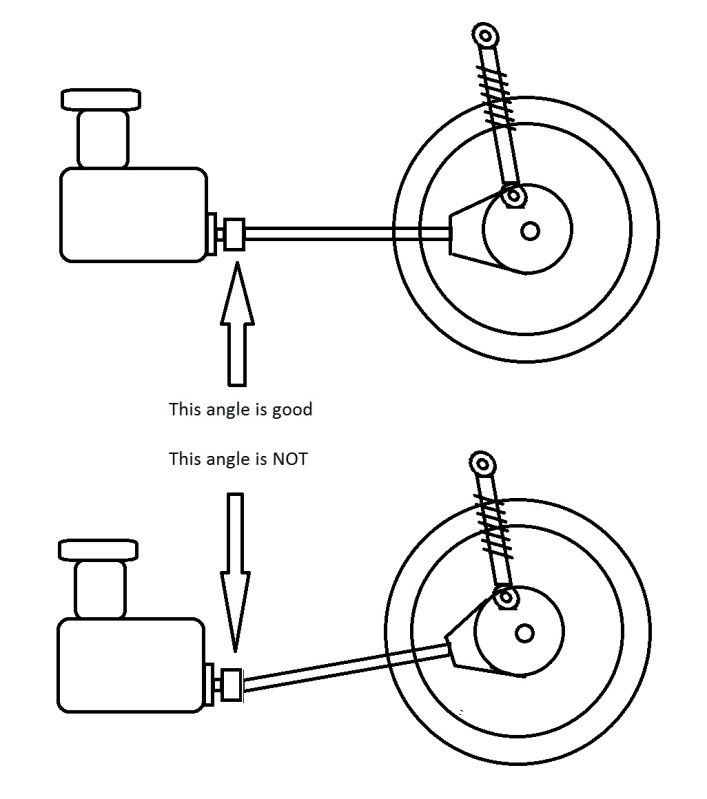
Personally, I would say NONE, but you can determine this for yourself. At the left rear corner of the engine, you will see a rubber boot where the driveshaft comes out. Note the angle of the flange. Now note the angle of the swingarm as it goes away. The swingarm probably drops a bit below a line perpendicular to the flange, but the rear suspension will compress a bit when you get on the bike.

Find a helper to help you determine just how much the suspension will compress. With the bike on the centersand (so the shocks are fully-extended), measure the length of the shocks (mounting bolt to mounting bolt). Take the bike off the stand, sit on it, bounce on it a couple of times to move the suspension. Balance the bike with most of your weight on the bike, balancing the least bit possible with your tippy-toes, have your helper measure the shocks again.

Put the bike back on the centerstand, remove the tops of the shocks, use a ratchet strap to raise the wheel until the shock mounting bolts are at the "compressed" distance. Now you can observe the angle of the driveshaft in its "normal" condition. It should be perpendicular to the flange at the back of the engine.

Hopefully this crude sketch will help you understand:

driveshaftangle.jpg


.
 
If your issue is not being able to reach the ground while stopped, do not lower the bike. Before doing anything to the suspension, lower the seat, and make it narrower.
This will help you reach the ground without compromising handling and cornering at all.
Making a mediocre handling motorcycle handle worse just to get a toe down is ludicrous.
 
This refers to both sets of springs. I would recommend getting a set of progressive fork springs regardless of the stance you decide. The progressive means that spring rate actually changes along the fork spring, allowing it to soak up the small bumps, but still provide enough 'hard' force to keep the front end planted. Make sense? You can find them new for about 60 dollars, and it is a good idea to upgrade them. Certainly makes the bike handle better.

For more information than you could want about them try some searches for "Progressive Fork Springs" :rolleyes:.


OK, I'm no expert but I'll take a crack at this for you. I think (correct me if I'm wrong) Steve's point is that it could put undo stress on the universal joint and cause it to wear out the splines prematurely due to the changes in shaft speed.

However, this would most likely only happen with dramatic changes in the drive shaft angle. Suzuki factored in a certain amount of 'wiggle room', for lack of a better term here, into the drive shaft and swing arm. Otherwise it would not be able to move at all without damaging itself. Consider the action on the swing arm when bouncing the rear end of the bike. It most certainly does move.

Now Steve is a certified GS guru, and knows probably too much about them :rolleyes:. That said I raised the rear end of my 850G by an inch, and 10,000 miles later still no extra wear on the spline. I also had read that it would cause issues with the drive shaft, and thus far I haven't noticed any.

To be safe, level the bike by changing the fork height. This should not affect the drive shaft angle, because it is staying the same, the bike will be lower, but still aligned.

Generally you have a small amount of safe room to change the rear shocks in either direction. I would keep the shock length between 12.5" to 14" to be on the safe side.

Any clearer for you?

Steve (or anyone else :rolleyes:), if I am catastrophically wrong here let me know.

Yes, thanks that's clearer. I've been reading a bit on Progressive shocks, so will continue looking into them and then get some for both the front and rear. Thanks for the info!
 
I thought it was rather clear, "you want the u-joint at the front of the shaft to be as straight as possible".
I did not mention "the entire bike", just the u-joint.


That depends on how you "level it out". If you lower just the front (by installing smaller wheel, sliding the fork tubes up, installing shorter fork tubes, whatever), you will not do anything to affect the u-joint angle. If you install shorter rear shocks, you WILL affect the angle. Any time the angle is not straight, there will be cyclic rotational speed changes. It is these speed changes in the drive shaft that might affect the splines. Yes, these happen while riding, anyway, as you hit bumps, go through corners or carry the occasional passenger, but there is no sense in setting up a situation where it happens ALL the time.


Again, it is NOT the height of the bike from the pavement, it is the angle of the u-joint in the driveshaft.


Personally, I would say NONE, but you can determine this for yourself. At the left rear corner of the engine, you will see a rubber boot where the driveshaft comes out. Note the angle of the flange. Now note the angle of the swingarm as it goes away. The swingarm probably drops a bit below a line perpendicular to the flange, but the rear suspension will compress a bit when you get on the bike.

Find a helper to help you determine just how much the suspension will compress. With the bike on the centersand (so the shocks are fully-extended), measure the length of the shocks (mounting bolt to mounting bolt). Take the bike off the stand, sit on it, bounce on it a couple of times to move the suspension. Balance the bike with most of your weight on the bike, balancing the least bit possible with your tippy-toes, have your helper measure the shocks again.

Put the bike back on the centerstand, remove the tops of the shocks, use a ratchet strap to raise the wheel until the shock mounting bolts are at the "compressed" distance. Now you can observe the angle of the driveshaft in its "normal" condition. It should be perpendicular to the flange at the back of the engine.

Hopefully this crude sketch will help you understand:

driveshaftangle.jpg


.
Yes, I understand now. I got the general concept the first time around, but now I really know what you're talking about. :lol: I will try that out, and see. Thank you for the diagrams and info Steve!
 
Back
Top