• Required reading for all forum users!!!

    Welcome!
    Register to access the full functionality of the GSResources forum. Until you register and activate your account you will not have full forum access, nor will you be able to post or reply to messages.

    A note to new registrants...
    All new forum registrations must be activated via email before you have full access to the forum.

    A Special Note about Email accounts!
    DO NOT SIGN UP USING hotmail, outlook, gmx, sbcglobal, att, bellsouth or email.com. They delete our forum signup emails.

    A note to old forum members...
    I receive numerous requests from people who can no longer log in because their accounts were deleted. As mentioned in the forum FAQ, user accounts are deleted if you haven't logged in for the past 6 months. If you can't log in, then create a new forum account. If you don't get an error message, then check your email account for an activation message. If you get a message stating that the email address is already in use, then your account still exists so follow the instructions in the forum FAQ for resetting your password.

    Have you forgotten your password or have a new email address? Then read the forum FAQ for details on how to reset it.

    Any email requests for "can't log in anymore" problems or "lost my password" problems will be deleted. Read the forum FAQ and follow the instructions there - that's what we have one for...

  • Returning Visitors

    If you are a returning visitor who never received your confirmation email, then odds are your email provider is blockinig emails from our server. The only thing that can be done to get around this is you will have to try creating another forum account using an email address from another domain.

    If you are a returning visitor to the forum and can't log in using your old forum name and password but used to be able to then chances are your account is deleted. Purges of the databases are done regularly. You will have to create a new forum account and you should be all set.

Suzuki also botched the stator wiring??

  • Thread starter Thread starter gsvol
  • Start date Start date
G

gsvol

Guest
Suzuki also botched the stator wiring by routing one leg up to the now discontinued head lamp switch. This needless wire path often overheats and damages the harness in the process. Do yourself a favor and rewire your charging system: run the stator wires directly into the R/R, make sure your R/R has a solid battery or frame ground point, and run the positive (power) R/R output either straight to the battery (with 20A fuse in-line) or though the regular fuse block after you check for resistance in the circuit and repair as needed.


R/R can someone explain this a little
 
In short, simply connect the three wires coming from the stator directly to the R/R, eliminating the unnecessary trip up and back to the headlight. You'll have two other wires from the R/R. Connect one to the negative battery post (with another connection from negative to a good frame ground), connect the other to the positive through a 20A fuse, or the fuse block.
 
Up until the '79 models, you were allowed to turn your headlight ON or OFF, as you saw fit. Then, the Feds stuck their noses in to make things "safer" for us, requiring the headlight to be ON at all times the bike was in operation. Different manufacturers chose different ways of making that happen.

The charging requirements varied rather widely, depending on the status of your headlight. Suzuki chose to run one of the three stator wires up to a second set of contacts in the headlight switch, so when you turned the headlight OFF, you also reduced the charging capacity by eliminating one of the three charging phases of the stator.

When the lights were later required to be ON at all times (at least in the US market), there was no need to have the stator wires run all the way to the headlight switch, so Suzuki changed the sub-harness to provide a short loop to re-direct the stator wire back down the harness to the R/R (Rectifier/Regulator). Other world markets still retained a functioning headlight switch, so only the sub-harness was changed.

That extra loop of wire consists of a connector at the stator wire, another connector (under the tank or in the headlight bucket), the short loop, another connector, then finally the connector to the R/R. Since there are three interfaces at each connector (wire to terminal, terminal to mating terminal, mating terminal to wire), you can see that there are TWELVE possible places for corrosion to affect the connections just in that one wire. By eliminating that extra loop by routing all three stator wires directly to the R/R, you will eliminate nine of those possibilites, making your charging system that much more reliable.

.
 
Okay. .

Okay. .

Up until the '79 models, you were allowed to turn your headlight ON or OFF, as you saw fit. Then, the Feds stuck their noses in to make things "safer" for us, requiring the headlight to be ON at all times the bike was in operation. Different manufacturers chose different ways of making that happen.

The charging requirements varied rather widely, depending on the status of your headlight. Suzuki chose to run one of the three stator wires up to a second set of contacts in the headlight switch, so when you turned the headlight OFF, you also reduced the charging capacity by eliminating one of the three charging phases of the stator.

When the lights were later required to be ON at all times (at least in the US market), there was no need to have the stator wires run all the way to the headlight switch, so Suzuki changed the sub-harness to provide a short loop to re-direct the stator wire back down the harness to the R/R (Rectifier/Regulator). Other world markets still retained a functioning headlight switch, so only the sub-harness was changed.

That extra loop of wire consists of a connector at the stator wire, another connector (under the tank or in the headlight bucket), the short loop, another connector, then finally the connector to the R/R. Since there are three interfaces at each connector (wire to terminal, terminal to mating terminal, mating terminal to wire), you can see that there are TWELVE possible places for corrosion to affect the connections just in that one wire. By eliminating that extra loop by routing all three stator wires directly to the R/R, you will eliminate nine of those possibilites, making your charging system that much more reliable.

.
Hi everyone I've read as much as I can about bypassing this wiring loop
- I'm looking at my GS850 bike right now -
I have four (3 yellow - 1 red) wires coming from the Regulator Rectifier
Three (black) wires coming from the stator.

Current setup:
Black Stator wire is going into the harness connected to White/Green
Red R/R wire is connected to Red Harness wire
Yellow R/R wire is connected to Red/white Harness wire

If I'm reading correctly I
Disconnect White / Green wire
Connect yellow R/R wire to Black Stator wire


Which leaves me with two un terminated connections in the harness (white/red) and (white/green)
What do I do with these two?

Any clarification would be appreciated

Thanks!
 
Which leaves me with two un terminated connections in the harness (white/red) and (white/green)
What do I do with these two?

Any clarification would be appreciated

Thanks!


The simplest thing to do with them is to ignore them
 
As posplayr stated. Ignore those two wires. They simply loop back to each other and are not connected to anything else.
 
Headlight switch, the first few years all Suzuki did was put a little plastic bump in the bottom of the headight switch, so it couldn't move. I have always shaved off the little bump, because I like to turn the headlight off sometimes. I leave the stator loop up to the switch in place, for the same reason Suzuki did it in the first place. With the headlight off, the stator has to shunt too much power if all three wires are used.

If you have a series regulator, there is no need to do this.
 
Headlight switch, the first few years all Suzuki did was put a little plastic bump in the bottom of the headight switch, so it couldn't move. I have always shaved off the little bump, because I like to turn the headlight off sometimes. I leave the stator loop up to the switch in place, for the same reason Suzuki did it in the first place. With the headlight off, the stator has to shunt too much power if all three wires are used.

If you have a series regulator, there is no need to do this.

If you keep spraying the contacts with Deoxit so they do not oxidize, heat up and melt plastics then you can get away with "how suzuki designed it".
 
Yeah, that's been working for me for about forty years. Clean the contacts every twenty years or so whether it needs it or not.
 
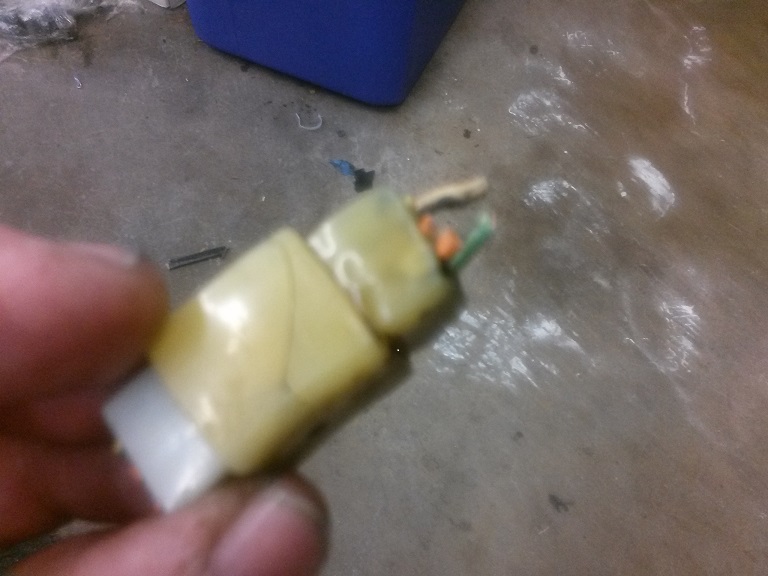
Here is what happens if you leave it:
81-18.jpg
 
Back
Top