• Required reading for all forum users!!!

    Welcome!
    Register to access the full functionality of the GSResources forum. Until you register and activate your account you will not have full forum access, nor will you be able to post or reply to messages.

    A note to new registrants...
    All new forum registrations must be activated via email before you have full access to the forum.

    A Special Note about Email accounts!
    DO NOT SIGN UP USING hotmail, outlook, gmx, sbcglobal, att, bellsouth or email.com. They delete our forum signup emails.

    A note to old forum members...
    I receive numerous requests from people who can no longer log in because their accounts were deleted. As mentioned in the forum FAQ, user accounts are deleted if you haven't logged in for the past 6 months. If you can't log in, then create a new forum account. If you don't get an error message, then check your email account for an activation message. If you get a message stating that the email address is already in use, then your account still exists so follow the instructions in the forum FAQ for resetting your password.

    Have you forgotten your password or have a new email address? Then read the forum FAQ for details on how to reset it.

    Any email requests for "can't log in anymore" problems or "lost my password" problems will be deleted. Read the forum FAQ and follow the instructions there - that's what we have one for...

  • Returning Visitors

    If you are a returning visitor who never received your confirmation email, then odds are your email provider is blockinig emails from our server. The only thing that can be done to get around this is you will have to try creating another forum account using an email address from another domain.

    If you are a returning visitor to the forum and can't log in using your old forum name and password but used to be able to then chances are your account is deleted. Purges of the databases are done regularly. You will have to create a new forum account and you should be all set.

voltage drop - blown 'lights' fuse

  • Thread starter Thread starter crookedspoon
  • Start date Start date
C

crookedspoon

Guest
There's so much information on this topic; ground-loops, high performance power, charging system quick test, stator papers, ...
I'm a bit at loss at where to start.

I have a '78 GS1000, with SH775 rr and regular light bulbs (no LEDs). SH775 + is connected to where the old RR was connected to the harness, the negative is connected directly to the battery.

The 'lights' fuse keeps blowing at irregular intervals. I haven't seen any other electrical issues.

Today I measured voltage between the main fuse and the lights fuse and notice a voltage drop of about 2V.
Engine off, I read about 12.8V at the main fuse (identical with battery voltage) and around 11V at the 'Lights' fuse (ignition & lights on)
Engine on (idling rpm), I read about 14V at the main fuse and around only some 12V at the 'lights' fuse.

The H4 connector at the headlight had also about 12V with the engine idling.

I checked all connectors - cleaned and sprayed them with WD40, all seemed plenty clean and solid. Fusebox isn't burned and solidly soldered.

I didn't find damaged cables or connectors.

Weird thing is that the fuse doesn't looked blown; it's visually still intact. Still the connection is broken, seemingly because the center thread disconnects from the ending tips. Batch of bad fuses?

I'm wondering what causes the voltage to drop so massively and what causes the fuse to blow.
Where to start looking further?

regards—
 
You need to go through the entire harness, clean all connectors, plugs, switches and grounds with DeoxIT D5 contact cleaner rejuvenator, and coat all contact surfaces with dielectric grease. You probably have high contact resistances building up enough to blow that fuse because of years of dirt and corrosion. The Deoxit was designed for cleaning up noise in amplifiers and electric guitars so it should be available world wide. If you disassemble any switches for cleaning, do it inside a clear plastic bag because there are little springs and clips that love to go flying into a never to be found again black hole. I would be surprised if you don't find several burnt bullet connectors that should be replaced. I found several on both my '78 and '79 parts bike. I take it you have also eliminated the stator leg that loops through the headlamp switch. That is a problem spot on all of these bikes.
 
Last edited:
It also helps to know the current path. :-k

The electrons leave the battery, go through the MAIN fuse to the ignition switch. When the ignition switch is turned ON, they go back to the fuse box to the other three fuses, one of which is the LIGHTS fuse.

When you measured your voltage drop, were you measuring the hot side or the dead side of the fuse?

Check all the connectors along the way to see where your voltage is dropping.

.
 
The 78 has a reputation for a bad fuse box, but it sounds like you've inspected yours (taken it off the bike and taken the back plate off?).
But, the power to the main fuse comes directly from the battery via the big red (cloth covered) wire, so I'd start with that positive cable and see why you're not getting 14V at the fuse box.

WD40 is pretty useless, see if you can get the DEoxit in the EU. Bright shiny connectors are your goal
 
WD40?..................:black_eyed:

Why not? That is half of everything you need to carry in a tool box. The other half is duct tape. :-k

If it moves, and it shouldn't, use the duct tape. If it doesn't move, and it should, use the WD-40. :-\\\

.
 
THAT part of the current path I got figured out :-)
With the fuses in, there's not really a hot or dead side of the fuse, I'd figure?

I did check all connections ? at least the ones I could reach, including the ones in the headlight. Opened them up, sprayed them with WD40 (yeah yeah, joke's on me :-) - figured it wouldn't hurt to get some solvent on those contacts). Took the fusebox off and that's looking very solid and clean!

I'm unsure about the condition of the ignition switch or the lights-controlswitches. Should I open them up to inspect? Alway weary I end up breaking stuff.


It also helps to know the current path. :-k

The electrons leave the battery, go through the MAIN fuse to the ignition switch. When the ignition switch is turned ON, they go back to the fuse box to the other three fuses, one of which is the LIGHTS fuse.

When you measured your voltage drop, were you measuring the hot side or the dead side of the fuse?

Check all the connectors along the way to see where your voltage is dropping.

.
 
With the fuses in, there's not really a hot or dead side of the fuse, I'd figure?
If the fuse blows, there is definitely a hot side and a dead side. :-\\\

Regardless of whether there is a (good) fuse in place, one side WILL be fed power, the other side WILL take that power to the load.

The purpose of determining which side you are measuring is so that you know how many extra connections are in the circuit.
If you measure from the dead side of the MAIN fuse to the hot side of the other fuses, the only connections in question are:
the interface from fuse to fusebox contact
the interface from the contact to the wire
the interface from the wire to the terminal in the connector near the ignition switch
the interface from that terminal to the the terminal on the other side of the connector
the interface from that terminal to the wire that goes into the ignition switch
the interface from that wire to the contact inside the switch
the interface from that contact to the wiper that moves to make the various connections
the interface from the wiper to the switched contact inside the switch
the interface from that contact to the wire that goes out of the switch
the interface from that wire to the terminal in the connector that goes back into the main harness
the interface from that terminal to the terminal on the other side of the connector
the interface from the terminal to the wire in the main harness
the interface from that wire to the contacts on the other three fuses.

Oh, some fuse boxes have a connector near them that will add another three interfaces going in and another three interfaces going out.

Now, if you happen to check your voltage on the "dead" side of the fuse, you add:
the interface from the contact to the end of the fuse
the interface from the end to the filament of the fuse
the interface from the filament to the other end of the fuse
the interface from the other fuse cap to the "dead" contact in the fuse box.

Any wonder why there might be some voltage loss in the system? :-k

And that is only from the battery to the fuses. There are just about as many more from the fuse box to the various loads. :oops:

.
 
Let's see, original question was dust causes a 2v drop? One answer is " dirty contacts".
 
Yep, the answer is "dirty contacts", the solution is finding which one(s). :encouragement:

.

I usually don't take a show to just wash behind one ear. I also save on time not having worry about looking in the mirror at which ear is dirtier.
 
fair enough — voltage drop should be close to zero, contacts should be clean.
It's the first time I'm having to deal with this, so I am missing a frame of reference. It's a 40 year old bike, I can't expect things to be new. So how bad is too bad.

Fusebox looks like new, will be checking another one with flat fuses since they seem sturdier than the glas ones.
I opened up the lightswitches today (for the first time) and they look sparkling new. Can't imagine them being 40 years old. Still very clean yet slightly less was the kill switch. Ignition contacts are another story. They need some scrubbing. All connectors along the harness have been checked and seemed fairly ok (again, frame of reference)

Another point is the ground connection. Been reading about the single point grounding, will need to implement that. Can that alone cause such a drop?

I noticed the voltage at the battery is exactly the same as the voltage measured between battery(+) and engine. That should indicate a proper ground connection, no?
Or can you only really measure those connections when under load?

Can the voltage drop (and hence the dirty contacts) cause the fuse to blow?

thank you so much for all the insights.

I usually don't take a show to just wash behind one ear. I also save on time not having worry about looking in the mirror at which ear is dirtier.
 
The headlamp draws 5 amps. 2V voltage drop is 0.4 ohms of combined resistance. How shiny is 0.4 ohms?

For the fusebox, figure 10 amps. 1V drop is only 0.1 ohms of combined resistance. How shiny is 0.1 ohms?

I can not think of any way that a fuse would blow due to dirty contacts except in the case of the regulator. I can't recall you mentioning any changes that might have been made.

Assuming the average voltages are normal, I would say you have a short.

Shorts can be caused by chaffed wires, or another major cause is melted connectors that short. Lets say that your headlamp plug was dirty, and getting hot. It might get so how that the plastic melts together and causes the contacts to touch shorting the source.

Again are all for contacts shiny enough to prevent connectors from shorting?

You should do Quick Tests and then the Phase A tests for how much the voltage drops are.

The fuse box maintenance involves a simple procedure. Remove the back chemically clean the fusebox crimps and flow a small amount of solver into them.

The crimps are the biggest issue with corrosion (not the contacts). You Can't get in there except with something like DeOxit.
 
You have made a few statements that I would like to highlight:[
...Fusebox looks like new, will be checking another one with flat fuses since they seem sturdier than the glas ones.
I opened up the lightswitches today (for the first time) and they look sparkling new. Can't imagine them being 40 years old. Still very clean yet slightly less was the kill switch. Ignition contacts are another story. They need some scrubbing. All connectors along the harness have been checked and seemed fairly ok (again, frame of reference) ...
There is a member here that has some very wise words in his signature: "To measure is to know". They may LOOK good/clean, but what if they have that .1 ohm resistance that posplayr mentioned? What if it's actually .4 ohm? You won't know unless/until you MEASURE.

The good part is that you don't actually have to measure the resistance, you can measure the voltage drop with a (somewhat) known load. With the key ON, which means the headlight and ignition coils are also ON, you will be drawing about 10 amps. Put your meter in VOLTS mode, attach the black lead to the battery NEGative terminal, start probing along the POSitive path. By the way, feel free to hook up jumper cables to another battery to make sure your battery doesn't give up prematurely. Record the voltages that you measure.
1. Battery POS
2. MAIN fuse 'hot' side
3. MAIN fuse 'dead' side
4. Red wire on each side of 4-pin connector near ignition switch (probably under tank)
5. Orange wire on each side of 4-pin connector
6. 'Hot' side of fuse box for LIGHTS/SIGNALS/IGNITION fuses
7. 'Dead" side of those same three fuses.
8. Battery POS, just to make sure the voltage is still about the same as when you started.

How close is #7 to #8? Did you see where it dropped? Don't let all the interfaces I mentnioned in post #8 scare you, the interfaces between the two pins inside the connectors are the most likely places for voltage drops. They are also the easiest to clean.

You are not done yet, you will also need to check the charging system, but at least you will know what condition the rest of the system is in. :encouragement:

.
 
There's so much information on this topic; ground-loops, high performance power, charging system quick test, stator papers, ...
I'm a bit at loss at where to start.

I have a '78 GS1000, with SH775 rr and regular light bulbs (no LEDs). SH775 + is connected to where the old RR was connected to the harness, the negative is connected directly to the battery.

The 'lights' fuse keeps blowing at irregular intervals. I haven't seen any other electrical issues.

Today I measured voltage between the main fuse and the lights fuse and notice a voltage drop of about 2V.
Engine off, I read about 12.8V at the main fuse (identical with battery voltage) and around 11V at the 'Lights' fuse (ignition & lights on)
Engine on (idling rpm), I read about 14V at the main fuse and around only some 12V at the 'lights' fuse.

The H4 connector at the headlight had also about 12V with the engine idling.

I checked all connectors - cleaned and sprayed them with WD40, all seemed plenty clean and solid. Fusebox isn't burned and solidly soldered.

I didn't find damaged cables or connectors.

Weird thing is that the fuse doesn't looked blown; it's visually still intact. Still the connection is broken, seemingly because the center thread disconnects from the ending tips. Batch of bad fuses?

I'm wondering what causes the voltage to drop so massively and what causes the fuse to blow.
Where to start looking further?

regards—

an alternate view, They are unrelated:

A SHORT is most likely causing the fuse to blow. Or just possibly, if your headlight is burning extremely bright for a second, you regulation has dropped out...

The Voltage drop is a different subject-ie you aren't bblowing fuses as you play with it? but it's pretty common on these bikes on the lighting circuit....However you might happen to fix the short by polishing your wiring up.

Get rid of the glass fuses for blade-type ,if you haven't already. It's too hard to find quality replacements it seems.
WD40 is a "water-displacer . I guess it's a coating too because I've heard technicians cry if they have to repair electronics yokels (their comment) have sprayed with it...
 
Last edited:
an update and some measurements:
I implemented the Single-Point-Ground.
I took all connections apart, sprayed them thoroughly with contact cleaner.
I took the ignition out and cleaned that thoroughly because those contacts were diiiirty
I put in a LED headlight - wanted to do that anyway.

with the engine off, contact & headlights on, I measured:
At the battery: 12.35V
Starter relay (+) / RR - SPG (-): 12.27V
Main Fuse Hot (+) / RR - SPG (-): 12.08V
Main Fuse Dead (+) / RR - SPG (-): 11.77V
Lamps Fuse Hot (+) / RR - SPG (-): 10.99V
Lamps Fuse Dead (+) / RR - SPG (-): 10.30V


That seems like an awful lot of voltage drop between one side of a fuse and another side of a fuse.
And between Main Fuse Dead and Lamp Fuse Hot there's the biggest drop!

I tried to clean the contacts. What now? Flat fuses? Re-crimp all connections?
 
Go back and read post #8, but concentrate on the connectors and the ignition key.

Not sure if your bike has a connector right next to the fuse box, but that is one place to look.

You WILL have a 4-pin connector about 6-8 inches from the ignition switch. Check that connector, but also the actual contacts inside the ignition switch.

.
 
an update and some measurements:
I implemented the Single-Point-Ground.
I took all connections apart, sprayed them thoroughly with contact cleaner.
I took the ignition out and cleaned that thoroughly because those contacts were diiiirty
I put in a LED headlight - wanted to do that anyway.

with the engine off, contact & headlights on, I measured:
At the battery: 12.35V
Starter relay (+) / RR - SPG (-): 12.27V
Main Fuse Hot (+) / RR - SPG (-): 12.08V
Main Fuse Dead (+) / RR - SPG (-): 11.77V
Lamps Fuse Hot (+) / RR - SPG (-): 10.99V
Lamps Fuse Dead (+) / RR - SPG (-): 10.30V


That seems like an awful lot of voltage drop between one side of a fuse and another side of a fuse.
And between Main Fuse Dead and Lamp Fuse Hot there's the biggest drop!

I tried to clean the contacts. What now? Flat fuses? Re-crimp all connections?

looks like you are demonstrating a dirty fuse box; I would do something about that.
 
@steve:
there's no connector next to the fusebox. The 4-pin connector coming from the ignition is inside the headlight. Unplugged & cleaned it with anti-rust & contact spray. Took out the ignition itself as well and cleaned everything there (copper plates) ? did all that before the voltage readings below.

@posplayr
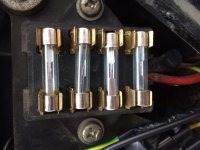
here's pics of the fusebox. looks clean and solid enough ? either way, the numbers prove me wrong. I guess I'll be installing an aftermarket box with flat fuses.

https://www.dropbox.com/s/c1bc95oifgr1tbx/IMG_4446.JPG
https://www.dropbox.com/s/hjh6lmo55uzle3e/IMG_4447.JPG
 

Attachments

  • IMG_4446.jpg
    IMG_4446.jpg
    90 KB · Views: 0
Back
Top