Let me first say hello to everyone, as this is my first post. Been a long time reader of these forums, some of you may know of me, as Kcwiro often refers to me in his posts as "his friend".
So Kc and I have been glued to this thread, and got started on my 83 GS550E, when we ran into a little confusion. The coils had the orange/white wires (from the kill switch) attached to the negative terminals, and the grounds attached to the positive ones......
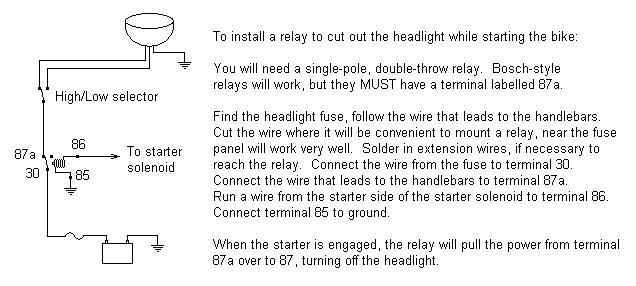
We are using a 5 terminal relay (30 85 86 87 87a of course) with the goal of having increased voltage at the coil and a headlight cutoff.
We've gone ahead and wired the 87 terminal to the coil +'s (double checked :-D), hooked the orange/white killswitch wires into the 86 terminal, and hooked the coil ground wires (which WERE on the coil +'s) into the negative terminals
Our concern is with those wires being backwards..... can a coil operate with this? Or would it do damage? I don't want to try and start the thing and end up needing to buy a new coil, but I'm inclined to hook these guys up according to the markings on the parts, not where the wires were before. Btw this 550e was in perfect running condition before we started this operation, so this has me confused
Also, about the headlight (87a) wire: in one of the earlier posts someone was saying to find the wire that runs from the headlight fuse up to the handlebars..... anyone know what color it should be? Just as a guide to help me out....
coils will work eather way it just changes the polarity of the spark, if you have a sharp eye you can see one plug on a coil fires the spark from the center to the out side and the other fires from the outside to the center electrode. some late model cars use two differant spark plugs for this reason as you need the platnum on the positive firing electrode.
Ford used to use two differant plugs but ended up changing to plugs with platnum on both the center and ground electrodes.
for the headlight mod that kills the headlight when the starter button is pushed, I installed mine on the ground side as I also have a relay that sends dirrect power to the headlight (much brighter)
to put it on the ground side you will need to cut the ground wire (black with white stripe) a short distance from the headlight socket, and splice in the leads that go to the relay.
placement of the relay depends on the bike but I found that a micro relay will fit in pretty much any headlight bucket, but standard generic VF-4 type relays don't fit in all due to clearance issues.
you run one of the ground leads to the 30 terminal and the other to the 87A terminal.
the wire for the 85 terminal goes to the wire COMING FROM the starter button. it will need to be spliced in and a simple cheep test light can be used to confirm the wire (green with yellow stripe) as that color wire does more than just the starter button on some bikes.
you hook a new ground ground wire from the 86 terminal and connect it to a good ground. on my 1000G there is a extra unused ground wire in the headlight bucket and I used that.
this is the relay I used and like using for other mods except the master relay as it is nice and small.
http://catalog.tycoelectronics.com/TE/bin/TE.Connect?C=1&M=BYPN&TCPN=1393293-8&RQPN=VFMA-15F41-S01
you can get one by asking for a headlight, or fog light relay for a Ford Focus. OK, parts people are for the most part idiots and only do what a machine tells them so tell them you need fog light relay for a 2001 Ford Focus ZX3, twin cam engine, 5 speed manual transmission, AC, manual windows. (I have been asked all that and I just needed a freaking dome light bulb)
now most of the VFMA relays are marked with 1 through 5 instead of 85,86,30,87,87A so here is the cross referance.
30= 3
87= 5
87A= 4
85= 1
86= 2
1 and 2 are for control and ground, polarity is not important, but I use 1 as +
3 is battery power in
4 is normaly on output, when relay is not energized by input on 85 (or86) power passes through 4
you only use terminal 4 when using relay to interupt a circuit (head light interupt)
5 is switched output, used when using relay to power something.

 /
/